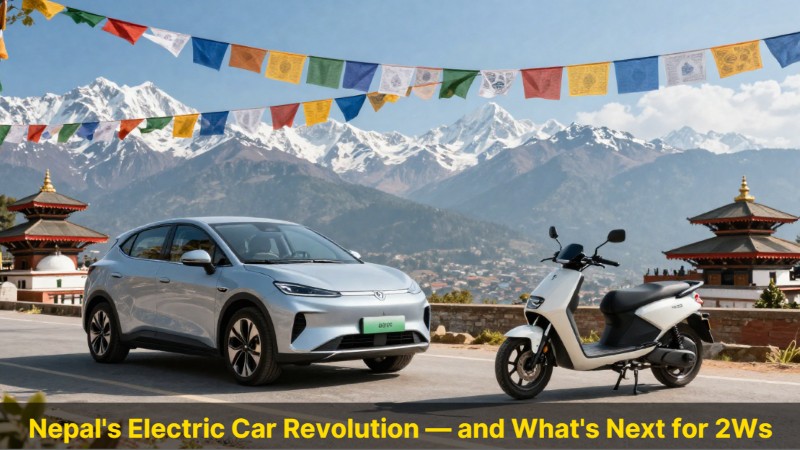
Nepal’s Electric Car Revolution — and What’s Next for 2Ws

The landlocked Himalayan nation of Nepal has achieved something that most of the world is still working toward: nearly 80 per cent of all new personal cars sold in the country are electric.
The Shift in Cars
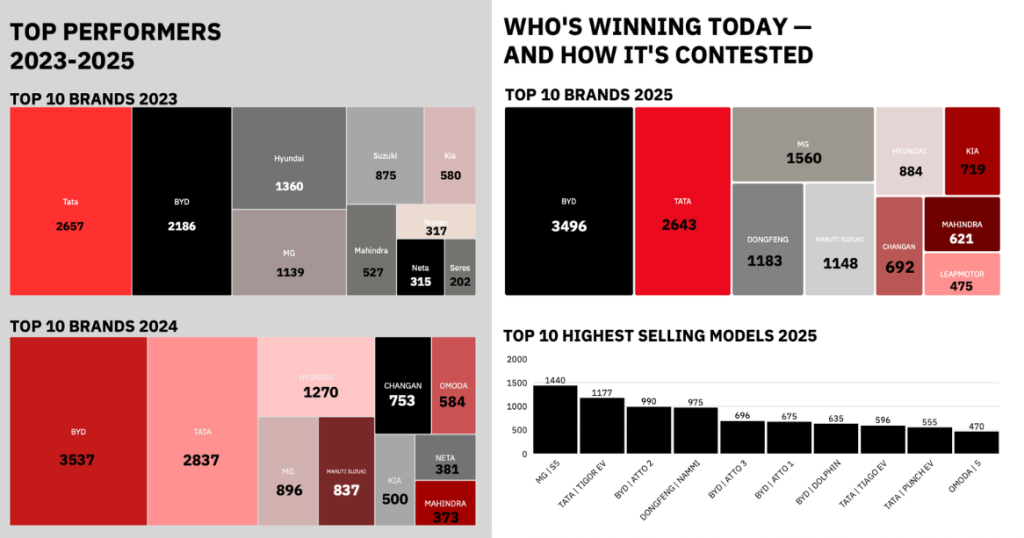
The dramatic electrification of personal vehicles in Nepal is not a result of a tech boom or a wealthy consumer class. Nepal has no domestic vehicle manufacturing to speak of — the country depends almost entirely on imports, or on low-level assembly operations for brands like Honda, TVS, Bajaj, Royal Enfield, Suzuki and Hyundai. Personal cars have long been considered a luxury, burdened by import taxes on ICE vehicles that range from 248 to 360 per cent. And yet, it is precisely this punishing tax structure — combined with Nepal’s reliance on hydropower for its electricity — that created the conditions for an EV tipping point. With EV-friendly tax brackets, electric cars became meaningfully cheaper than their ICE counterparts. Chinese EV brands — led by BYD and Changan Auto — swept in, displacing the earlier incumbents, Toyota, Suzuki, Mahindra, and Tata.
Two-wheelers are Set to Join the Trend
The two-wheeler story is at an earlier but equally compelling stage. Two-wheelers vastly outnumber cars in Nepal — annual 2W sales run between 250,000 and 300,000 units, compared to just 13,000–14,000 cars. EV penetration in this segment is around 5 per cent today, but momentum is building. Rising global fuel prices play a significant role.

Suryansh Vaidya from Vaidya Energy, the official distributor of Ather Energy scooters in Nepal, reports significant month-on-month sales increases over the past few months. He notes that average monthly sales have risen from 300 to 800 units over the last two months. To understand the forces shaping this transition and where it is headed, EVreporter spoke to Suryansh Vaidya.
As part of the Vaidya Energy | VOITH Group, his family has been at the heart of Nepal’s automotive trade for decades, holding distribution rights for Toyota, Morbidelli and Benelli.
Today, he is also the distributor for Ather Energy electric scooters in the country, and the group is preparing to present Ultraviolette to the Nepalese market.
Vaidya brings a rare dual perspective: he has seen Nepal’s roads from the vantage point of a legacy ICE distributor, and he is now actively building the EV ecosystem of tomorrow. In this conversation, he reflects on the policy decisions and market forces that drove Nepal’s e-4W revolution, the emerging story in 2Ws and his outlook for Nepal’s electric leap.
What are the current tax brackets for ICE Cars and Electric Cars in the country? And what has been the influence of the tax structure on the shift in Nepal’s car market?
Tax in Nepal has historically been very high on ICE-fueled vehicles, and it was categorised as a luxury tax. This has always been the case as far as I can remember, and, in my opinion, it was never reinvestigated, as the kingdom and the governments it funded were happy with that level of income. EV tax initially, when the first electric cars started coming in, was minuscule and compared to ICE almost nonexistent, leading to the mass adoption.
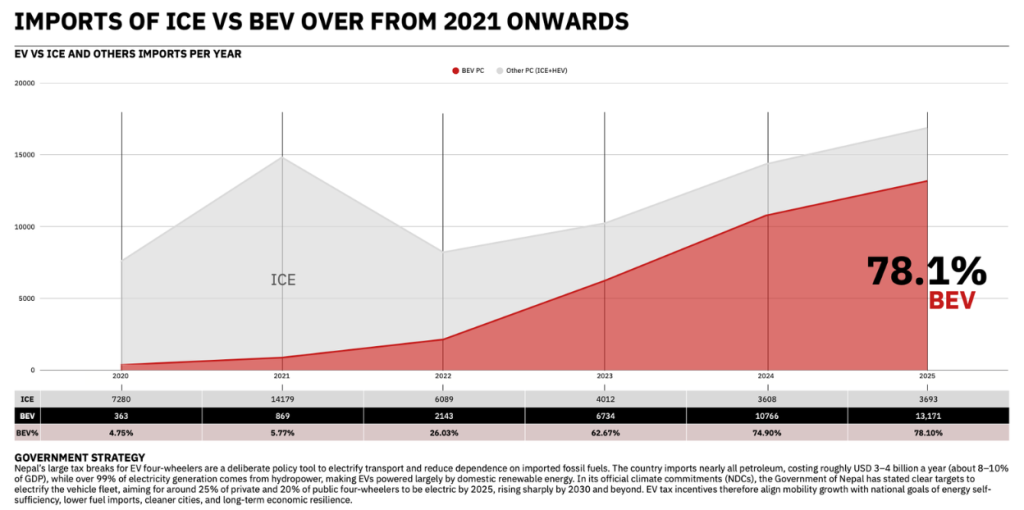
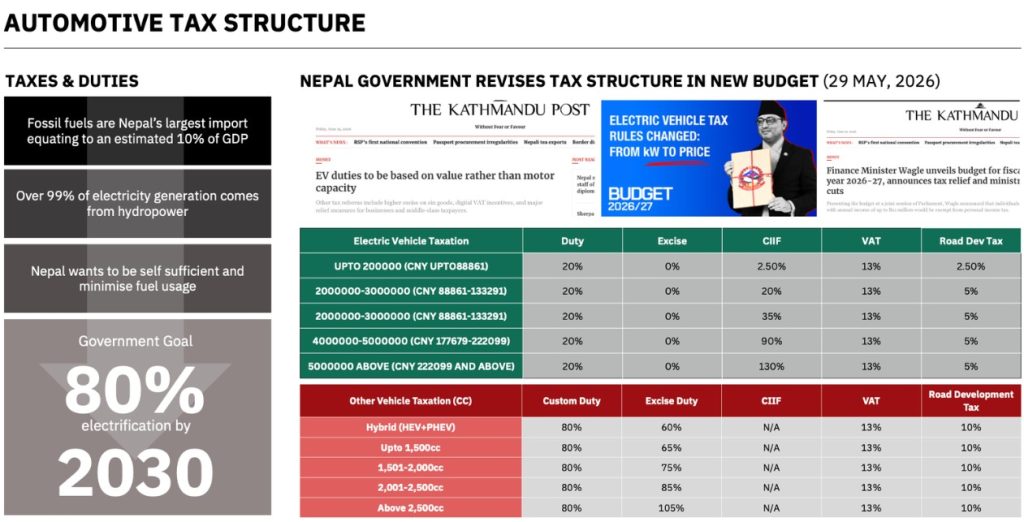
The major reason for this is that our largest imports are fossil fuels, which account for around 10% of our GDP, and we are now approaching energy sufficiency, all via hydropower.
Every year after 2018, we saw the number of BEV vehicles increase little by little, and it exploded post-COVID pandemic. And the government has tried to balance the loss in revenue with fuel savings since then, but has had a tough time. The tax has increased, as shown in the table below.
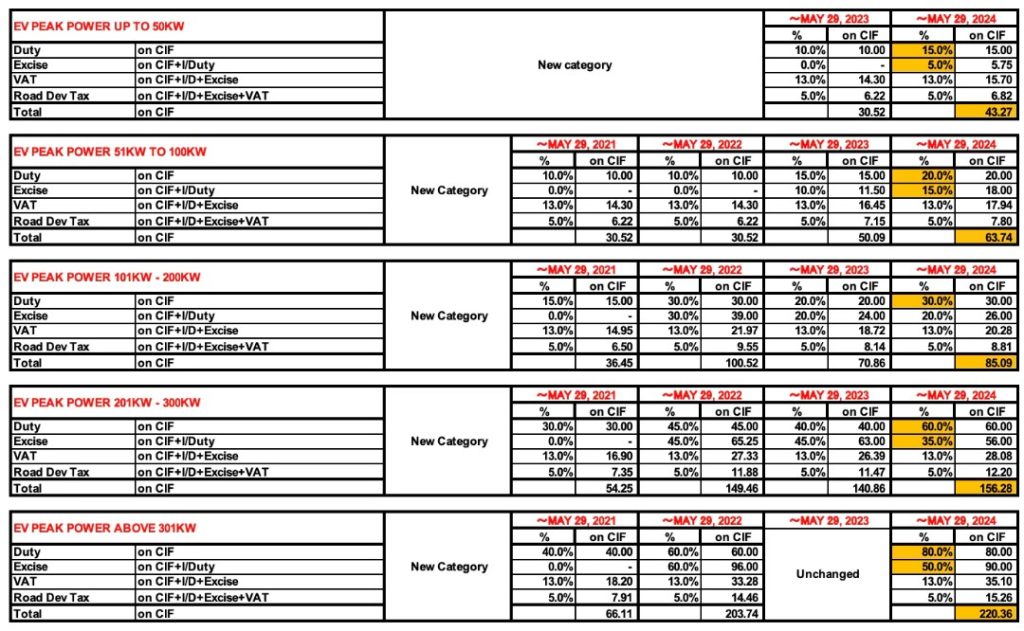
Another massive change that has now taken place is that instead of taxing based on peak power, the government has now changed the laws to tax electric vehicles based on import value. Less expensive = Less tax and vice versa.
Apart from tax structure, what are the other factors driving the shift to Electric cars?
Nepal is a country with few sprawling cities that rarely require people to drive very long distances daily. Range anxiety is seen a bit differently here, as most people who do have the means to purchase 4 wheelers in general have homes where they can charge a vehicle on their premises for the very limited daily use. Another factor is that not many people live in apartments, where charging can be more challenging. A large proportion of Nepali car buyers still have access to private parking and home charging, which has made EV adoption easier.
Finally, even the general cost of energy is quite low in Nepal: the residential electricity price is NPR 5.790 per kWh, or USD 0.038. The electricity price for businesses is NPR 9.210 kWh or USD 0.061. In general, this is very cheap compared to the rest of the world, making it very advantageous for reducing operational costs.
Is it correct to say that Chinese EV brands — led by BYD and Changan Auto — have largely displaced earlier incumbents in the four-wheeler space in recent years?
Chinese automotive brands have entered the Nepali market in successive waves, with new brands and models frequently capturing significant market attention and achieving strong sales volumes shortly after launch. In many cases, newly introduced models have sold hundreds, and sometimes thousands, of units within a relatively short period. A key factor behind this success has been timing. Chinese manufacturers entered the market at a point when few global automakers were offering electric vehicles with comparable levels of technology, features, and production scale—particularly at such competitive price points. Their ability to rapidly innovate, manufacture at scale, and bring products to market efficiently allowed them to establish a strong early-mover advantage.
The combination of favourable EV tax policies and the inherently competitive pricing of Chinese-made vehicles enabled these brands to offer exceptional value for money to consumers. As a result, many Chinese vehicles became highly attractive to the Nepali market, accelerating their adoption.
How are the traditional automotive brands responding to this shift?
Different manufacturers are taking different approaches. Some are accelerating BEV development, others are focusing on hybrids and multi-pathway strategies. From our experience, traditional brands are studying customer behaviour carefully and adapting their product plans to meet changing market needs. Working with legacy automotive brands, we as distributors have been explaining and studying together on how the next generation starts. We, as a company, are working to provide all kinds of information to companies so they can do what is necessary to deliver the best possible products to people.
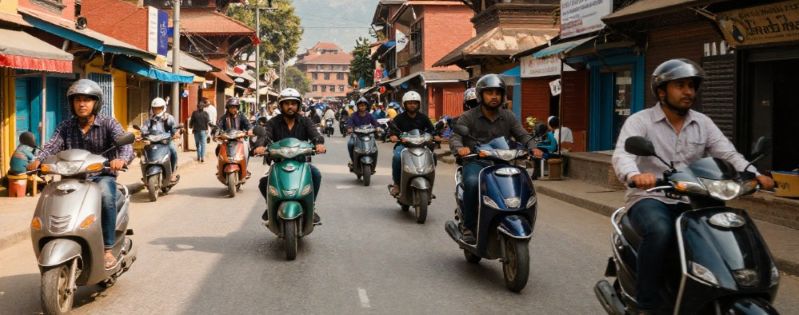
Indian OEMs have long dominated Nepal’s 2W automotive market. How is the EV transition rapidly redrawing market leadership?
Honda, Bajaj, TVS, and Hero have always been front-runners, and they still are, and I see some of them looking towards the next chapter of this industry. I do see innovation in 2W products led by Indian companies. So, I do not see the tide changing when it comes to India’s dominance as a country of origin, but rather it will be the people who innovate for the subcontinent that will prevail in the long run. BEV, as mentioned, still accounts for a small share of the two-wheelers sold in Nepal, but of the top 5, three are from India. During the industry’s evolution, I believe there is a greater opportunity for new entrants to find their place in the market.
Chinese EV brands are dominating the 4W space, and in two-wheelers, brands like Yadea are making inroads alongside Indian players like Ather, TVS, and Bajaj. Do you think India is at risk of losing Nepal’s auto market?
In my view, when I look at the global landscape of the automotive industry, the Chinese are ahead in 4W for next-generation products, but Indian products are in the lead in 2W. Again, I think it comes down to the use case and the actual requirements of the general public in either country. India primarily moves on 2-wheelers, whereas China moves differently.
In my opinion, Indian 4W companies would need to do something drastic in order to challenge the Chinese, especially considering that China currently benefits from a highly integrated battery and EV supply chain, giving manufacturers advantages in scale, cost, and speed to market. When it comes to 2Ws, we see massive innovations coming aggressively from India.
The number of 2W EV importers in Nepal has shrunk from 86 to just 24 over about 3.5 years. What drove that consolidation, and is it a healthy sign for the market?
Many people would import these BEV vehicles consignment by consignment, with only a few shops, with the intention of achieving a quick turnaround and making some money. It was an easy sell, the early movers made a bit of money, and the rest saw it as an opportunity and got into the market. The problem here was that the product arriving was not receiving after-sales support.
Now, quite a few people understand this and are investing in the manpower, ecosystem, and general education for BEV 2Ws, which is creating a moat for businesses that actually have these facilities, making it harder for single consignment importers to do business the old way. I do believe that, with serious manufacturers trying to change the game in the two-wheeler industry and the right partners, it will raise riders’ expectations and standards, too. We see higher numbers from brands that have actually invested in the entire ecosystem.
Ather leads the electric two-wheeler space in Nepal, with Yadea from China and, more recently, TVS and Bajaj entering the fray. How do you see the competition evolving?
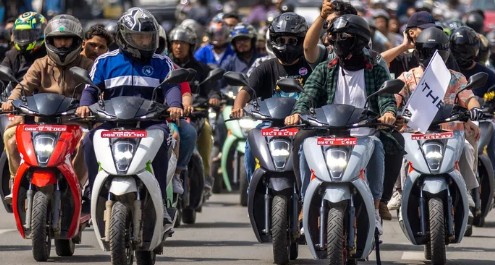
With fuel prices rising, we see people looking towards BEVs now more than ever. It will be up to the distributor who works on building trust into the industry and the new technology that will finally win out, but right now I think any advancement in any EV brand is a win for the industry as a whole. I am looking forward to the competion where we are made to do better than one another in this industry and expand the piece of the electric pie.
You are also taking on the distribution of Ultraviolette in Nepal. Is there a market for performance-based premium electric motorcycles in Nepal today?
Nepal has a passionate motorcycling culture, and there is a growing segment of riders looking for premium performance products. While it will remain a niche category initially, I believe there is room for brands like Ultraviolette to create a strong enthusiast following.
Where do you see Nepal’s EV penetration in both 2Ws and 4Ws five years from now?
I imagine that 4W BEV adoption will remain around 80-90%, but I don’t see a complete takeover. At this point in Nepal’s development, BEVs appear to be the most practical and economically attractive solution for a large share of personal mobility. But we still need fossil fuels, especially because we are still a global south country with infrastructure still in its early stages. Just an example: there are large infrastructure projects where BEV cars won’t be best suited to reach remote locations with no energy infrastructure, let alone the lack of knowledge to repair these vehicles.
When it comes to 2Ws, I think there’s a greater chance of change. In general, two-wheelers are used for shorter distances and are more likely to prioritise operational costs, for which EVs provide a huge advantage. I think the consolidation over the last couple of years, coupled with environmental factors such as people becoming comfortable with EV tech in Nepal due to 4W adoption, low energy costs, and high fuel costs, will lead to a ramp-up in 2W EV adoption.
This interview was first published in EVreporter July 2026 magazine.
Also read: Nepal’s electric leap: Lessons from one of the world’s fastest-adopting EV markets
Subscribe & Stay Informed
Subscribe today for free and stay on top of latest developments in EV domain.