How Indians Actually Charge Their EVs at Home? Key Findings from Kazam and AEEE Report

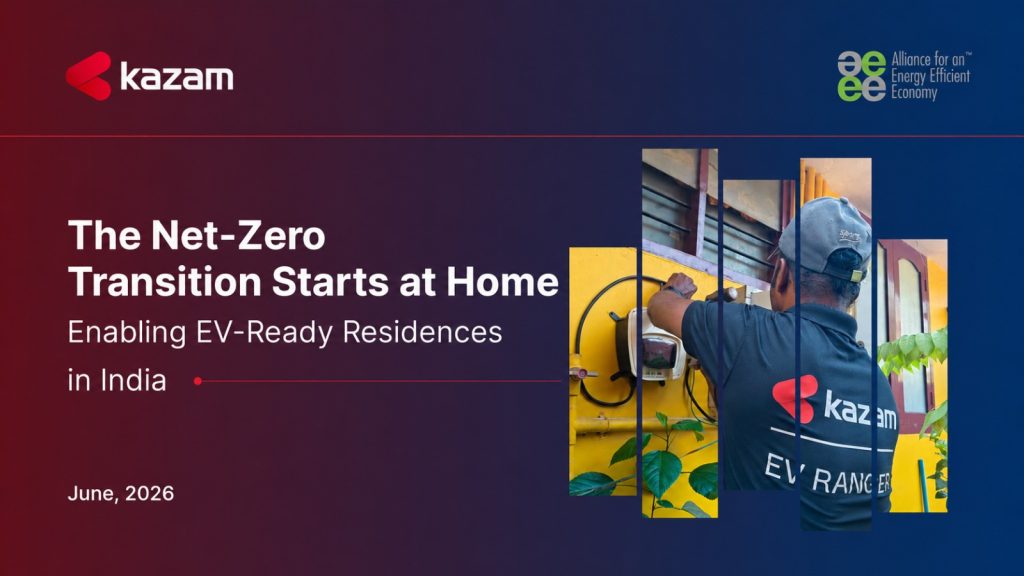
Kazam, in partnership with the Alliance for an Energy Efficient Economy (AEEE), has launched the report titled “The Net-Zero Transition Starts at Home: Enabling EV-Ready Residences in India.” The report highlights the urgent need for EV-ready residential infrastructure and presents key recommendations to support India’s transition towards sustainable mobility.
Akshay Shekhar, Co-founder & CEO, Kazam, gives these insights as part of the study. The report is particularly relevant in the context of the recent Delhi EV Policy, which emphasises expanding EV adoption and strengthening charging infrastructure. As EV ownership continues to grow, the report underscores that residential charging readiness must become a core part of urban planning, housing development, and power infrastructure.
Drawing on insights from over 80,000 real residential charger installations, along with field surveys and consumer interviews across more than 10,000 pin codes spanning tier-1 metropolitan cities, tier-2 and tier-3 towns, and semi-urban and peri-urban regions, the report maps how Indians actually charge their EVs at home.
Key findings of the study
1. Home charging is already the backbone of EV energy
- Residential/home charging currently supplies about 80–90% of India’s daily EV energy demand for 2-wheelers, cars, and autorickshaws.
- India’s rapidly expanding gig workforce, projected to reach 23.5 million workers by 2030, depends on access to home charging, which directly impacts earning potential.
- Charging at home is typically 2–4 times cheaper than public charging, making it the most practical option for everyday use, particularly for light EVs used for commuting and deliveries.
2. Access gap: Many potential buyers can’t charge at home
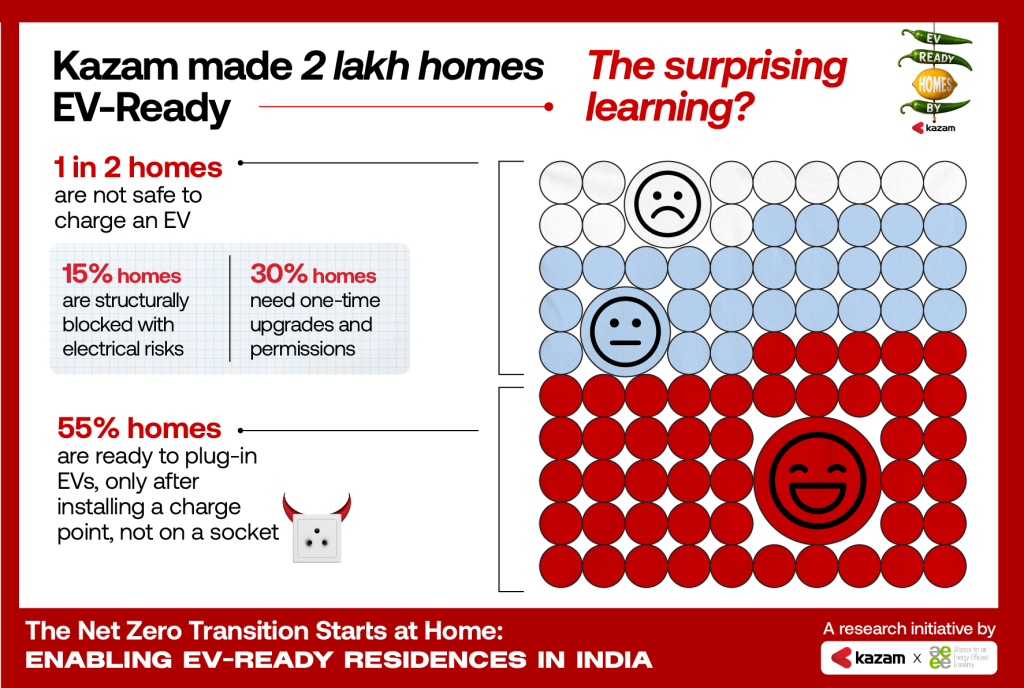
- Only around 55% of prospective EV buyers presently have feasible home-charging access (parking plus basic electrical readiness).
- Another ~30% could get home charging, but only after upgrading their electrical systems (wiring, load capacity, and safety).
- Close to 15% are completely structurally blocked.
- Overall, nearly 45% of Indian homes need electrical upgrades before they can safely support EV charging.
- In a typical apartment in Delhi or a tier-2 city, limited parking, shared meters, and landlord/RWA permissions are often the real bottlenecks—not just the charger hardware.
3. Common infrastructure and safety problems at homes
The study highlights widespread issues in existing residential electrical setups, including:
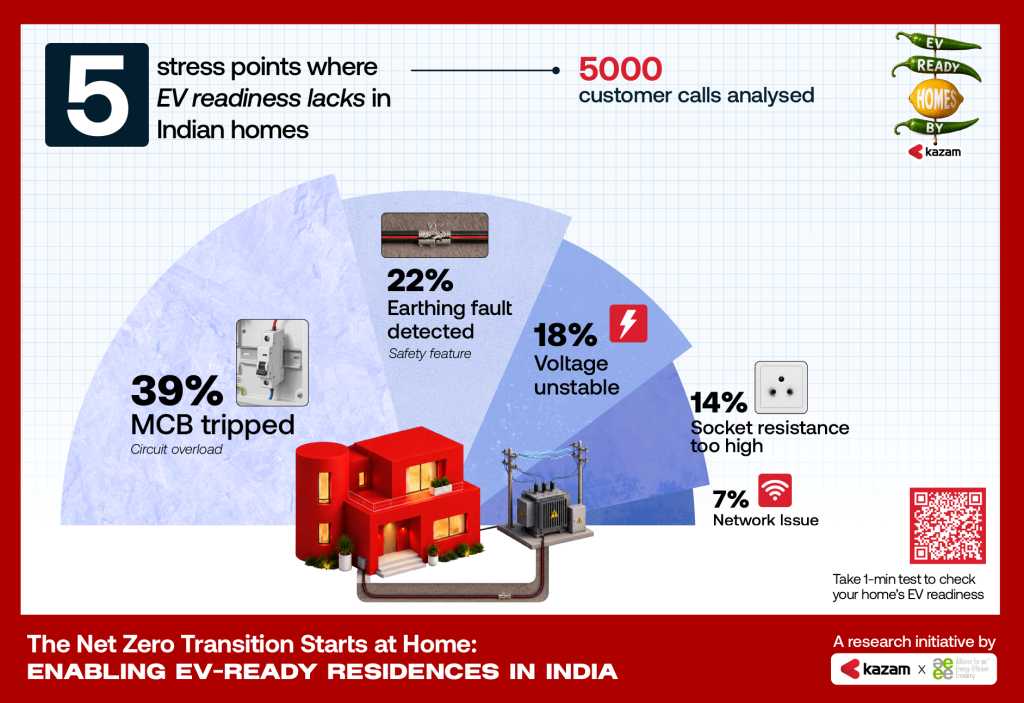
- Inadequate earthing and voltage fluctuations
- Undersized or ageing wiring and overloaded circuits
- Use of regular 5A/15A sockets, extension cords, and improvised connections instead of dedicated EV charging points
These “jugad” solutions increase fire and electrical safety risks, reduce charging reliability, and can harm battery health over time.
4. Key barriers beyond hardware
The report identifies five broad barriers to scaling residential EV charging:
Electrical infrastructure gaps
- Load: Commercial electric 3-wheelers act as a daily “stress test” on household grids because they charge continuously for 4–6 hours.
- Wiring: Standard domestic plugs cannot safely handle commercial-duty EV loads, leading to overheating and fire hazards.
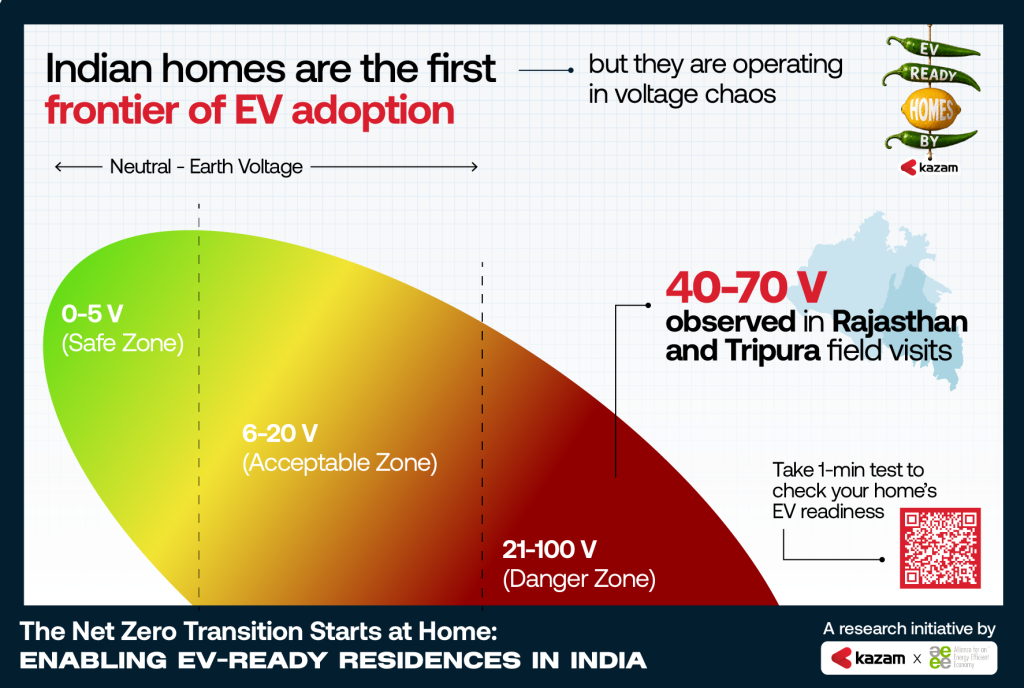
- Voltage and earthing safety: Chargers frequently auto-shutdown due to dangerous “floating neutrals” and the widespread lack of proper earthing, which consumers often mistake for faulty chargers.
The report also draws on field studies conducted in tier-2 cities and deployment learnings from Kazam’s residential charging network:
- Tripura: High humidity requires 4 sq. mm wiring to prevent overheating during sustained charging.
- Rajasthan: Frequent voltage drops (180V–190V) make stabilizers essential for reliable charging.
Additional barriers include:
- Structural constraints, with 70–75% of urban households living in apartments or multi-family buildings where residents face a lack of dedicated parking, installation delays, and resistance from Resident Welfare Associations and landlords.
- Low consumer awareness about safe charging practices and electrical upgrade requirements.
- Upfront costs associated with electrical upgrades and dedicated EV metering.
The report concludes that EV readiness is as much a housing and governance challenge as it is an automotive or technology issue.
5. Demand is shifting to Bharat
- EV adoption is accelerating fastest in tier-2 and tier-3 towns, driven primarily by electric two- and three-wheelers used for personal mobility and last-mile logistics.
- Residential charging deployments are now spread across more than 10,000 pin codes, demonstrating that EV adoption is no longer limited to metropolitan cities.
- This reinforces the need to plan EV-ready homes not only in metros but also in smaller cities and new residential developments across India.
6. Grid impact: EVs will shape future power planning
- EV-related electricity consumption is projected to increase from around 0.2% of India’s total electricity demand in 2024 to about 6% by 2035.
- Since most charging will occur at home, particularly overnight, the report identifies managed home charging through smart meters, load management, and time-of-day tariffs as essential for maintaining grid resilience.
- As highlighted by DISCOMs, there remains a significant gap between EV registrations and dedicated EV meters. In Delhi, only 2% of EV owners currently have a separate metered EV connection, limiting utilities’ visibility into future electricity demand.
- With increasing heat waves creating dual electricity demand peaks—one during the afternoon due to cooling and another in the evening—EV charging represents a flexible load that can be shifted through smart charging and well-designed time-of-day tariffs.
7. What the report recommends
The report notes that while India already has adequate standards and technical guidelines, implementation remains fragmented across the power, housing, and mobility sectors.
It recommends a four-layer framework to make Indian homes EV-ready through coordinated implementation across power supply, housing, and electrical safety systems:
- Deploy only verified EVSE, instead of conventional domestic sockets, along with dedicated EV metering suited to different housing typologies.
- Expand access to EV-ready infrastructure through financial support for electrical upgrades and large-scale training and certification of electricians.
- Future-proof residential charging by integrating smart charging, solar compatibility, and demand flexibility that enables DISCOMs to better manage growing EV loads.
Also Read: India’s EV transition needs target-driven interventions
Subscribe & Stay Informed
Subscribe today for free and stay on top of latest developments in EV domain.