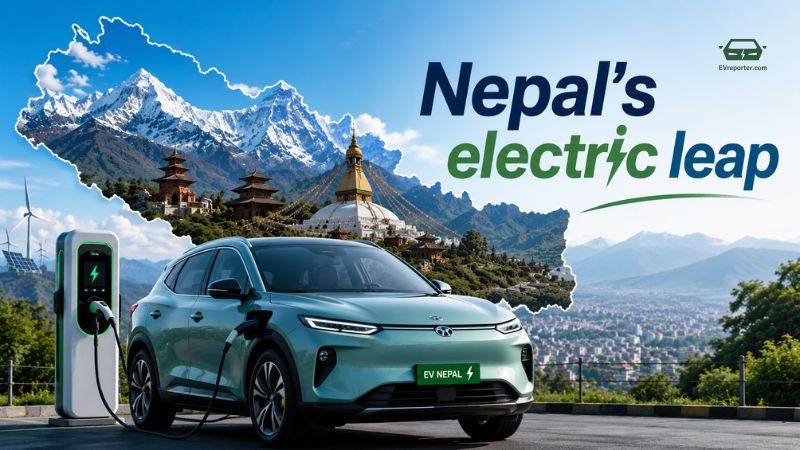
Nepal’s electric leap: Lessons from one of the world’s fastest-adopting EV markets

Five years ago, if you saw an electric car on the streets of Kathmandu, it still felt like a novelty. Today, it is increasingly the opposite. In many parts of the city, EVs have become so common that they barely attract attention.
Nepal’s EV story has received significant attention over the last two years, largely because of the rapid electrification of the four-wheeler market. In the fiscal year ending July 2025, EVs accounted for roughly 73% of passenger vehicle imports, making Nepal one of the highest EV adoption markets in the world by share of new vehicle sales.
The numbers are impressive, but I would argue they are not the most interesting part of the story.
Having spent the last few years working across vehicle deployment, battery-swapping infrastructure, and commercial mobility operations, I have come to believe that Nepal’s EV journey offers a more important lesson. The real challenge is not getting people to buy electric vehicles. The real challenge is building the ecosystem required to support them once they are sold.
Why Nepal Took Off
A lot of factors came together at the right time.
The most obvious is economics. Nepal imports nearly all of its petroleum products while generating the majority of its electricity from hydropower. From a national perspective, every EV reduces fuel imports and increases the use of domestically generated energy. From a consumer perspective, lower running costs are immediately visible.
Government policy also deserves credit. Reduced duties on EVs dramatically improved affordability and gave importers confidence to invest in the market. Without those policy decisions, adoption would almost certainly have been much slower.
The third factor is something we often overlook: the products simply got better. A few years ago, almost every conversation with customers started and ended with range anxiety. Today, customers ask about charging speed, service networks, battery warranties, software updates, and resale value. That shift in customer questions tells us something important. The market is no longer debating whether EVs work. It is trying to determine which EV ecosystem works best.
Four-Wheelers: The Success Story Everyone Talks About
The four-wheeler segment has been Nepal’s biggest EV success story.
What is particularly interesting is how quickly public perception changed. Initially, EVs were viewed as environmentally friendly alternatives. Today, many consumers see them as the better product altogether.
The driving experience, lower maintenance requirements, and running cost advantages are well understood. Charging infrastructure has also improved considerably, particularly along major urban corridors.
Interestingly, Nepal’s terrain has turned out to be less of a challenge than many expected. In fact, the torque characteristics of electric drivetrains and the benefits of regenerative braking make EVs surprisingly well suited to many of the country’s road conditions.
That does not mean all the problems have been solved. The next phase of growth will depend less on vehicle sales and more on service capability, battery diagnostics, spare parts availability, and the development of a healthy resale market.
Two-Wheelers: The Opportunity Is Bigger Than the Reality Today
While four-wheelers dominate headlines, I believe the biggest long-term opportunity still lies in the two-wheeler segment. The economics are compelling. Daily travel distances are manageable, fuel savings are meaningful, and the value proposition becomes even stronger for commercial users.
However, two-wheelers introduce a completely different set of challenges.
One lesson we have learned through commercial deployments is that a private vehicle owner and a professional rider think very differently. A private owner may tolerate a vehicle being off the road for a few days. A delivery rider or ride-sharing rider cannot. For someone earning a daily income from their vehicle, downtime matters more than almost anything else.
This is where many EV discussions become disconnected from reality. Adoption does not end when a vehicle is sold. In many ways, that is when the real work begins.
The strength of a two-wheeler ecosystem is determined by technician capability, spare parts availability, warranty support, and service response times. Customers rarely talk about these things when buying a vehicle, but they become critically important once the vehicle is in operation.
Why Battery Swapping Matters
One of the more interesting developments in Nepal’s EV ecosystem has been battery swapping. There is sometimes a tendency to frame charging and battery swapping as competing solutions. In practice, I think they solve different problems.
For most private users, home or public charging works perfectly well. But commercial riders operate under different constraints. Their biggest challenge is often not range—it is time. If a rider spends hours waiting for a vehicle to charge, those are hours not spent earning. Battery swapping addresses that problem directly by reducing charging downtime to a matter of seconds.
It also changes the economics of ownership by separating the battery from the vehicle purchase. For many riders, that lowers the initial cost of entry while reducing concerns about future battery replacement expenses.
That said, battery swapping is not a universal solution. It requires significant capital investment, dense infrastructure networks, and high utilization to become sustainable. The model works best in concentrated urban environments where riders travel high daily distances and infrastructure can achieve sufficient throughput.
The future is unlikely to be charging versus swapping. More likely, both models will continue to coexist, serving different customer needs.
The Challenges We Don’t Talk About Enough
Despite the progress, several challenges remain.
The first is technical manpower: Vehicle adoption has grown faster than the availability of trained EV technicians, battery specialists, and diagnostic engineers. Across the industry, this remains one of the biggest bottlenecks to scaling after-sales support.
The second is infrastructure economics: Whether we are discussing charging or battery swapping, infrastructure requires patient capital. Utilization takes time to build, and returns often arrive much later than vehicle sales.
The third challenge is financing: In the commercial segment, financing often matters more than technology. Most riders already understand the savings offered by electric mobility. The bigger question is whether they can access affordable capital to purchase the vehicle in the first place.
Finally, there is policy certainty: Nepal’s EV growth story has benefited enormously from supportive government policies. The industry now needs consistency. Infrastructure investments, distribution networks, and service ecosystems are built over years, not months. Predictability matters.
Looking Ahead
Nepal has already answered one question that many developing countries are still asking: can electric mobility scale rapidly outside mature markets?
The answer is clearly yes. The more difficult question is what happens next.
The next phase of Nepal’s EV journey will depend less on the number of vehicles imported and more on how effectively the industry can support them. Service capability, financing, technician development, charging infrastructure, battery-swapping networks, and spare-parts ecosystems will determine whether growth remains sustainable.
If there is one lesson I believe other emerging markets can take from Nepal, it is this: EV adoption is not primarily a vehicle problem. It is an ecosystem problem. The countries and companies that understand that distinction early will be the ones that succeed over the long term.
About the author

Sahayu Goyal is a leading advocate for clean mobility in South Asia and has been an active contributor to Nepal’s evolving electric vehicle ecosystem. Over the years, he has worked to strengthen the foundations of EV adoption by supporting the development of technical expertise, battery service capabilities, and reliable mobility infrastructure across the country, including in some of its most remote regions. With experience spanning financial services and technology-driven ventures, he is focused on building the infrastructure, partnerships, and scalable solutions needed to accelerate mass EV adoption and advance sustainable transportation in Nepal and the wider region.
Also read: Suitability of EVs in Nepal – Policy, Economics, Topography and Demography
Subscribe & Stay Informed
Subscribe today for free and stay on top of latest developments in EV domain.