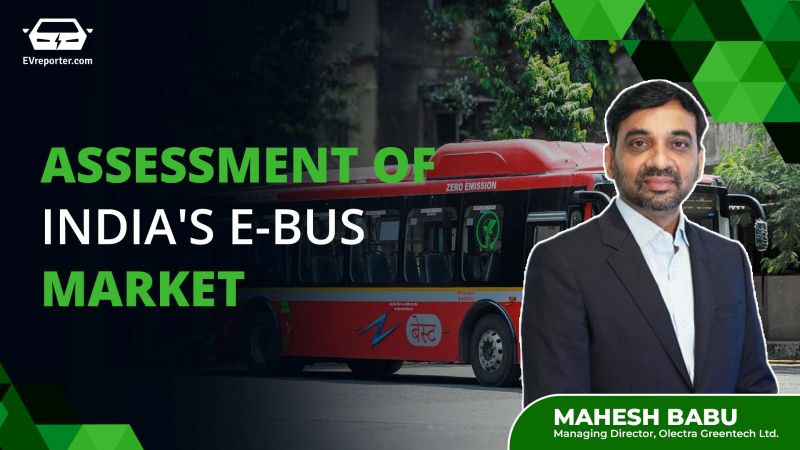
India’s electric bus market can reach 8,000 units in FY26-27: Mahesh Babu, MD, Olectra Greentech

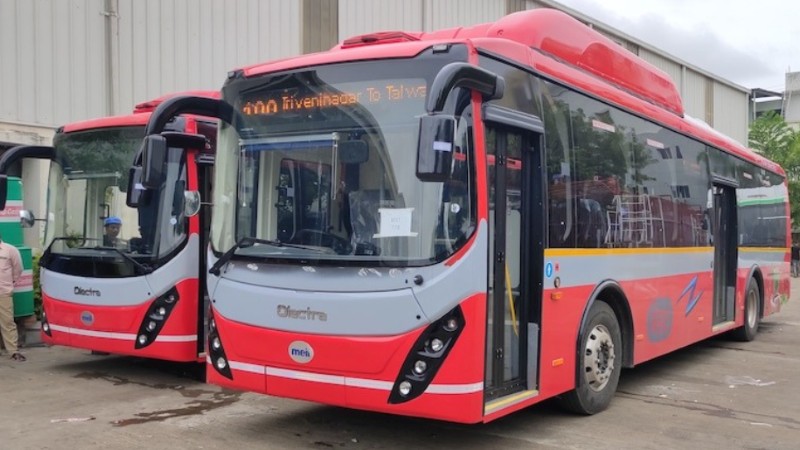
A decade ago, India’s electric bus market was virtually non-existent. Today, over 17,000 electric buses ply on Indian roads — and Olectra Greentech, with a fleet share of over 21%, has been a frontrunner. Mahesh Babu, MD of Olectra Greentech, reflects on Olectra’s strong FY26 performance, shares candid views on current supply-side constraints, lessons from a parc of 3,800 e-buses, and lays out the company’s product roadmap.
How do you view the electric bus industry’s performance in the last FY, and how do you expect the growth rate to evolve going forward?
The overall bus industry is around 115,000 buses, with the 9-meter and 12-meter segments accounting for about 60,000 units. EV bus registrations were around 5,400 this year, and the market grew by about 30% year on year. We had expected registrations to cross 6,500 units, but supply chain issues related to magnets and geopolitical challenges impacted growth. Looking ahead, I expect 7,000-8,000 registrations in the current FY, assuming the current geopolitical situation stabilises soon and the next three quarters remain strong for deliveries.
Last year, we delivered ~1,280 vehicles, while our revenue and profitability both grew by about 28%. Most of our ongoing tenders are profitable, although a few operational challenges with some are being addressed.
Beyond financial performance, we have initiated two new platforms—one for buses and one for trucks. Our second-generation 9-meter and 12-meter bus platform is under development, and we have already secured 1,085 orders in Telangana under the PM E-Drive scheme. These products are expected to be launched by the end of this calendar year. We are also developing a truck platform in the 28-tonne to 55-tonne segment, with launches planned for the last quarter of the financial year and the first quarter of the next calendar year.
With a strong order book (10,000+), a clear product pipeline, and nearly a decade of experience in the sector, we currently have around 3,800 electric buses on the road, representing roughly 22% of the industry base. By the end of this month, we expect to become the first company in India to register 4,000 electric buses.
What are the key supply-side challenges that could impact growth or deliveries?
- The first is shipping availability, as ongoing geopolitical conflicts have disrupted global shipping and logistics.
- The second concerns crude oil derivatives, such as polymers. Their prices have increased, and availability has become constrained, creating challenges for the industry.
I hope these issues are resolved soon and that conditions return to normal within a month. If that happens, the industry should be able to make the most of the remaining three quarters of the financial year.
Success in e-bus market largely depends on winning tenders, and government-led procurement. Do you see any meaningful private-sector demand emerging as well?
Following the recent geopolitical disruptions, we have seen increased interest from private-sector operators. Many diesel bus operators who were previously evaluating electric buses passively have now become more active in exploring adoption.
One key challenge, however, is financing. Electric buses and trucks require financing terms of 7 to 8 years, compared to the typical 3- to 5-year financing period for diesel vehicles. To address this, we are working with NBFCs and private equity funds that are beginning to support these financing models. In addition, the Ministry of Heavy Industries recently held discussions with banks and financial institutions on ways to support long-term financing for electric buses and trucks. As financing options become more widely available, I believe private-sector adoption will accelerate significantly.
We were recently at a conference where one of the leading electric bus financiers mentioned that battery degradation in real-world conditions is not as quick as initially assumed. Is that your experience as well?
Yes, our experience also shows that while we typically plan for a battery replacement around the sixth year in a 12-year cycle, in practice, the battery can often be used for another one to two years, depending on the actual application. This helps improve overall lifecycle and contract costs.
Do you see strong use cases in segments like school buses and employee transportation. What are the specific friction points in these applications?
For school buses, regulations generally prevent the vehicle from being used for any other purpose. A typical school bus may run only 25 km one way, or roughly 40 km per day for pickup and drop-off. At that utilisation level, electric buses do not achieve TCO parity for a long time. Most electric bus use cases become economically attractive at around 150–200 km per day or more. As a result, school bus electrification is often driven more by policy than economics. For example, Delhi’s EV policy proposes a phased increase in electric school buses to reduce pollution. That is a useful policy approach because some applications require balancing economic considerations with public health and environmental goals.
Employee transport has a different challenge. Cities have become increasingly congested. Routes that previously covered 150–200 km per day with multiple pickup-and-drop cycles are now affected by slower traffic and lower average bus speeds in cities such as Bengaluru, Chennai, Mumbai, Pune, and Delhi. This reduces asset utilisation and weakens the economics.
In practice, employee transport electrification is therefore often linked to ESG commitments, Scope 3 emissions targets, and sustainability objectives rather than pure TCO. Companies that prioritise decarbonisation may still adopt electric buses, but they generally need to do so with a clear understanding of the operational constraints.
Olectra already has around 3,800 electric buses on the road. What performance metrics do you track from these deployments? What are the key learnings being incorporated into future platforms?
One of the most important metrics we track is uptime. Across our fleet, we maintain an average uptime of around 98.5%, and in many deployments it exceeds 99%.
Operating electric buses in India has also generated valuable lessons, particularly given the country’s extreme summer conditions, which differ significantly from those in many global EV markets such as China, Europe, and the US. We have gained insights into AC performance and preventive maintenance practices to be carried out before the summer and monsoon seasons. Over time, we have developed structured maintenance cycles around these learnings.
Another key insight comes from actual operating conditions. While tenders specify a certain number of seated and standing passengers, most operators run buses with significantly higher passenger loads. This means vehicles must be designed for more demanding real-world conditions than initially assumed. As a result, our next-generation buses are being engineered with more robust structures, including CED-coated bodies designed for a service life of over 15 years.
We have also adapted our approach to energy efficiency. Most vehicle software and optimisation strategies were originally developed around top speeds of up to 80 km/h, with systems typically optimised for average speeds of 40–50 km/h. However, in many Indian cities, average bus speeds have fallen to 10–20 km/h due to congestion. We are therefore optimising motor efficiency and vehicle performance for lower-speed urban operations. In addition, learnings from the wear and tear on interiors, seating, and other high-use components are helping us improve the durability and overall design of our next-generation vehicles.
How does your relationship with Technology partner BYD influence Olectra’s product roadmap? As you continue to gather more field data, how is the partnership evolving to incorporate those learnings?
BYD is one of the pioneers in electric mobility and among the largest EV companies globally. Our partnership is based on technology licensing, where Olectra handles manufacturing in India while leveraging BYD’s technology expertise.
As part of this collaboration, we are discussing establishing a blade battery assembly line and plan to bring battery pack assembly in-house for our next-generation products. Currently, battery packs are assembled at BYD’s facility in Chennai, but we are working towards localising this capability within our own manufacturing operations.
We are also collaborating on advanced technologies such as flash charging, which supports charging capacities of up to 1MW. This technology is particularly relevant for electric trucks and certain intra-city bus applications, as it can charge a vehicle to around 80% in 12–18 minutes, enabling an additional range of 300–400 kilometres.
Going forward, we will continue to evaluate and adopt new technologies developed by BYD and bring them to the Indian market wherever they can create value for our customers.
Which key use cases are you targeting for your electric heavy commercial vehicles?
We are developing six truck variants ranging from 28 tonnes to 55 tonnes. These include a 55-tonne tractor-trailer, a 35-tonne tipper for construction and mining applications, and a 28-tonne truck for goods transport, waste collection, and other use cases. We are also working on multiple configurations, including 8×4 and 6×4 platforms, and plan to launch these trucks progressively over the next calendar year.
Based on how the electric mobility ecosystem has evolved over the past few years, what developments are you most encouraged by, and what challenges or gaps do you believe still need to be addressed?
What makes me happy is the significant growth in the EV ecosystem. Across two-wheelers, three-wheelers, buses, and trucks, a large number of players have entered the market, bringing greater choice, competition, and value for customers. When I started in 2015, the industry was still in its early stages. The progress made over the last decade in terms of investments, products, and market participation has been substantial.
I am also encouraged by the government’s consistent policy support through initiatives such as FAME I, FAME II, PM E-Drive, PM E-Sewa, and the PLI scheme. These policies have evolved over time and played an important role in driving EV adoption.
Areas that could have progressed faster include charging infrastructure and vehicle financing. While both have improved, financing institutions have taken longer to adapt to EV technologies compared to some other markets. These remain key areas of opportunity for the industry. That said, all stakeholders are working on them, and the challenge is more about execution than intent.
This interview was first published in EVreporter June 2026 magazine.
Also read: Olectra Greentech to supply 1,085 electric buses worth ~₹1,800 crore for Telangana project
Subscribe & Stay Informed
Subscribe today for free and stay on top of latest developments in EV domain.