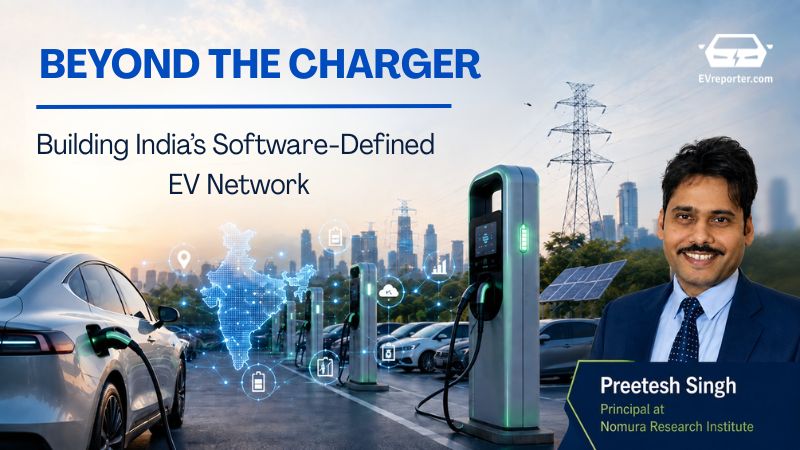
BEYOND THE CHARGER | Building India’s Software-Defined EV Charging Network

In this article, Preetesh Singh, Principal at Nomura Research Institute, explains why the next phase of electric mobility will depend as much on location intelligence, interoperability, uptime, payments, and grid orchestration as it does on hardware.
An electric-vehicle charger is easy to recognise: a cabinet, a cable, a screen and a parking bay. The infrastructure that determines whether it is useful is far less visible. A driver needs to know that the charger exists, that it is compatible, that it is available, that payment will work and that the promised power will actually be delivered. The operator needs to know whether the site is economically viable, whether a failing component can be repaired before the next customer arrives and whether dozens of vehicles can charge without exceeding the building’s or the local grid’s capacity.
This invisible layer—connectivity, software, data and operating intelligence—is becoming the decisive layer of India’s charging network.
The central proposition is straightforward: India will not solve charging merely by installing more boxes. It must build a dependable digital system around those boxes. That system has four jobs. It must put chargers in the right places, make them easy to find and use, keep them operational, and coordinate their demand with the electricity system. When those jobs are done well, charging becomes an ordinary background service. When any one fails, even an expensive high-power charger can become a stranded asset.
The real test of a charging network is not how many chargers have been commissioned. It is how many drivers can start and complete a charging session, at the place and time they need it, without having to think about the system behind it.
India’s charging build-out has entered a new phase
India’s EV transition is no longer a niche story. According to the Federation of Automobile Dealers Associations, retail sales reached 24.52 lakh electric vehicles in FY2025–26, 24.63% higher than the previous year. Yet the national market is structurally different from the passenger-car-heavy markets that dominate global EV discussions. Electric two-wheelers accounted for roughly 14.0 lakh retail units and electric three-wheelers for about 8.3 lakh. Together, they represented approximately 91% of all EVs sold by unit during the year.[1]
That figure updates a commonly repeated estimate that two- and three-wheelers constitute only 70–75% of India’s EV market. They now dominate the unit mix even more strongly. But unit share should not be confused with charging-energy demand. A car, bus or truck consumes far more electricity per vehicle and can require much higher charging power. India therefore needs multiple charging systems at once: inexpensive neighbourhood and workplace charging for light electric vehicles, reliable urban and highway fast charging for cars, and tightly managed depot or corridor charging for commercial fleets and heavy vehicles.
Market snapshot: India, mid-2026
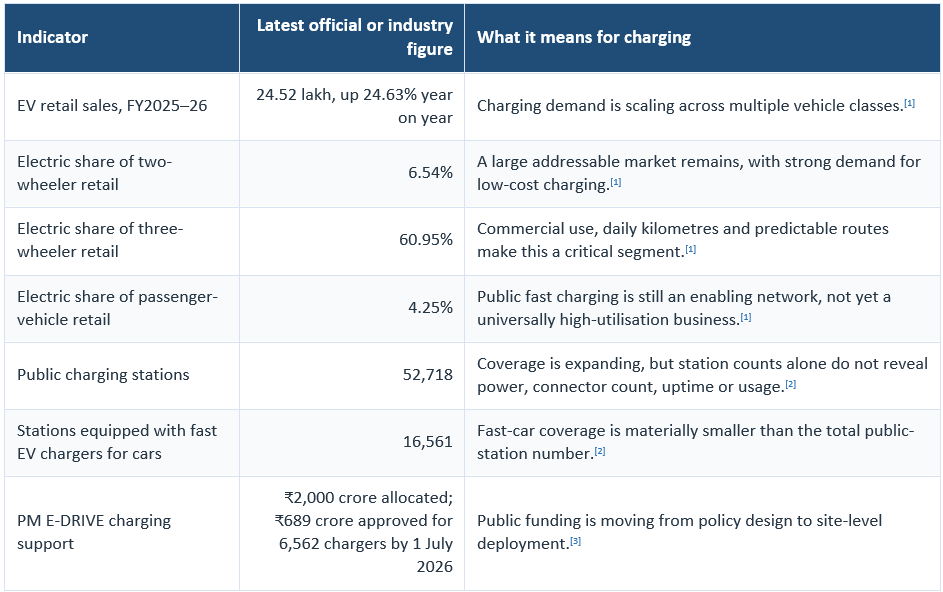
The distinction between a station, a charger, a connector and a charging gun is important. Public announcements and databases do not always use these terms consistently. One location may contain several charge points, while one charger may provide two connectors that cannot always deliver maximum power simultaneously. A credible national picture therefore needs more than a headline count: it needs connector-level status, rated and delivered power, accessibility, session-success data and energy throughput.
India is not one charging market
A useful charging strategy begins by rejecting the idea of a single “Indian EV user.” The charging need follows the operating pattern of the vehicle.
- Private scooters and motorcycles are often charged at home or work, generally at low power. Safety, convenience and access to a socket matter more than extreme charging speed.
- Commercial two- and three-wheelers may travel long distances every day and lose revenue while idle. Predictable charging windows, battery swapping in selected models, and reliable opportunity charging can matter more than a premium retail experience.
- Private cars are commonly charged where they remain parked for hours, but intercity journeys require dependable corridor fast charging. Drivers need confidence that a charger will be working before they commit to a route.
- Taxis and urban fleets require high daily availability, known turnaround time and account-level billing. Their demand can improve charger utilisation but also create sharp peaks.
- Buses, trucks and commercial depots concentrate large loads at a few sites. Here, connection capacity, charging schedules and route readiness become part of one operational system.
- Agricultural and specialised vehicles create additional regional and seasonal patterns that a passenger-car template will not capture.
This diversity has an important business implication. A low-utilisation highway site can still be strategically essential because it removes range anxiety and connects two cities. A depot charger can be financially attractive with a small number of vehicles because every vehicle returns on a schedule. A neighbourhood charger that works for scooters may be irrelevant to a premium car, even if both are shown as “one public charger” in a database.
India should therefore evaluate charging assets by use-case archetype, not by a single national utilisation benchmark.
The four jobs of a digital charging backbone
The software-defined charging network can be understood as a four-part operating loop:
1. Location intelligence: decide where capacity should be built.
2. Discovery and transaction: help a user find, access and pay for the service.
3. Service availability: ensure the charger completes the session and recover quickly when it does not.
4. Energy orchestration: fit charging demand within the limits and opportunities of buildings, tariffs and the grid.
These are not separate software products. Data from one stage improves the next. Actual sessions reveal demand; demand improves site planning; better planning raises utilisation; higher utilisation generates more operating data; operating data improves reliability and load forecasts. The objective is a learning network, not a static inventory.
1. Location intelligence: choosing the site before choosing the charger
The easiest mistake in charging is to begin with hardware. A high-power charger is not valuable merely because it is fast. It is valuable when it is placed where compatible vehicles need energy, at a time when users can reach it, on a site with sufficient electrical capacity and a reason to remain there.
Good location intelligence combines at least four layers of evidence:
- Mobility demand: traffic flows, vehicle class, origin–destination patterns, route frequency, dwell time and EV adoption.
- Electrical reality: substation and feeder capacity, sanctioned load, connection lead time, power quality, renewable generation and the cost of reinforcement.
- Land and access: ownership, lease terms, visibility, entry and exit, parking geometry, safety, operating hours and the ability to expand.
- Customer context: food, restrooms, lighting, shelter, security, retail, service facilities and the duration of a useful stop.
The Ministry of Heavy Industries’ PM E-DRIVE operational guidelines reflect this logic. They call for data-led highway planning, including high-traffic corridors and toll information, and define different charging categories—from light electric vehicles to 250–500 kW high-power systems for buses and trucks.[4] That is a better starting point than a uniform distance rule, because the best site depends on what travels through it.
A practical site-screening scorecard
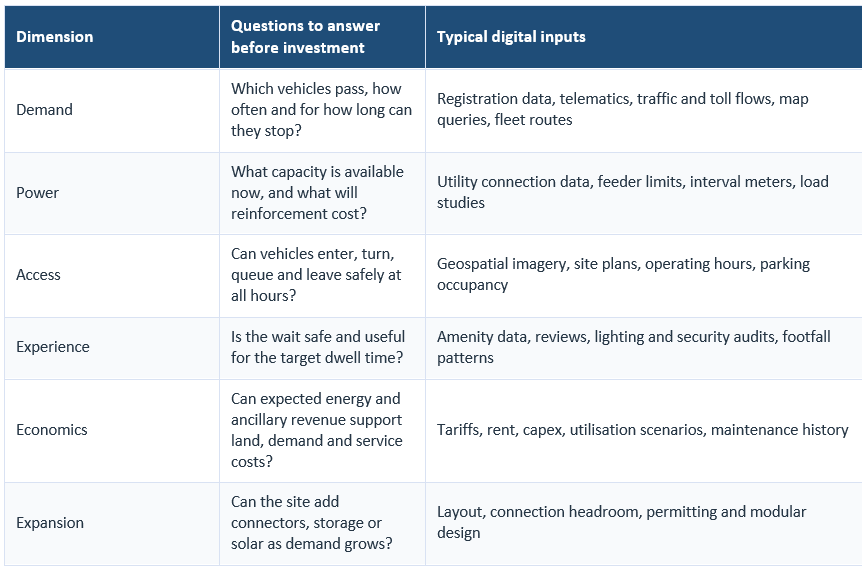
Software can rank candidate sites, but a model cannot rescue poor input data or replace physical inspection. The best process uses analytics to narrow the field and engineering judgement to validate it. It should also preserve the reason each site was selected, so assumptions can later be compared with actual demand.
2. Discovery and transaction: make charging accessible without app fatigue
Once a charger exists, the user must be able to trust it before arriving. A useful listing should show location, connector type, available power, live status, access hours, price, parking or idle fees and recent reliability. Navigation should lead to the correct entrance—not merely the centre of a large property.
India’s PM E-DRIVE framework envisages a National Unified Hub and a national app with charger discovery, real-time status, slot booking and digital payments.[4] This can create a common information layer, but it should not become another closed destination that every driver is forced to use. Charging data should be capable of appearing in multiple channels: vehicle navigation, map services, fleet software, mobility apps and operator interfaces.
The same principle applies to payment. Regular users may value an account, subscription or loyalty programme. Occasional users should still be able to start a session through an ad-hoc method such as a QR flow, UPI, a payment card or another widely accessible mechanism. An app can add value, but it should not be an entrance exam.
The journey should become progressively simpler:
- Today’s baseline: locate the charger, confirm compatibility, initiate the session and pay without mandatory registration.
- Interoperable experience: use one account across multiple networks, with consistent price and session information.
- Plug & Charge: connect the vehicle and allow secure machine-to-machine authentication and billing.
Plug & Charge is not simply “automatic payment.” Under the ISO 15118 family of standards, the vehicle and charging equipment exchange information over the charging cable. A production-grade implementation also needs trusted digital certificates, contract management, secure back-end connections and clear responsibility among the vehicle manufacturer, charging operator, mobility provider and certificate ecosystem.
This is why interoperability matters. The user sees one cable and one charging session; the transaction may involve several companies. The system must pass identity, tariff, authorisation, meter and settlement data across those boundaries without exposing more personal data than necessary.
The protocol stack: different standards solve different interfaces
Charging discussions often treat “open protocol” as if it were one technology. In reality, several standards cover different links in the chain.
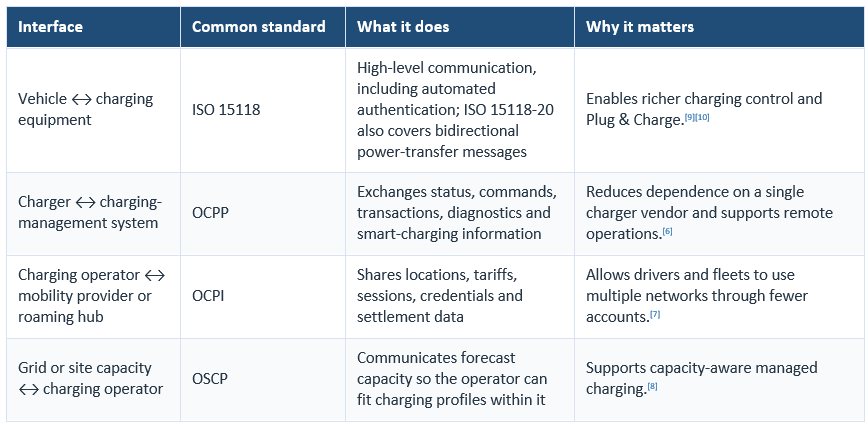
These standards complement one another. OCPP does not by itself provide roaming; OCPI does not control the electrical conversation between vehicle and charger; ISO 15118 does not replace the operator’s payment and settlement systems. “Open” also does not mean “secure by default.” Implementations still require certificate lifecycle management, access control, encryption, patching, monitoring and careful conformance testing.
India’s 2026 dialogue with the European Union explicitly highlighted OCPP, smart and bidirectional charging, the Megawatt Charging System and harmonised standards.[13] The strategic opportunity is not to copy another region’s architecture wholesale, but to combine global interoperability with India’s payment rails, vehicle mix, languages, heat, dust, power conditions and operating economics.
3. Service availability: uptime is an end-to-end property
A charger can be powered on and still be unusable. The connector may be damaged. The cable may overheat. The payment gateway may time out. The cellular link may be unstable. The back end may show a connector as free after a previous session has failed to close. The vehicle and charger may not complete their communication handshake. A local power-quality event may cause repeated resets.
That is why backend availability and charging availability are not the same metric. A cloud platform can report extremely high uptime while drivers continue to encounter failed sessions in the field.
The operational chain includes:
Grid supply → site electrical system → charger power electronics → cable and connector → vehicle handshake → network connectivity → operator cloud → authorisation and payment → customer support.
The user experiences the weakest link.
Metrics that reveal real service quality
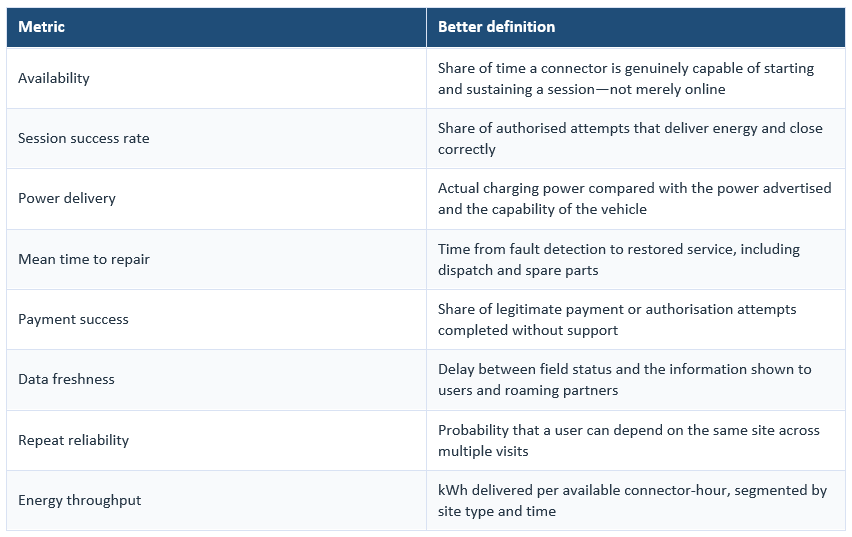
Internationally, regulation is starting to move from installation counts toward service outcomes. The United Kingdom, for example, requires each operator’s rapid public network to achieve 99% average reliability over a calendar year and requires contactless payment for specified chargers.[15] India need not copy the exact rule, but the direction is useful: publish comparable, auditable service metrics.
Remote monitoring is the foundation. A charging-management system should detect abnormal temperature, repeated resets, insulation alarms, communication errors, payment failures and falling power output. Diagnostics should distinguish failures that can be resolved remotely from those requiring a field visit. Spare-parts planning and technician routing should then be driven by asset criticality, not merely by the order in which tickets arrived.
Predictive maintenance can go further. A model may detect that a connector’s temperature rise is becoming abnormal, that one modem is reconnecting more frequently, or that a contactor is taking longer to close. But predictions need operational discipline: clear thresholds, work orders, feedback from technicians and records of whether the alert was correct. Without that loop, “AI maintenance” is only another dashboard.
Utilisation: a number without a denominator is misleading
The economics of charging are frequently reduced to utilisation. Yet there is no universally useful national number because operators calculate it differently. It may mean occupied minutes divided by total time, delivered energy divided by theoretical maximum energy, sessions per day, or revenue relative to capacity. A charger can also appear highly utilised because a vehicle remains connected after charging has finished.
India should avoid treating anecdotal ranges as national benchmarks. Public, fleet, workplace, residential and corridor sites have fundamentally different roles.
- Fleet and depot charging can reach attractive utilisation because routes and return times are known. Software schedules vehicles, energy and charger availability around the next dispatch.
- Urban public charging is sensitive to neighbourhood demand, parking rules, pricing, queueing and visibility. A good site can generate repeat use; a poor one may remain idle regardless of software quality.
- Highway charging may require deliberate capacity ahead of demand. Its value includes network confidence and geographic continuity, not just immediate energy sales.
- Destination charging competes on dwell time and amenity fit. The right power is the power that matches how long the user intends to stay.
Software can improve a viable site through pricing, reservations, fleet contracts, loyalty, marketing, roaming and operational reliability. It cannot manufacture traffic, remove an unsafe entrance or create grid capacity. The honest hierarchy is: good use case first, good location second, reliable operations third, commercial optimisation fourth.
4. Energy orchestration: the charger is part of a building and a grid
As charger power and site size increase, an operator is no longer managing isolated electrical appliances. It is managing a flexible energy portfolio inside a constrained facility.
Consider a bus depot, logistics hub or large workplace. Vehicles arrive with different states of charge and different departure times. The building also has critical loads. Solar generation changes during the day. The grid connection has a sanctioned limit and may face demand charges or time-varying tariffs. Charging every vehicle at maximum power as soon as it arrives is usually unnecessary—and may be expensive or impossible.
Managed charging changes the question from “How fast can this charger run?” to “How much energy must each vehicle receive by its departure deadline, within the site’s constraints?”
The first priority is building safety and continuity. Charging power should yield to critical processes when necessary. The second is operational readiness: vehicles must receive enough energy for their scheduled work. The third is cost and carbon optimisation: shift flexible charging toward lower-price or higher-renewable periods, within battery and route limits.
India already has a policy basis for time-of-day electricity pricing. Ministry of Power rules introduced lower tariffs during specified solar hours and higher tariffs during peak periods for applicable consumers, with implementation linked to consumer categories and smart-metering.[11] The gap is not that India has only flat tariffs; it is that granular, automated and consistently available price signals are not yet the norm across all charging contexts.
Open Smart Charging Protocol provides one model for capacity coordination: a grid or site party communicates predicted capacity, and the charging operator schedules within that envelope.[8] In practice, India will require integration among utilities, distribution companies, building-energy systems, charging platforms, fleet-management systems and meters.
Unidirectional smart charging—often called V1G—should be the near-term priority because it can shift or modulate demand without sending energy back from the vehicle. Bidirectional applications, including vehicle-to-building and vehicle-to-grid, may eventually provide backup or grid services. ISO 15118-20 provides communication messages for bidirectional power transfer, but commercial deployment also depends on compatible vehicles and chargers, warranty treatment, metering, market rules, tariffs and compensation.[10]
The sequence matters: establish reliable charging, good metering, flexible schedules and clear tariffs first. Bidirectional value cannot be built on top of unreliable sessions or ambiguous settlement.
Where artificial intelligence can deliver practical value
AI is useful when it shortens a decision loop or reduces uncertainty. It is not a substitute for electrical design, standards compliance or maintenance capacity.
The strongest near-term applications are operational:
- Predictive maintenance: identify equipment likely to fail and prioritise inspection before service is lost.
- Fault diagnosis: correlate charger, vehicle, payment, network and power events to isolate the likely cause of a failed session.
- Demand forecasting: estimate sessions and energy by site, time, vehicle class, weather, events and fleet schedules.
- Managed-charging optimisation: allocate limited site capacity among vehicles according to departure time, state of charge, tariff and operational priority.
- Routing with reliability: recommend a charger using live status, queue risk, historical success, vehicle range and the cost of a failed stop—not simply distance.
- Customer support: provide multilingual, context-aware guidance through voice or chat, while escalating safety issues and unresolved faults to a human.
- Commercial optimisation: design fleet offers, subscriptions and promotions using real behavioural segments rather than indiscriminate discounts.
Managed charging has well-established system logic: spreading flexible demand can reduce peak loading and make better use of renewable generation.[14] The role of AI is to improve forecasting and control within that framework. A model should always operate inside hard safety, capacity, customer and regulatory constraints. It must also be monitored for drift. An optimiser trained on last year’s vehicle mix may make poor decisions when a high-power fleet arrives.
The business architecture will separate into layers
As the market matures, it is unlikely that every charging company will own every layer. Three broad roles are emerging:
1. Infrastructure and operations: acquire sites, connect power, finance equipment, maintain assets and deliver electricity.
2. Interoperability and exchange: connect operators, mobility providers, fleets, vehicles and settlement systems through neutral data and trust services.
3. Customer and fleet experience: provide discovery, navigation, accounts, tariffs, support, loyalty and workflow integration.
Some companies will combine these roles, particularly while the market is young. But open interfaces allow specialisation. A fleet may use one software layer across chargers from multiple vendors. A vehicle-navigation provider may show stations from several operators. A charging operator may reach new users through roaming without surrendering ownership of the physical asset.
This is also the correct frame for the “build versus buy” decision. A company should build the capability that creates a lasting strategic advantage and buy or partner for the rest.
A disciplined build-versus-buy test
- Is the capability central to the company’s differentiation or merely necessary infrastructure?
- Can the company operate it securely 24 hours a day for years, not just develop a prototype?
- Will ownership materially reduce cost or improve speed at scale?
- Does the capability require scarce protocol, payments, cybersecurity or grid-integration expertise?
- Can the organisation keep pace with standards, vehicle variants and charger firmware?
- What is the exit cost if a vendor underperforms, and are the interfaces genuinely portable?
The right answer may change over time. Early-stage operators often benefit from a proven platform because their scarcest resources are sites, grid connections and field operations. Large fleets or networks may later internalise selected scheduling, pricing or customer functions. Open protocols are what make that evolution possible.
What India can learn from other regions—without importing the wrong model
Global charging markets offer useful patterns, but India’s architecture should reflect its own demand.
Southeast Asia offers relevant lessons in mixed vehicle classes, rapid urbanisation, fragmented geography and the importance of mobile-first user experiences. Yet policy, utility structures and two-wheeler economics vary widely by country.
The Middle East demonstrates high-power highway charging, premium user experience and the potential to integrate charging into service destinations. India must adapt those lessons to greater price sensitivity and a much more diverse vehicle base.
Europe provides the deepest experience in roaming, standardisation, public-data obligations, reliability rules and privacy governance. India should learn from this institutional infrastructure while avoiding unnecessary complexity for low-value transactions and light vehicles.
The transferable principle is interoperability. The non-transferable assumption is that every market has the same vehicles, dwell times, tariffs or willingness to pay.
Privacy and cybersecurity are operating requirements, not legal footnotes
A digital charging network can process vehicle identifiers, location histories, payment tokens, account information, fleet routes and energy behaviour. Some of this data can reveal where a person lives or works and when a commercial vehicle is likely to arrive at a depot.
India’s Digital Personal Data Protection Rules were notified on 14 November 2025 with a phased commencement; several core operational provisions are scheduled across a one-year and an 18-month transition.[12] Operators should use the transition to engineer compliance into their systems rather than bolt it on later.
At minimum, that means:
- collect only the data needed for the stated service;
- give understandable notices and meaningful choices;
- separate identity from analytics where possible;
- define retention and deletion rules;
- secure APIs, chargers, technician accounts and certificates;
- maintain software inventories and patch processes;
- monitor for anomalous access and fraudulent sessions;
- establish breach-response responsibilities across vendors;
- allow customers to exercise applicable data rights without navigating a maze of operators.
Cybersecurity must cover the field device as well as the cloud. A charger is an internet-connected power system installed in a public or semi-public place. Physical access, default credentials, exposed service ports, outdated firmware and insecure remote-support tools can undermine an otherwise well-designed platform.
A practical agenda for India’s next charging phase
The next stage should be measured by useful service, not procurement volume. Ten actions would move the market in that direction.
1. Publish a common data dictionary. Define station, charger, connector, gun, rated power, available power, uptime, session success and utilisation consistently.
2. Create a connector-level national data layer. Make live status, price, access and reliability available through documented interfaces so multiple services can use it.
3. Measure end-to-end reliability. Report whether users can successfully receive energy, not just whether equipment responds to a network ping.
4. Keep ad-hoc access universal. Accounts and subscriptions may add value, but a stranded driver should not need to install an app to buy electricity.
5. Make open interfaces enforceable. Procurement should test conformance, data portability and vendor-switching—not accept a protocol checkbox.
6. Segment planning by use case. Set different expectations for neighbourhood light-EV charging, urban public fast charging, highways, destinations and depots.
7. Coordinate power and transport planning. Utilities, urban agencies, highway authorities, fleets and charging operators should share forward demand and connection plans.
8. Prioritise managed charging before V2G. Build metering, scheduling, tariff integration and reliable control now; add bidirectional services when the commercial rules are ready.
9. Build the field-service workforce. Train electricians, technicians, network engineers and customer-support teams in charging-specific diagnostics and safety.
10. Design for privacy and security from the first procurement. Make certificate management, patching, access control, logging, data minimisation and incident response contractual requirements.
The Electricity (Rights of Consumers) amendment of February 2024 already allows separate electricity connections for EV charging and sets indicative connection timelines of three days in metropolitan areas, seven days in other municipal areas, 15 days in rural areas and 30 days in specified hilly terrain when distribution-main extensions or new substations are not required.[16] The next improvement is transparency: applicants should be able to track connection readiness, reinforcement needs, responsibility and cost digitally.
The destination: charging that disappears into the journey
The best charging network will not be the one that asks for the most attention. It will be the one that quietly removes decisions.
The driver will know the destination has a compatible, working charger. The vehicle and charger will authenticate securely. The price will be visible before the session begins. Payment will happen through the user’s chosen channel. If one site develops a fault, navigation will know before the driver does. At a depot, software will deliver the energy each vehicle needs without exceeding the connection limit. Operators will see faults early, send technicians with the right part and understand which sites deserve expansion.
Hardware remains indispensable. India needs more chargers, more grid connections, better equipment and stronger field maintenance. But the return on that physical investment will increasingly be decided by software: where assets are placed, how easily they are accessed, how reliably they work and how intelligently they use electricity.
That is the real digital transformation of EV charging. Success will arrive not when charging feels technologically impressive, but when it becomes uneventful.
Sources and data notes
1. Federation of Automobile Dealers Associations, FY 2025–26 and March 2026 Vehicle Retail Data, including segment retail volumes and EV shares
2. Press Information Bureau, Ministry of Petroleum & Natural Gas, Public Charging Stations and fast EV chargers for cars, 21 July 2026
3. Press Information Bureau, Ministry of Heavy Industries, PM E-DRIVE charging approvals and EV penetration, 28 July 2026
4. Ministry of Heavy Industries, PM E-DRIVE Operational Guidelines for Public Charging Infrastructure, 26 September 2025
5. Bureau of Energy Efficiency / Ministry of Power, Guidelines for Installation and Operation of Electric Vehicle Charging Infrastructure–2024
6. Open Charge Alliance, Open Charge Point Protocol (OCPP): https://openchargealliance.org/protocols/open-charge-point-protocol/
7. EVRoaming Foundation, Open Charge Point Interface (OCPI): https://evroaming.org/ocpi/
8. Open Charge Alliance, Open Smart Charging Protocol (OSCP): https://openchargealliance.org/protocols/open-smart-charging-protocol/
9. International Organization for Standardization, ISO 15118-2: Vehicle-to-grid communication interface
10. International Organization for Standardization, ISO 15118-20: Second-generation network and application protocol requirements:
11. Press Information Bureau, Ministry of Power, Time-of-Day tariff and smart-metering changes, 23 June 2023:
12. Press Information Bureau, Ministry of Electronics & IT, Digital Personal Data Protection Rules, 2025 notified, 14 November 2025; Gazette notification
13. Press Information Bureau, India–EU workshop on harmonised and interoperable EV charging infrastructure, 17 March 2026
14. U.S. National Renewable Energy Laboratory, Aligning Utilities and Electric Vehicles for the Greater Grid, 10 January 2022:
15. UK Government, Public Charge Point Regulations 2023 guidance, updated 21 October 2024:
16. Press Information Bureau, Ministry of Power, Electricity (Rights of Consumers) amendment and EV-charging connections, 23 February 2024
Data note: Counts for “stations,” “chargers,” “charge points,” “connectors” and “guns” are not always directly comparable. This article preserves the terminology used by each cited source and recommends connector-level reporting for future comparability.
Also read: From Momentum to Mainstream: The ELECTRIC VEHICLE Inflection Point Is Now
Subscribe & Stay Informed
Subscribe today for free and stay on top of latest developments in EV domain.