From Momentum to Mainstream: The ELECTRIC VEHICLE Inflection Point Is Now

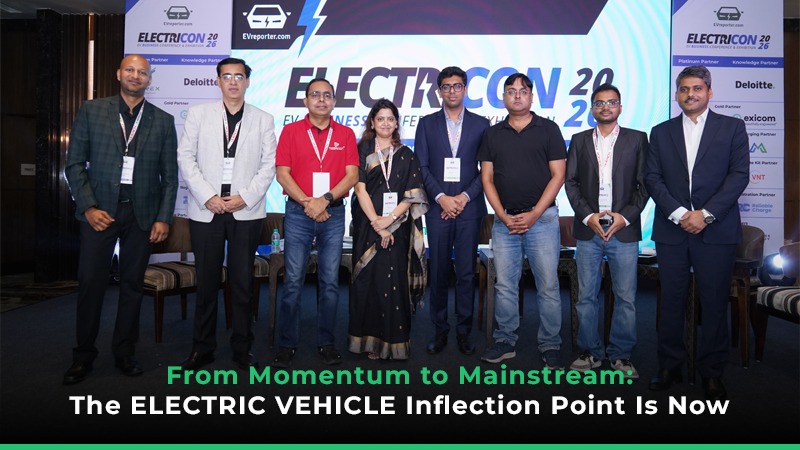
The debates that once dominated Indian EV industry forums — will EVs work, will consumers adopt them, will the infrastructure keep up — have been replaced with a far more consequential set of questions: Can the ecosystem deliver reliably at scale? And is India ready to convert a geopolitical crisis into a structural energy transition? At Electricon 2026, EVreporter brought together six practitioners building this transition from the inside. Moderated by Preetesh Singh, the conversation moved across the full EV value chain.
What emerged was an industry taking honest stock of itself — acknowledging reliability gaps while quantifying progress, and recognising that the West Asia crisis has done in months what policy alone could not: made electrification a commercial imperative, not an environmental aspiration. Our key takeaways are presented in this write-up.
Reliability Is Not One Thing
The conversation opened with a challenge to one of the industry’s most overused words. Arth Patel of Tirex gently pushed back on how casually the term “reliability” gets thrown around. For him, it operates at three distinct levels — the company, the product, and the service.
Charging infrastructure is a long-term commitment. The charger installed today is expected to last 10 to 12 years. Patel pointed to instances where companies entered the charging space and exited within a year, leaving their installed base without support. At the product level, reliability is how well a charger works. Are the internal components actually rated for the charger’s stated output? Patel noted that this is a common gap. At the service level, reliability is measured by turnaround time and repair speed when issues arise. He also discussed a metric that is beginning to gain traction in the industry: success rate — how many attempts does a user need before charging actually begins.
Anshuman Divyanshu of Exicom stressed the importance of internal R&D competence and recognised that the ability to identify failures quickly and course-correct is what R&D investment ultimately buys. Companies that do not invest in R&D will find themselves unable to meet the demands of a market that is accelerating rapidly.
Who Is Responsible When A Charging Session Fails?
Kartikey Hariyani of ChargeZone was unequivocal – The CPO is responsible. The CPO’s name is on the charger, and the customer’s trust is placed there. He further added that ChargeZone call centre agents are trained to remotely take over and resolve issues in real time. And if it cannot be fixed, the team will guide the customer to a competitor’s charger to ensure they get the charge.
Hariyani also rejected the idea that customers need to be educated about charging. The analogy he used was ICE: nobody needs to understand how a diesel engine works to refuel a car. The same standard should apply to EV charging. The industry’s job is to make the experience seamless — through innovations like auto-charge and plug-and-charge — not to train users to navigate its shortcomings.
The Fleet Economics Conversation
The panel then shifted to the commercial vehicle segment, where the economics of electrification are increasingly compelling — but where execution complexity is also highest.
Sandeep Gambhir of Vertelo described their model that goes well beyond conventional financing. Vertelo engages fleet operators from the moment they begin considering electrification — helping them build the business case, identify the right asset, and structure their approach before an invoice even exists. Once funded, Vertelo manages the entire depot ecosystem: land, grid connectivity, energy supply, OEM servicing, battery replacement, and end-of-lease lifecycle. The operating lease model serves two purposes: it takes ownership risk off the operator’s balance sheet, and it transfers the uncertainty of a still-maturing asset class to a party better equipped to manage it.
On TCO assumptions, Gambhir was candid about the limits of early projections. The most important variable is battery life, and real-world data is beginning to revise earlier assumptions. Fleets funded by Vertelo have logged 6 lakh kilometres over 3 years with batteries still at 91% state of health. Delaying battery replacement significantly improves operator IRR. Renewable energy integration can reduce energy costs by ₹2–3 per kilometre — far more impactful than negotiating marginal improvements elsewhere in the TCO. For large-format trucks running more than 300 kilometres a day, or buses running 500 kilometres a day, he said there is no reason not to go electric — it pays for itself.
Alpna Jain of Drivn framed the operator’s perspective with equal clarity. The intercity bus market is still 85–90% diesel. An EV operator with operating costs of approximately ₹35 per kilometre has a cost advantage over diesel at around ₹50 per kilometre. A saving of ₹15 per kilometre across 2 lakh kilometres a year translates to ₹30 lakh in annual savings — enough to recover the premium paid for the EV asset within roughly three years.
The diesel asset gets churned after five years. The EV asset, if battery life is well managed, can run productively for 10 to 12 years. Making that longer runway predictable — through financing structures, AMC coverage, and battery replacement warranties — is what determines the tenure of financing that can be obtained. On large-format trucks running more than 7,000–8,000 kilometres a month, she said payback is 2.5 to 3 years, with contracts of 7 to 8 years viable at freight pricing equivalent to diesel. Kartikey Hariyani added that 6-year leases on large-format commercial vehicles are increasingly viable and attractive for both operators and their customers.
Two-Wheelers and the Standardisation Gap
Jyotiranjan Harichandan of Bolt.Earth brought the 2Ws and 3Ws segment into focus — the category with the highest EV penetration in India. The TCO case here was settled as far back as 2022. What remains unresolved is access to fast charging away from home.
Bolt.Earth has deployed 500–600 chargers, serving 80,000 to 1,00,000 unique users every month. Delivery and gig workers account for 25–30% of utilisation. The majority, 60–70%, is coming from Tier 2 and 3 cities, where daily commuters travel longer distances and need top-up charging away from home. Network density, he observed, directly correlates with utilisation: as more chargers go in, usage skyrockets.
The connector standardisation problem, however, remains unresolved for two and three-wheelers. The government has published standards but has not mandated them. He drew a parallel with USB-C: nobody today asks whether a phone needs an iPhone or Android charger, because the standard was mandated. The same clarity is needed for 2W and 3W charging connectors. Harichandan also noted that Bolt.Earth is working with additional OEMs to expand brand compatibility, with launches expected in the next two quarters.
The Recent West Asia Crisis That Changed the Conversation
The panel closed with a question about the West Asia oil crisis and what it means for EV adoption. The responses were unified.
Sandeep Gambhir: “The future became the present. The war did what the government was trying to do for years.”
Kartikey Hariyani: “The inflection point just went by in February–March. Electrification is an irreversible process now. It is no longer a choice.”
Alpna Jain: “The motive to go electric is no longer sustainability — it is commercial. What a time to be part of this.”
Arth Patel: “Energy independence has become a massive focus for every country. The future is not coming — it is already here.“
Anshuman Divyanshu offered a measured note. The opportunity is real, he said, but it also places responsibility on every stakeholder to deliver on their promises in a fair and transparent manner. Short-term gains pursued by any part of the ecosystem could discourage adoption just as it reaches its most critical stage.
Harichandan ended with a personal story. His father, in Bhubaneswar, waited six hours in a petrol queue and came away with only ₹1,500 worth of fuel. That evening, he called his son and asked him to find nearby locations for placing EV chargers. “I always thought Odisha would be late to the EV party,” Harichandan said. “I think that has changed.”
This article was first published in EVreporter July 2026 magazine.
Subscribe & Stay Informed
Subscribe today for free and stay on top of latest developments in EV domain.