The Invisible Stack — data, diagnostics, and charging infrastructure will make or break India’s EV future

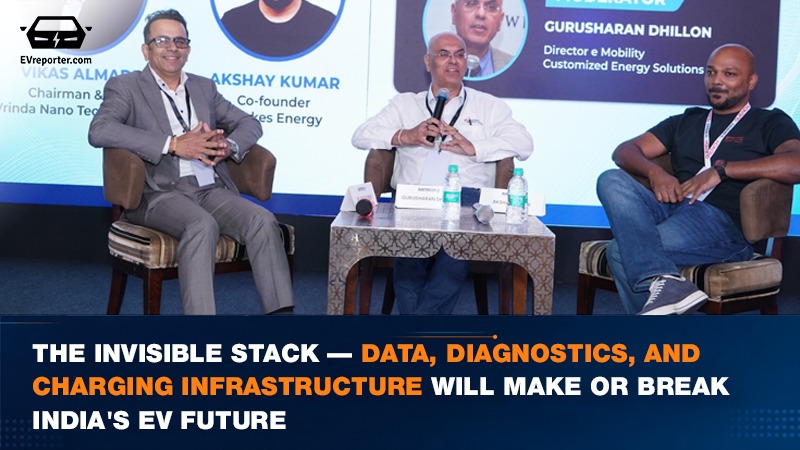
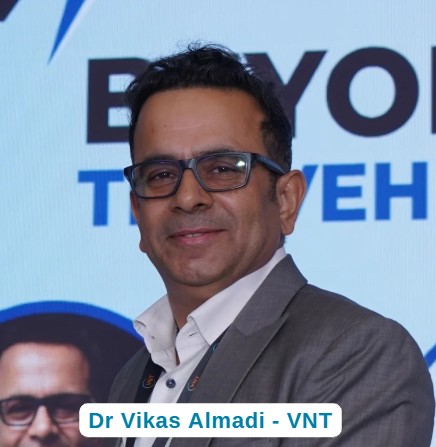
At Electricon 2026, the fireside chat titled Beyond the Vehicle: Technology Stack for Reliable EV Operations brought together two practitioners working at two ends of the EV ecosystem. Akshay Kumar, co-founder of Fawkes Energy, is building the intelligence layer that tells you what’s really happening inside a battery. Dr Vikas Almadi, founder and chairman of Vrinda Nano Technologies (VNT), is engineering the hardware that keeps vehicles charged and running in some of India’s harshest environments. Moderated by Gurusharan Dhillon, the conversation moved into unglamorous but critical territory of data ownership, degradation science, charger reliability, and the infrastructure choices that will determine whether India’s EV transition delivers on its promise.
Charger utilisation and real-world reliability
Public car chargers in India are severely underutilised — sometimes only a few hours a day or week — meaning they’ve never been truly stress-tested for endurance or temperature in the real world.
Coming from the telecom energy sector, where chargers run 24×7, VNT deliberately pivoted to electric buses and trucks, where charger utilisation runs much higher than e-4W charging points, providing real-world reliability validation. The company has deployed chargers in coastal areas and dusty mining environments. After 3 years of deployment in these conditions, chargers still perform at ~96.7% efficiency, equivalent to a new unit.
Electrification in mining sector
Mining is a high-potential sector for EVs, especially in Odisha, Andhra Pradesh, and Tamil Nadu. VNT is currently the only company supplying chargers in mining environments. Key solutions include totally sealed, liquid-cooled chargers with advanced thermal management and customised filtration. An interesting advantage in deep mining: regenerative braking while vehicles descend contributes to battery charging. However, IEC/BIS standards don’t currently capture the high-reliability requirements of mining applications — VNT is going beyond standards.
Serviceability in remote mining locations
Mining sites have no telecom network, making standard remote service approaches unviable. VNT is deploying specialised service teams distinct from their telecom network service teams. Uptime is non-negotiable in this environment, as vehicles return to chargers multiple times a day.
Future of charging capacity
Battery capacities are increasing even within similar physical form factors, driving a need for higher-capacity chargers. Dr Almadi predicts that 30 kW and 60 kW DC chargers will become obsolete. The future is a charging hub model — analogous to a petrol pump — with a centralised power unit and multiple dispensers that can dynamically and intelligently shift power between guns based on real-time vehicle load requirements. This architecture allows capacity to scale without replacing entire charger units. Any vehicle type (car, truck, bus) should be serviceable from a single hub.
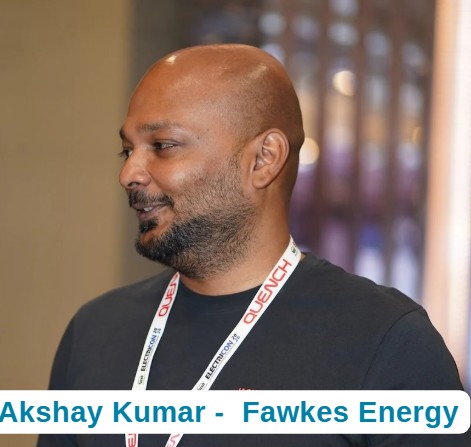
Fawkes Energy builds intelligence infrastructure for battery assets across their lifecycle. Using a combination of physics-based modelling and data-driven models, they predict State of Health, Remaining Useful Life, detect anomalies, and deliver predictive analytics — helping make batteries reliable, predictable, and financially bankable assets. The goal is to reduce fleet downtime and cut servicing and maintenance costs by 40–50%.
Why batteries are hard to diagnose
Unlike fuel tanks with a direct float sensor, batteries don’t give direct signals of internal state. Only indirect signals of voltage and temperature are observable, making capacity estimation complex. True capacity assessment requires understanding lithium loss and deep electrochemical behaviour layered with data signals and contextual usage patterns. Most onboard BMS algorithms are rudimentary and rule-based, and their capacity readings are often inaccurate.
Value delivered to fleet operators (key case study)
Working with a large 3W fleet company (~20,000 assets), Fawkes identified 3,000 battery issues over 8 months, of which ~30% were false positives from the BMS — causing unnecessary downtimes and significant cost. Their continuous monitoring algorithms helped eliminate these false alarms and improved asset uptime.
Data ownership in India – There is currently no legal framework governing data ownership in the EV space — whoever has access to data effectively controls it. OEMs tend to be resistant to sharing data. Fawkes navigates this by working through financiers/insurers (who have leverage over OEMs), partnering with telemetry players who have OEM data access, and building models that work at varying levels of data fidelity (e.g., pack-level vs. cell-level).
Desired enablers for growth
- Charge Point Operators — Charging session data can be used to build powerful battery health models, making CPO partnerships highly valuable.
- BMS manufacturers — Fawkes wants to embed their algorithms as a firmware/SDK layer on top of BMS hardware, enabling edge-level insights without full cloud dependency. They are looking to partner with Indian BMS makers, given the government’s push for BMS localisation.
Fireside chat moderated by Gurusharan Dhillon (Director e-Mobility – Customized Energy Solutions) at Electricon 2026.
This article was first published in EVreporter June 2026 magazine.
Also read: Battery360 Alliance presents emerging battery technologies
Subscribe & Stay Informed
Subscribe today for free and stay on top of latest developments in EV domain.