Battery360 Alliance presents emerging battery technologies

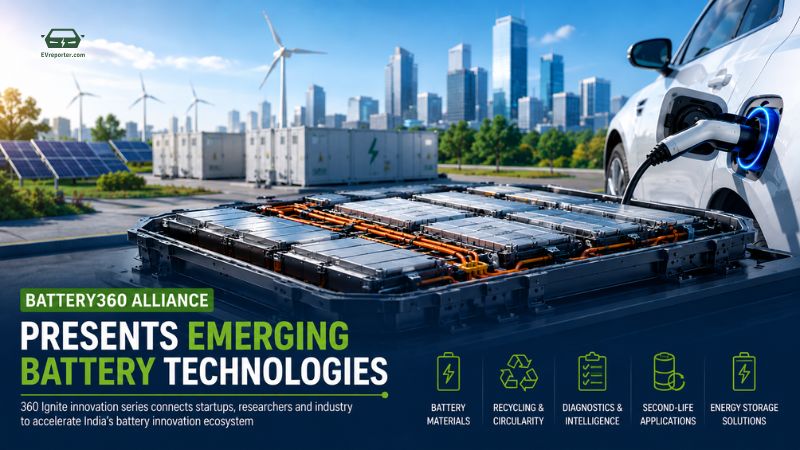
The Battery360 Alliance, a multi-stakeholder platform focused on India’s battery ecosystem, recently conducted “360 Ignite,” a three-city innovation series aimed at connecting early-stage battery technologies with deployment opportunities through the Alliance’s network of more than 80 partners.
The programme was organised in partnership with the Department of Energy Science and Engineering at Indian Institute of Technology Delhi and the Bengaluru Science and Technology Cluster at Indian Institute of Science for the Delhi and Bengaluru editions. The events featured participation from 23 startups, university teams, and early-stage companies presenting technologies related to battery materials, energy storage technologies, diagnostics, recycling, circularity, and second-life applications. The final edition is scheduled to be held in Mumbai on 20 May at D. J. Sanghvi College of Engineering.
The three editions are intended to provide visibility to early-stage battery technologies and support their technical development and commercial deployment within India’s battery ecosystem. Six organisations were selected by a jury comprising industry experts and investors to advance to “The Battery Summit 2026,” scheduled for 16 June 2026 at The Ashok.
The selected organisations are:
- Feynman Energy, developing cobalt-free LMFP cathode materials using a single-step manufacturing process.
- GridXenergy, developing a battery-swapping platform designed for compatibility across EV systems and charging networks.
- Deep Valley, working on second-life battery intelligence systems for electric mobility applications, including battery-as-a-service solutions for e-rickshaw users.
- Meine Electric, developing iron-air battery systems for renewable energy storage applications.
- Fawkes Energy, developing battery analytics tools focused on diagnostics, degradation monitoring, and lifecycle management.
- JOL Energy, developing recycling technologies for recovery of lithium, cobalt, nickel, and manganese from battery waste streams.
R Anantharaman, CEO, Bengaluru Science and Technology Cluster – an initiative of the Office of the Principal Scientific Adviser to the Government of India said, “India has no shortage of scientific talent or promising battery innovations. The real challenge is creating stronger bridges between research, industry and commercialisation. Platforms like Battery360 Alliance are important because they help early-stage technologies access the partnerships, validation and market pathways needed to move from the lab to deployment. Bengaluru’s deep innovation ecosystem is uniquely positioned to support this transition and accelerate the growth of India’s battery sector.”
Pawan Mulukutla, Executive Program Director, Integrated Transport, Clean Air and Hydrogen at WRI India, “India’s battery transition will require stronger ecosystems for collaboration. Platforms such as the Battery360 Alliance and convenings like 360 Ignite are important for bringing together researchers, startups, industry, investors and policymakers to share knowledge, build partnerships and accelerate promising solutions. We congratulate the winners and look forward to seeing these innovations contribute to a more resilient and circular battery ecosystem in India.”
According to the organisers, India’s battery demand is projected to reach 160 GWh by 2030, driven by growth in electric mobility and energy storage applications. Lithium-ion battery imports increased from $384 million to $3.3 billion by October 2025. Government initiatives related to the sector include the ACC PLI scheme, viability gap funding for battery energy storage systems, and the R&D Innovation Fund for deep-tech innovation.
The organisers referred to research by WRI India stating that academic institutions and research laboratories in India are primarily focused on early-stage technology readiness levels (TRL 1–4), while industry participation is concentrated at later stages (TRL 7–9). The organisers stated that the gap between TRL 4 and TRL 7 is often referred to as the “Technological Valley of Death,” where technologies may face challenges related to funding, industry partnerships, and commercialisation pathways for emerging technologies. According to the organisers, the 360 Ignite series was launched to help address this gap by connecting innovators with academia, industry, investors, and deployment opportunities.
Also read: Tata Technologies presents WATTSync platform for India’s Battery Aadhar Framework
Subscribe & Stay Informed
Subscribe today for free and stay on top of latest developments in EV domain.