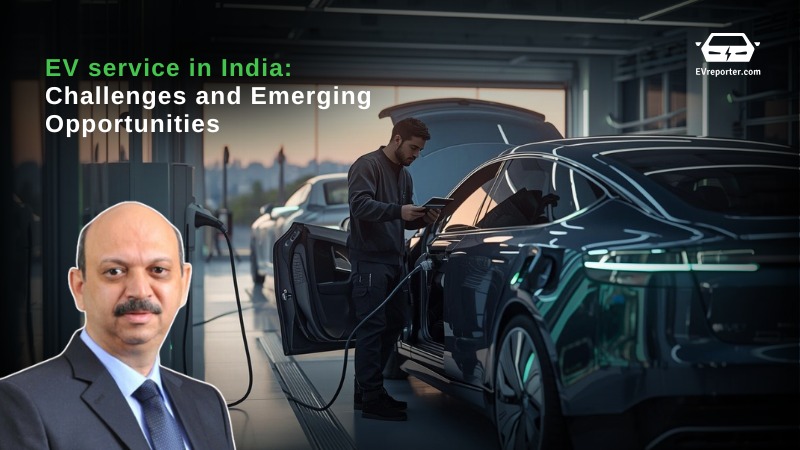
EV service in India: Challenges and emerging Opportunities

India’s automotive landscape is undergoing a transformative shift as electric vehicles (EVs) rapidly penetrate the market across all vehicle categories. While manufacturing capacity and consumer adoption have received considerable attention, the service ecosystem, a critical enabler of sustainable EV growth, remains underdeveloped and fragmented. This article by Alok Kapoor examines the current state of EV service infrastructure, identifies capability gaps, and explores emerging trends that will shape India’s aftersales service sector through the remainder of this decade.
The urgency of this discourse cannot be overstated. India sold over 2 million electric vehicles in 2024, with the penetration rate accelerating. Yet the service infrastructure lags far behind demand, creating a looming crisis that threatens customer confidence and the sustainability of EV adoption. Unlike traditional internal combustion engine (ICE) vehicles, where an extensive network of roadside mechanics and service centres evolved organically over a century, EV servicing requires specialized knowledge, infrastructure, and equipment that are currently scarce across India’s vast landscape.
The EV Penetration Story: Faster-Growing Categories
India’s EV market has demonstrated remarkable resilience and growth, particularly in urban and semi-urban segments. However, this growth is highly skewed across vehicle categories, with two-wheelers and three-wheelers leading the charge.
Two-Wheeler and Three-Wheeler Dominance: Two-wheeler electric vehicles have become the mass-market segment for EV adoption in India. In FY 2024-25, e-two-wheelers accounted for 59.4% of total EV sales, representing 1.15 million units with a year-on-year growth of 21.2%.
The three-wheeler segment has emerged as the most electrified vehicle category in India, with e-three wheelers capturing 29.7% average monthly penetration in 2025 (January-August), a substantial increase from 18.2% in the same period of 2024. This segment saw 1,22,794 units registrations between January and August 2025 alone. E-three-wheelers represent the optimal use case for electrification, predictable daily usage patterns, fixed charging infrastructure at terminal points, significantly lower operational costs, and strong economic incentives for fleet operators.
Four-Wheeler Expansion: While four-wheelers remain a smaller segment in India’s overall EV market, they are experiencing accelerated growth. Electric passenger vehicles crossed the 100,000-unit milestone with 18.2% growth, indicating that premium and mid-segment consumers are increasingly adopting EV technology. This category is expected to drive the next wave of service infrastructure development, particularly in metropolitan areas and affluent consumer hubs.
Strategic Observation: The differential adoption rates across categories reflect end-use suitability and cost sensitivity. Two and three-wheelers demonstrate faster electrification because they operate in high utilization scenarios where battery costs amortize quickly through operational savings. This pattern has significant implications for service infrastructure planning: the service needs of a two-wheeler operator differ fundamentally from a four-wheeler owner.
EV Service Infrastructure: The Critical Gap
While manufacturing has scaled and consumer adoption has accelerated, the physical and human infrastructure required to service these vehicles remains inadequate and geographically fragmented.
Current Infrastructure Landscape: India’s EV charging infrastructure, the most visible component of the service ecosystem, has expanded from 1,800 public chargers in early 2022 to over 16,000 by November 2025. This represents an approximate nine-fold increase in just three years, a remarkable achievement. However, this expansion is misleading when viewed against actual demand. Projections suggest that India will require nearly 1.32 million charging stations to support an estimated 50 million EVs on roads by 2030. Based on current trajectories, we are tracking toward less than 2% of the required infrastructure by 2030. The distribution of charging infrastructure is severely skewed toward metropolitan areas. Cities like Delhi, Mumbai, and Bangalore lead deployment, while northeastern and remote regions face acute infrastructure scarcity. This urban-centric development pattern creates a critical vulnerability: two and three-wheelers, which dominate EV sales in India, are often used in semi-urban and rural markets with minimal charging infrastructure.
Service Centre Availability: Beyond charging infrastructure, the availability of dedicated EV service centres remains limited. Traditional dealership networks, which form the backbone of passenger vehicle aftersales service, are slowly transitioning to provide EV-specific services. However, this transition is incomplete. Many independent service providers, the lifeline of the two and three-wheeler service ecosystem, lack the technical capabilities, equipment, and certifications to service modern EVs. Government charging stations operate at approximately 72% uptime compared to the required 97% standard, primarily due to shortages of trained maintenance personnel. This operational deficit reflects deeper systemic issues: insufficient skill development, unclear career progression pathways, and inadequate compensation for specialized EV technicians.
Infrastructure Requirements for Key Service Functions – EV service infrastructure requirements diverge significantly from ICE vehicle servicing. The critical infrastructure components include:
- High-voltage DC charging stations (7kW to 350kW capability) with smart grid integration and real-time diagnostics
- Battery diagnostic and thermal management systems for identifying state-of-health (SoH) degradation
- Motor and power electronics repair capabilities with oscilloscopes, thermal cameras, and battery testing equipment
- Software diagnostic systems linked to OEM platforms for firmware updates and performance optimization
- Battery swapping facilities (for commercial vehicles and standardized platforms)
- Thermal management stations for battery cooling, particularly critical in India’s hot climate zones.
Most service centres in India currently lack even half of these capabilities. The capital investment required to establish a fully equipped EV service centre ranges from INR 50-100 lakhs for a basic centre to 2+ crores for a comprehensive facility. This capital barrier has deterred independent service providers from upgrading their infrastructure, creating a service void that is only partially filled by OEM-authorized dealerships.
Specialized Service Needs: Battery, Charging, and Powertrain
The shift from ICE to EV technology has fundamentally transformed the nature of vehicle failures and maintenance requirements.
Battery Management from Replacement to Reconditioning: In ICE vehicles, battery failures are relatively rare and typically result in straightforward replacement. In EVs, battery diagnostics and health monitoring form a continuous service function throughout vehicle ownership. EV batteries degrade predictably, losing approximately 2-3% capacity annually under normal operating conditions. However, premature degradation can occur due to thermal stress, incomplete charging cycles, high-ambient temperature exposure, or manufacturing defects. Indian climatic conditions, particularly in regions like Rajasthan, Gujarat, and parts of South India, accelerate thermal degradation, making battery health monitoring a critical service function.
The service needs include:
- Battery state-of-health (SoH) diagnostics: Regular monitoring to assess remaining capacity and performance degradation
- Thermal management: Active cooling systems that maintain optimal battery operating temperatures
- Cell balancing and recalibration: Software-based optimization to equalize charge distribution across cells
- Module replacement: Replacing failed modules rather than entire battery packs, extending vehicle life
- Repurposing and second-life applications: Extracted batteries with 70-80% capacity can be repurposed for stationary energy storage
Currently, most service providers in India lack the diagnostic equipment and software access to perform these functions. Battery diagnostics typically require connection to OEM systems, creating service dependency and limiting the emergence of independent multi-brand service providers.
Charging Infrastructure and Standardization: The explosive growth of charging infrastructure has created a fragmented ecosystem with multiple connector types, charging protocols, and payment systems. As of 2025, India has yet to fully standardize on universal charging connectors and interoperable payment
systems, creating consumer friction and complicating service provider operations.
Service needs related to charging include:
- On-site charger installation and certification at consumer residences and commercial locations
- Troubleshooting intermittent charging failures arising from software mismatches or power quality issues
- DC fast-charging station maintenance, including cooling system upkeep and power conversion equipment
- Charging port replacement and connector standardization as vehicles age
- Grid integration and load management: Managing peak demand periods to prevent local grid stress
The proliferation of charging station operators (Ather, Fortum, Exicom, Raise, Shell Recharge, and others) each with proprietary systems has created a fragmented service landscape. A customer experiencing charging issues may require support from the vehicle OEM, the charging network operator, the electrical infrastructure provider, or a combination of entities. This fragmentation creates service delays and customer dissatisfaction.
Powertrain and Power Electronics – Unlike ICE vehicles, which have proven maintenance protocols refined over decades, EV powertrain servicing remains in its infancy in India. Power electronics, the inverter, DC-DC converter, on-board charger, and battery management system (BMS), represent the most failure-prone components in an EV after the battery. Service requirements include:
- Motor winding diagnostics and replacement: AC synchronous and permanent magnet synchronous (PMSM) motors require specialized equipment for testing
- Inverter troubleshooting and reprogramming: Power conversion failures require deep electronics expertise
- Thermal management of power electronics: Many power electronics failures result from inadequate cooling in high-ambient conditions
- Software updates and recalibration: Regular firmware updates improve efficiency and address performance issues
- Brake fluid and cooling system servicing: While appearing similar to ICE vehicles, EV cooling and brake systems operate under different thermal profiles
Few independent service providers in India currently possess the expertise to diagnose power electronics failures beyond component replacement. This limitation forces customers to rely entirely on OEM service centres, creating bottlenecks and extended service lead times.
The Skill Deficit: An Existential Threat
India faces an acute and expanding shortage of skilled EV service technicians. According to the Society of Indian Automobile Manufacturers (SIAM), India will require between 100,000 to 200,000 skilled EV professionals by 2030, spanning manufacturing, assembly, after-sales service, and charging infrastructure maintenance. Current training capacity falls dramatically short of this requirement.
Magnitude of the Skill Gap: India’s current skilling infrastructure for EVs is woefully inadequate. Approximately 523 automotive training centres across India offer automobile-related courses, with a combined capacity of roughly 54,000 students. Of this capacity, fewer than 40 job roles address EV-specific competencies, and only 8 out of 34 apprenticeship courses focus on EV and charging infrastructure technologies. Even accounting for rapid expansion in private training institutions, current output is unlikely to exceed 15,000-20,000 trained EV technicians annually, a fraction of the requirement. The skill deficit impacts both the quality and availability of service: maintenance personnel shortages at government charging stations result in 72% uptime, below the required 97% standard.
Roadside mechanic uncertainty: Traditional mechanics, who form the backbone of after-sales support in two-wheeler and three-wheeler segments, lack confidence to service EVs due to perceived complexity.
Technician attrition: Service providers in the EV sector experience high attrition among mechanics due to low income, lack of transparent career progression, and insufficient technical recognition compared to ICE vehicle specialists.
Nature of Required Competencies: EV service technicians require a fundamentally different skill set compared to traditional automotive mechanics:
- High-voltage electrical safety: Understanding and working safely with battery systems operating at 400V-800V
- Battery chemistry and thermal management: Knowledge of lithium-ion cell behavior, thermal runaway risk, and active cooling systems
- Power electronics and signal processing: Troubleshooting inverters, DC-DC converters, and motor controllers
- Software diagnostics and programming: Familiarity with diagnostic tools, firmware updates, and OEM telematics platforms
- Mechanical systems adaptation: Understanding how traditional systems (cooling, braking, suspension) function differently in an EV context
These competencies span electrical, electronics, software, and mechanical domains, a breadth that far exceeds traditional automotive mechanic training. Few technical institutions in India offer comprehensive curricula addressing all these domains.
Government and Industry Response: The Government of India has recognized this imperative, incorporating EV-focused green jobs in its national skill development agenda. However, implementation remains fragmented. Partnership models, such as linking government training centres with OEMs and leading EV companies for curriculum development and placement. have emerged but remain ad-hoc rather than systematic. Progressive companies like Tata Electric, Ather Energy, Bajaj, and others are investing in proprietary training programs for their authorized service centres. However, this fragmented approach creates a two-tier service ecosystem where OEM-authorized centres have trained technicians while independent providers remain under-skilled. This dynamic will likely intensify consolidation pressure, potentially reducing service competition and consumer choice.
Shifted Customer Expectations and Service Behaviour in the EV Era
EV ownership has introduced fundamentally different customer behaviours and service expectations compared to traditional ICE vehicles.
Predictability and Reduced Maintenance Dependency: ICE vehicle owners have trained themselves to expect regular maintenance cycles: oil changes, filter replacements, transmission servicing, and seasonal inspections. This maintenance culture emerged because ICE systems inherently degrade through combustion byproducts, mechanical friction, and thermal cycling.
EV owners, conversely, expect significantly reduced maintenance needs. Regenerative braking systems eliminate traditional brake pad replacement. No oil changes are required. No transmission servicing is necessary. The absence of high-frequency maintenance cycles creates a psychological shift: EV owners view their vehicles as “maintenance-lite” products and resent service recommendations they perceive as unnecessary. This expectation paradox creates service challenges: while routine maintenance is reduced, diagnostic monitoring becomes more critical. EV owners need regular battery health checks, software updates, and cooling system inspections, but these services lack the tangibility of traditional maintenance. Service advisors struggle to justify these interventions to customers accustomed to binary maintenance (broken/working) paradigms.
Charging-Centric Service Anxiety: For two and three-wheeler owners, charging access is inextricably linked to vehicle usability. Unlike fuel vehicles, where a customer can refuel at any station, EV owners face infrastructure fragmentation and charging anxiety. When a customer cannot charge their vehicle due to faulty home charger, non-functional public charger, or app-based access issues, they perceive this as a service failure, even if the vehicle itself functions perfectly.
This creates a service expectation that traditional dealerships are ill-equipped to manage: owners expect seamless integration between vehicle systems, charging infrastructure, payment platforms, and telematics services. Service centres must now address issues spanning hardware (chargers), software (apps), and network operations (charging operators). domains that extend far beyond traditional automotive service.
Digital Connectivity and Service Transparency: EV owners, typically early adopters of technology, expect digital engagement. Real-time battery health dashboards, predictive maintenance alerts, remote diagnostics, and transparent service tracking are now baseline expectations rather than premium features. Service centres that lack digital infrastructure, the majority of Indian service providers, find themselves unable to meet these expectations. Moreover, EV owners use digital platforms (social media, online reviews, manufacturer forums) to compare service experiences and share satisfaction metrics. Negative service experiences propagate rapidly, damaging brand perception and creating reputational pressure on service networks.
Multi-Brand Service Preferences: Unlike ICE vehicles, where brand loyalty in after-sales service is relatively stable, EV owners show higher propensity to shift between OEM-authorized and independent service providers.
This reflects:
- Cost sensitivity: EV ownership often correlates with environmental consciousness and budget awareness, driving price-sensitive service purchasing
- Geographic convenience: With limited OEM service centres, customers pragmatically choose proximity over brand loyalty
- Multi-brand ownership scenarios: As various OEMs proliferate, households may own multiple EV brands, creating demand for multi-brand service expertise
This behavioural shift presents both challenge and opportunity: it threatens OEM-authorized dealer exclusivity but creates market space for emerging independent multi-brand service networks.
The Future of EV Service: Emerging Models and Disruption
India’s EV service landscape is unlikely to stabilize around traditional dealership models. Instead, multiple parallel service delivery models are emerging, creating ecosystem heterogeneity.
Multi-Brand Service Chains: The Startup Opportunity Recognising the market gap, several startups have launched multi-brand EV service networks designed to aggregate demand across vehicle OEMs. Companies like EV Point, EVTech, and emerging regional operators are establishing service centres equipped to handle multiple EV brands using standardized diagnostic platforms and training protocols. These multi-brand models offer competitive advantages:
- Economies of scale: Aggregating service demand across brands enables investment in expensive diagnostic equipment and specialized training
- Geographic distribution: Operating independent of OEM dealer networks allows service presence in underserved markets
- Customer convenience: One-stop multi-brand service reduces customer search and coordination costs
- Pricing transparency: Competition between multi-brand chains introduces price pressure, benefiting consumers
However, multi-brand chains face structural challenges: limited access to OEM proprietary software and diagnostics, difficulty attracting OEM-trained technicians, and working capital constraints. Many incumbent OEMs view independent service networks as channel threats and restrict software access, training support, and parts availability, creating friction that inhibits chain expansion.
Battery Swapping and Modular Service Infrastructure: In commercial segments (three-wheelers and small commercial vehicles), battery swapping, where depleted batteries are exchanged for charged units at battery swap stations, is emerging as a viable alternative to charging infrastructure.
Companies like Sun Mobility, BatterySmart and others are establishing swap networks, fundamentally changing service models. Swapping infrastructure requires different service capabilities:
- Fast charging infrastructure to recharge swapped batteries between cycles
- Battery diagnostics and health monitoring to remove degraded cells before they reach customers
- Logistics and routing optimization to manage battery flow through the network
- Payment and accounting systems to track swaps and manage battery ownership
This modular approach decouples vehicle ownership from battery ownership, creating new service revenue streams and reducing customer charging anxiety. However, swapping requires standardized battery form factors and electrical interfaces, currently absent in India’s fragmented EV ecosystem.
Franchise and Asset-Light Models: Recognizing capital barriers to service centre establishment, several companies are experimenting with franchise models where service expertise is franchised to existing repair shops. This approach transforms traditional mechanics into EV service providers through training, equipment leasing, and diagnostic software access.
Asset-light models reduce capital requirements for service network expansion, enabling rapid geographic coverage. However, quality control and brand consistency remain challenging, particularly given the diverse technical capabilities of India’s existing mechanic population.
OEM-Direct Service Evolution: Leading OEMs, particularly Tesla, Tata Electric, Ola Electric and Ather, are increasingly investing in owned service infrastructure rather than relying on traditional dealership models. This reflects recognition that EV service is fundamentally different and cannot be effectively delivered through existing ICE-trained dealer networks. Direct OEM service offers advantages in brand control and service quality but faces scalability challenges and creates geographic gaps in areas where OEM service presence is sparse.
Converted ICE Vehicles and the Aftermarket Challenge
An emerging phenomenon in India, largely unaddressed by formal service infrastructure, is the retrofitting of conventional ICE vehicles (particularly commercial vehicles) with electric powertrains. This “converted EV” segment represents dozens of startups converting existing truck chassis with electric motors and batteries, creating functional EVs without OEM development costs.
Service Infrastructure Gaps for Converted EVs: Converted EVs face unique service challenges:
- No OEM support: These vehicles lack manufacturer service networks or proprietary diagnostic systems
- Hybrid expertise requirements: Service technicians must understand both the original vehicle architecture and the aftermarket electric conversion
- Spare parts sourcing: Component availability depends on aftermarket suppliers rather than established OEM supply chains
- Warranty and liability ambiguity: Unclear responsibility boundaries between vehicle converters and component suppliers create service friction
The absence of formal service infrastructure for converted EVs creates a market opportunity for independent technicians, but also introduces quality variability and consumer risk.
Replacement Over Repair: The Emerging Service Model
A fundamental shift in EV service economics is driving replacement-over-repair behaviours, diverging from ICE service paradigms. In ICE vehicles, service involves repairing or replacing failed components while retaining the vehicle base. Prolonged vehicle life (often 10-15 years) and amortized vehicle cost justify investment in repair. In EVs, particularly in India’s price-conscious two and three-wheeler segments, the economics often favour component replacement over repair:
- Power electronics failures: Replacing an entire inverter unit (₹30-50K) is often cheaper than troubleshooting and repairing individual components
- Battery module replacement: Rather than complex battery cell-level repairs, replacing entire modules is more economical
- Motor replacement: Rewinding or repairing failed motor windings is labour-intensive; replacement is often preferable
- Charging port replacement: Rather than complex connector repairs, replacement is the standard practice
This replacement-centric model reflects manufacturing costs, technician skill constraints, and economic incentives. However, it creates environmental challenges (e-waste generation) and sustainability concerns that conflict with the environmental rationale for EV adoption. The emerging service model prioritizes rapid vehicle return-to-service over component longevity, reflecting utilization economics in commercial (two and three-wheeler) segments where uptime directly impacts operational revenue.
Critical Success Factors for EV Service Ecosystem Development
Establishing a mature EV service ecosystem in India requires coordinated action across multiple stakeholders:
Standardization and Interoperability: National standards for charging connector types, battery interfaces, and diagnostic protocols are foundational. India’s current fragmentation, where multiple proprietary systems coexist, creates systemic inefficiency. Mandated standardization, aligned with global standards (CCS2, IEC 62196), would enable rapid service network scaling and reduce consumer friction.
Skills Development at Scale: Government and industry must dramatically expand training infrastructure. This requires:
- Curriculum modernization in 500+ automotive training centres to incorporate EV-specific modules
- Technician compensation improvements to attract talent toward EV specialization
- Career pathway clarity connecting training investments to transparent advancement opportunities
- Industry-education partnerships linking training institutions with OEMs and service operators for quality assurance and placement. Target: Training 20,000+ EV-ready technicians annually by 2028.
Regulatory Clarity and Service Standards: Government-mandated service standards for EV diagnostics, battery safety, and charging infrastructure would establish floor standards and accelerate professionalization of the service sector. Certification requirements for EV technicians and service centres, currently voluntary, should be formalized.
Capital Mobilization for Service Infrastructure: Government incentive schemes (similar to FAME II for charging infrastructure) should extend to EV service centre establishment, particularly in underserved markets. Tax incentives, accelerated depreciation, and concessional financing for service centre investment would reduce capital barriers for independent providers.
Software Access and Data Democratization: OEMs should be incentivized to provide diagnostic software access to certified multi-brand service providers, enabling competition while maintaining safety and quality standards. Data access, particularly battery health data and vehicle diagnostics, should be made available to vehicle owners and authorized service providers, reducing information asymmetries.
Conclusion
India’s rapid EV adoption has outpaced the development of service infrastructure, creating a crisis that
threatens the sustainability of the EV transition. The state of EV service in India today is characterized by:
- Chronic infrastructure scarcity: Fewer than 20,000 public charging points for millions of vehicles
- Skill deficits: Acute shortage of trained EV technicians and service providers
- Fragmentation: Multiple proprietary systems, charging standards, and service models co-existing without interoperability
- Economic volatility: Service costs remain unpredictable due to lack of standardization
- Geographic inequality: Service availability is concentrated in metropolitan areas, leaving semi-urban and rural markets underserved
Simultaneously, significant opportunities are emerging:
- Startup innovation: multi-brand service chains, battery swapping networks, and asset-light franchise models are challenging traditional service paradigms
- Customer demand: EV owners’ expectation of reduced maintenance and seamless digital integration are driving service model evolution
- Converted EV growth: Aftermarket electrification creates service demand that established dealers cannot meet, opening space for independent providers
- Government support: FAME II and emerging state-level incentives are creating enabling conditions for infrastructure investment
The future of EV service in India will likely involve a heterogeneous ecosystem of OEM-authorized centres (providing premium brand-aligned service), multi-brand independent chains (offering competitive pricing and geographic coverage), specialized swap/charging infrastructure operators, and adaptive traditional mechanics (transitioning to EV competencies through training and partnerships). Success requires unprecedented coordination between government agencies (for standardization and skill development), OEMs (for software access and training support), startups (for innovation and market competition), and existing service providers (for adaptation and upskilling).
The stakes are high: inadequate service infrastructure will dampen EV adoption precisely when environmental imperatives demand accelerated electrification. India’s EV service challenge is not primarily technical, the technologies required are globally proven. Rather, it is an organizational and institutional challenge: scaling coordination mechanisms, standardizing fragmented systems, and mobilizing capital and human resources toward ecosystem development. The next 3-5 years will prove decisive in determining whether India’s EV promise is fulfilled or constrained by inadequate after-sales support.
About the author

Alok Kapoor has 35 years of experience, mostly in Automotive Marketing, Servicing and EV Manufacturing with majors like Greaves, Mahindra, Mitsubishi Motors, Escorts & TAFE.
He gained diverse functional experience while working in Production, Projects, Sales, Service, Marketing, Network Development and Operations at various levels, including his tenures as Head-Franchise Business at Mahindra First Choice Services and CEO & Director at one of Greaves Group company.
He was also involved in the development of ‘Service Excellence Academy’ at the Mahindra Leadership University. Earlier in his career at Mitsubishi Motors, he spearheaded the creation of the iconic Pajero CRZ & Pajero SFX variants.
By educational qualification, he is a Mechanical Engineer from Govt. Engineering College, Jabalpur. He has undergone Business Leadership MDP at IIM, Ahmedabad.
Contact: alok.kap@gmail.com, LinkedIn, Cell: +91 9619605542
Also read: The technology’s biggest shifts coming to EV powertrains by 2030
Subscribe & Stay Informed
Subscribe today for free and stay on top of latest developments in EV domain.