Powering Quick Commerce EV fleets with Predictable Battery Behavior: Q&A with EMO Energy


As quick commerce scales, the demand for reliable, high-utilisation EV energy systems is increasing. In this interview, Sheetanshu Tyagi, Co-founder & CEO of EMO Energy, explains how the company is building an integrated energy ecosystem for last-mile delivery, focusing on uptime, battery life, and data-driven fleet management.
What parts make up the overall solution that Emo Energy provides to quick commerce hubs?
EMO Energy delivers a fully integrated energy solution purpose-built for high-utilisation, last-mile logistics like quick commerce. At a system level, our solution has three tightly integrated layers:
- Vehicles powered by EMO battery systems: We work with leading OEMs to integrate our battery packs into electric two-wheelers used for high-frequency delivery operations.
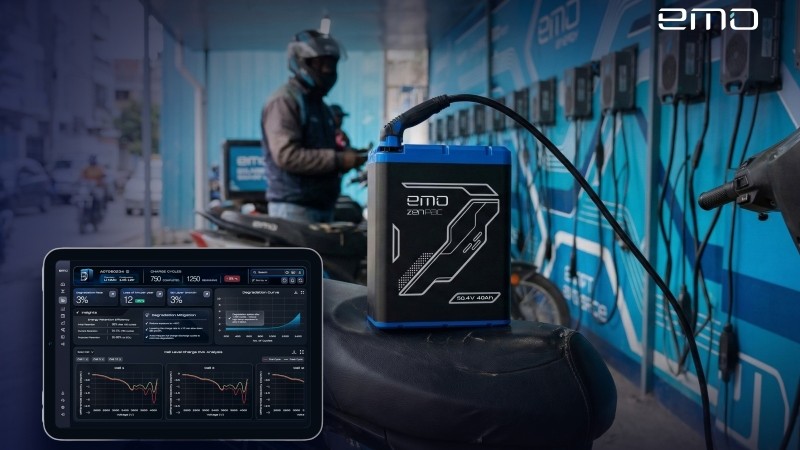
- Fast-charging infrastructure: Our chargers are designed for high-utilisation environments, enabling rapid top-ups (typically ~5 minutes) that align with delivery downtime rather than forcing long idle periods.
- Energy intelligence layer – SENS: This is our proprietary software stack that sits on top of the hardware. SENS continuously monitors cell behaviour, predicts degradation pathways, and dynamically optimises charging and discharging in real time.
What differentiates EMO is that we don’t treat these as separate components; we operate them as a single, orchestrated energy system. This allows us to optimise for uptime, lifecycle cost, and predictability simultaneously, which is critical for quick commerce operators running dense fleets.
Can you share EMO Energy’s current scale of operations in Bangalore and Gurugram?
Across Bangalore and Gurugram, EMO Energy currently has over 15,000 battery packs deployed in active commercial operations.
These packs are not sitting idle; they are part of high-duty-cycle fleets, particularly in quick commerce and last-mile logistics, where vehicles typically run multiple shifts per day with frequent fast charging.
What’s important is not just the number of packs, but the depth of operational data:
- Millions of charge-discharge cycles tracked
- Real-world performance across varying weather, load, and rider behaviour conditions
- High-frequency usage patterns unique to quick commerce
This scale has allowed us to move beyond lab assumptions and build data-backed energy intelligence, which directly feeds into our product and software improvements.
Can you share which OEMs you are currently working with?
For our 2 kWh battery platform in last-mile mobility, we partner with a range of leading and emerging EV OEMs, including:
- Quantum Energy
- Numeros Motors
- Kinetic Green
- BNC Motors
- eSprinto
- Revamp Moto
- Bounce
These partnerships allow us to embed our energy platform across diverse vehicle architectures while maintaining consistent battery performance standards.
Importantly, our approach is OEM-agnostic but deeply integrated – we work closely on vehicle-level optimisation (thermal, electrical, and usage patterns) to ensure that the battery system performs optimally in real-world fleet conditions.
Your data shows that EMO battery packs retain 85–88% SoH after 75,000 km, whereas conventional packs often drop to 70–75%. What are the primary differences in EMO packs that help achieve this performance delta?
The performance delta is the result of designing the battery as an integrated system combining thermal engineering, adaptive control, and predictive intelligence.
First, thermal management plays a critical role. EMO’s immersion cooling architecture maintains a uniform temperature across all cells, eliminating hotspots that typically accelerate degradation in conventional air-cooled packs. This consistency significantly reduces uneven ageing within the pack.
Second, our Active Balancing BMS moves away from static charging logic. It continuously adapts charging and discharging behaviour based on real-time parameters such as cell impedance, temperature variations, and usage patterns. This ensures that the battery is always operating within optimal electrochemical limits, rather than being subjected to one-size-fits-all charge profiles.
Third, our SENS platform adds a predictive layer. It models cell behaviour at a granular level and forecasts how each pack will degrade over time. This allows us to proactively adjust operating conditions, avoid stress-inducing states, and maintain battery health over long usage cycles.
The combined effect is not just slower degradation, but more uniform and predictable ageing. That predictability is critical; it allows fleet operators to plan asset lifecycles with confidence, while consistently extracting higher performance from the same battery over time.
Your report also notes that quick commerce fleet vehicles perform 4–5 short, fast-charging sessions daily (about 5 minutes each) to maintain uptime. How do your batteries manage the electrochemical stress of these frequent micro-charges that could accelerate degradation?
Frequent fast charging is typically one of the most damaging usage patterns for lithium-ion batteries, but that assumption is based on conventional battery architectures.
At EMO, we’ve designed the system specifically for this use case:
- Thermal Stability First: Our immersion cooling ensures that even during rapid charging bursts, cells remain within optimal temperature bands, preventing thermal stress accumulation.
- Pulse Charging Algorithms (BMS layer): Instead of continuous high-current charging, we use modulated charging profiles that reduce lithium plating and internal stress during micro-charge events.
- Real-time Charge Optimisation via SENS: Each 5-minute charge is dynamically tuned based on Current state of health, Recent usage and Environmental conditions.
This coordinated approach allows us to extend cell life by ~40% compared to standard lithium-ion systems, even under daily fast-charging conditions.
What lessons can you draw into the predictability of the residual value of battery packs (generally a grey area) through data analysed so far? How does the ability to forecast degradation course impact asset lifecycle planning for a fleet manager looking to scale to thousands of EVs?
Residual value has historically been one of the biggest uncertainties in EV adoption, especially for commercial fleets.
What our data shows is that battery degradation is not random; it is highly modelable when you have the right data and control systems. Key learnings:
- Degradation follows identifiable patterns: When you track high-resolution operational data, you can map how different usage behaviours impact battery health over time.
- Predictability reduces financial uncertainty: With SENS, we can forecast:
– Remaining useful life
– Future SoH at given mileage milestones
– Optimal replacement or redeployment windows
- Enables structured second-life strategies: Instead of treating batteries as end-of-life assets, fleets can:
– Repurpose them into lower-duty applications
– Monetise residual capacity more effectively
For a fleet manager scaling to thousands of EVs, this translates into:
- Better capex planning (knowing when replacements will be needed)
- Improved financing terms (due to predictable asset value)
- Higher asset utilisation over the lifecycle
Ultimately, this turns the battery into a predictable asset, one that can be planned, optimised, and scaled alongside the rest of the fleet.
Also read: EMO Energy collaborates with BNC Motors to launch EMO Challenger, an electric mobility platform
Subscribe & Stay Informed
Subscribe today for free and stay on top of latest developments in EV domain.