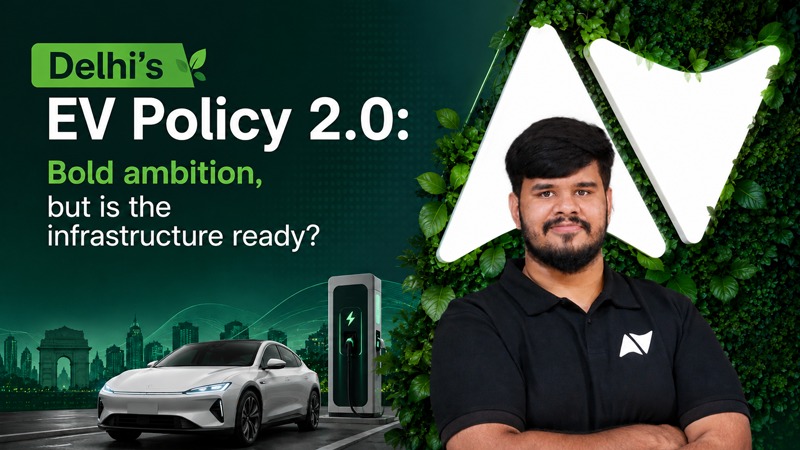
Delhi’s Draft EV Policy 2.0: Bold ambition, but is the infrastructure ready ? A Counter-view

At EVreporter, our effort has been to give space to all voices in the mobility ecosystem. This article by Vaibhav Kaushik, Co-founder & CEO of Nawgati, explores whether the infrastructure is ready for a mandate as sharp as that being proposed in the Draft of Delhi EV Policy 2.0?
Delhi’s new draft EV Policy 2.0 is being positioned as a bold clean-mobility transition, but the transition raises serious questions about infrastructure sequencing and economic disruption for existing mobility ecosystems. At the same time, with a target of adopting nearly 95% electric vehicles in new registrations by 2027, there is an aggressive transition for a city whose transport economy relies heavily on CNG infrastructure built over years of investment.
The larger concern is not whether EVs are the future. They undoubtedly are, but the real question is whether cities are attempting to accelerate the future faster than the infrastructure underneath can realistically support. Because it’s not just about replacing fuel; the bigger challenge is whether charging networks, grid systems, and urban mobility data infrastructure are truly prepared for a transition.
The Shift Is Bigger Than Just Vehicles
What is happening in Delhi is an economic restructuring of the city’s mobility ecosystem. Thousands of crores have already been invested over the years into CNG stations, fleet financing, conversion technologies, maintenance systems, and distribution infrastructure. Small transport operators, fleet owners, auto drivers, and logistics businesses built their economics around a fuel ecosystem that policymakers themselves once promoted as the clean future of urban transport.
Now, within a relatively compressed timeline, the city is moving toward an electric-first framework where even petrol two-wheelers could eventually stop receiving new registrations. The proposed policy suggests that from 2028 onward, only electric two-wheelers may be eligible for new registration in Delhi. Considering that nearly 67.7% of Delhi’s registered vehicles are two-wheelers.
The concern here is not environmental; cleaner mobility is necessary. The concern is transition sequencing. Infrastructure ecosystems cannot be replaced overnight simply because policy ambition has accelerated.
The Charging Infrastructure Gap we should not ignore
There are around 10,000 public charging points in operation in Delhi, whereas according to requirements, we need about 36,000 to 37,000 charging points. Although the government plans rapid expansion through charging corridors and fast-charging networks across major roads. But even with that expansion, projections suggest the city would require infrastructure at a far larger scale to comfortably support EV penetration targets approaching 95%.
The challenge is not only the number of chargers; we also need to consider the complexity behind them.
Unlike conventional fuel stations, EV charging systems place dynamic pressure on electricity networks. A commercial delivery cluster charging simultaneously during peak evening hours creates a very different energy burden than residential overnight charging. This is where Delhi’s transition begins to expose a deeper issue: India’s EV transition is no longer just a mobility challenge. It is becoming a data infrastructure challenge.
Delhi’s Electricity Consumption Under Stress
One of the most revealing indicators is Delhi’s electricity consumption for public EV charging. Despite accounting for only a small percentage of India’s total EV population, Delhi contributes nearly one-fourth of the country’s public EV charging electricity consumption. Between April and November 2025 alone, public charging usage in the city crossed approximately 240 million units of electricity.
In BSES-served areas alone, EV charging load has grown from just 24 MW in FY2018–19 to nearly 227.48 MW currently, and this demand is expected to rise further to nearly 375 MW within the next two years, according to predictions. The pace of this increase reflects how rapidly electrification is reshaping the city’s energy consumption patterns.
Delhi currently accounts for nearly 24.1% of India’s total public EV charging electricity consumption, with the city consuming close to 239.63 million units out of the national figure of 992.73 million units. BSES networks alone contribute more than 124 million units, which represents nearly half of the capital’s total EV charging electricity demand. These numbers are significant because they reveal how concentrated and energy-intensive urban electrification can become within a short period.
That raises a difficult question: if current EV penetration is already creating disproportionately high charging demand, what happens when adoption scales aggressively over the next three to five years?
The answer cannot simply be “build more chargers.” Charging infrastructure without intelligent data coordination risks becoming fragmented.
The Real Missing Layer is Data Infrastructure
The conversation around EV transition still focuses heavily on infrastructure that is visible, such as charging stations, battery swapping networks, subsidies, and vehicle sales. But the invisible layer that needs more attention is data orchestration.
A successful EV ecosystem requires continuous real-time coordination between mobility behaviour and energy systems. Cities need predictive analytics capable of forecasting charging demand clusters before congestion occurs. Utilities require grid-balancing systems that can anticipate sudden load spikes across commercial corridors. Municipal planners need unified visibility into charging patterns, transformer stress, and traffic movement.
At present, most Indian cities still operate with fragmented mobility and energy databases.
Charging operators often work independently. Grid planning and charging deployment are not always synchronised. Residential charging remains difficult in apartment clusters and rented housing. Several implementation concerns raised publicly regarding Delhi’s draft policy point to the same issue: policy targets are advancing faster than operational readiness.
Even among EV supporters, there is increasing recognition that charging access, service readiness, technician training, and grid preparedness remain significant bottlenecks.
Why Fuel Diversity Still Matters
India’s mobility future will undoubtedly become more electric over time. But transitions at this scale work best when they are layered, not absolute.
Cleaner gaseous fuels, bio-CNG, and hybrid systems are not transitional placeholders; they are structurally important components of a large urban mobility economy where affordability, accessibility, and infrastructure readiness vary sharply across user segments. CNG in particular has demonstrated its viability as a clean, cost-effective fuel for public transport and commercial fleets, and that role does not diminish simply because electrification is accelerating elsewhere. Delhi’s public transport and commercial mobility ecosystem evolved gradually, not through overnight disruption. That same principle should apply to electrification as well.
A city cannot build sustainable mobility merely by replacing one fuel with another. It must also ensure that charging reliability, electricity distribution, battery ecosystems, and urban energy intelligence mature simultaneously. Otherwise, the risk is that policy success on paper may create operational stress on the ground.
The Future Cannot Be Built on Speed Alone
Delhi’s Draft EV Policy 2.0 is not just a mobility transition; it is an urban infrastructure transition unfolding at an enormous pace. While the push toward electrification is necessary, the larger challenge lies in whether energy systems, charging infrastructure, grid intelligence, and mobility data networks are evolving fast enough to support it sustainably.
The success of this transition will not be measured solely by how quickly EV adoption rises or by how quickly older fuels disappear. It will depend on whether cities can build mobility ecosystems that are reliable, interconnected, economically practical, and operationally intelligent at scale. Because the future of mobility is not defined by a single fuel alone, but by how effectively infrastructure, energy, and data systems learn to work together.

Article by: Mr Vaibhav Kaushik, Co-founder & CEO of Nawgati
Also read: Maharashtra Electric Vehicle Policy 2025
Subscribe & Stay Informed
Subscribe today for free and stay on top of latest developments in EV domain.