India Adds 11,823 New CCS2 Connectors in Last 12 Months

Note by Authors Priyans Murarka and Garvit Singh – At ExpWithEVs, we collect and publish quarterly reports on charging infrastructure in India. Our data collection methodologies involve manual data collection from CPO apps. For this particular edition, we collated data from 84 CPO apps on public charging infrastructure and presented our findings and insights here. A detailed report can be found at expwithevs.in
An overview of public charging infrastructure in India
Indian cars charge primarily on CCS2 and Type2 infrastructure, thus, we’ve assumed only those. We are tracking only public charging infrastructure, meaning anyone can charge at these charging stations. This does not include OEM-exclusive or home chargers, or any captive chargers reserved for fleets or other cars.
Our definitions: A single connector connects to a single car. A charger can have one or more connectors. A charging station can have one or more than one chargers.
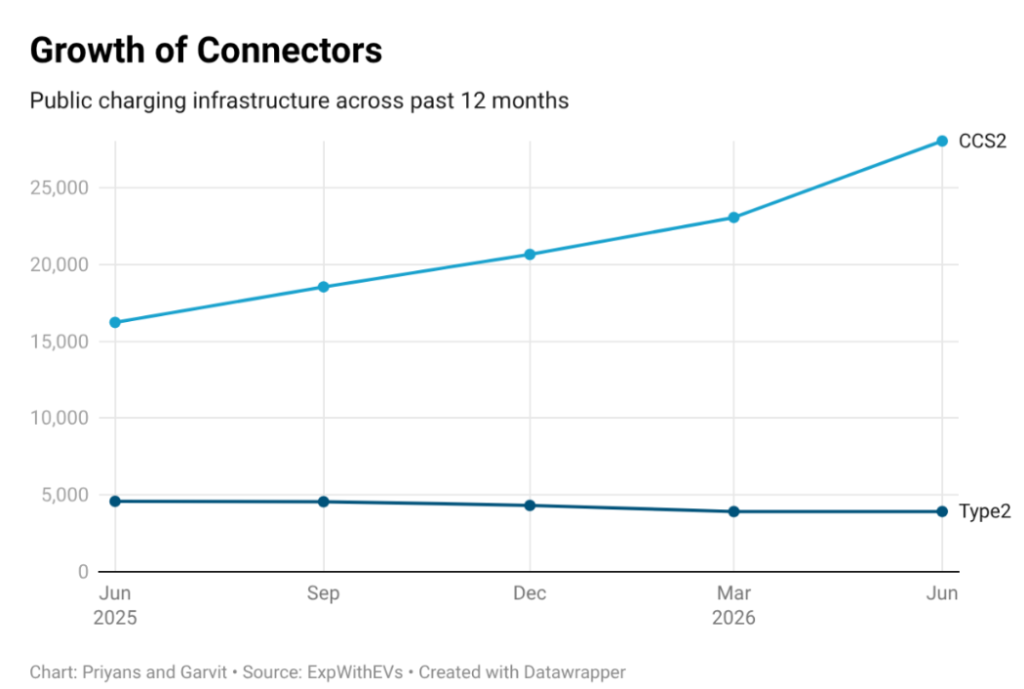
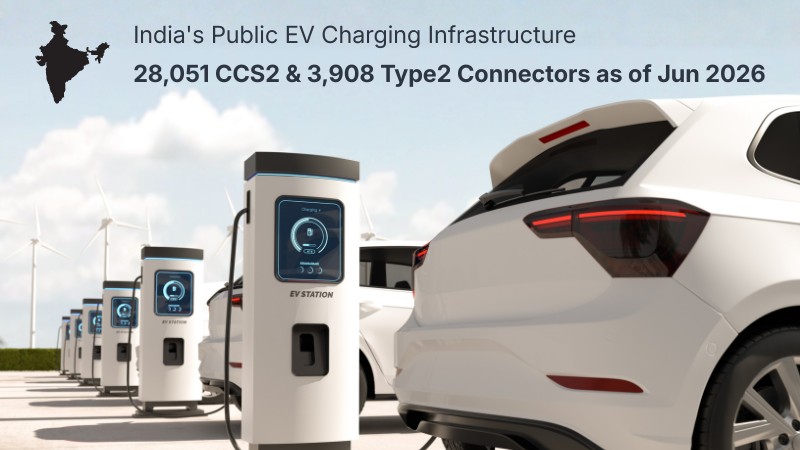
- Based on our findings, India has 28,051 CCS2 connectors and 3,908 Type2 connectors. The CCS2 fast connectors in India grew by 73% year on year.
- While the CCS2 connectors have grown, the Type2 charging infrastructure has seen a steady year-on-year decline of ~14.5%.
The return on investment for CPOs in Type2 charging infrastructure is a lot lower than CCS2. They can sell more units in the same amount of time with similar fixed costs, i.e. rental for parking. The industry is realizing this and can be seen in the data.
- In Q1FY27, the industry added one CCS2 fast connector every 26 minutes. If we keep up with this speed, India can cross 50,000 connectors in the next one year. Based on EVreporter’s sales data [Jan 2020 to Jun 2026], we know that ~580K electric cars were sold in India. This brings our car to connector ratio at 18.4, at par with many developed economies.
Charging Connectors | Top Ten states
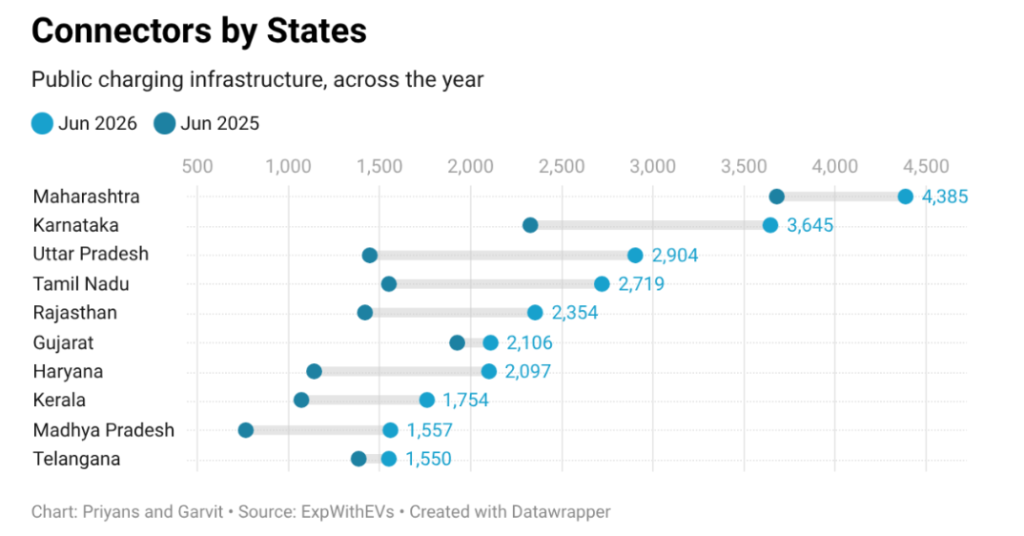
- Over the year, among the top ten states, Telangana and Gujarat saw the least growth, whereas Uttar Pradesh saw the highest growth, followed by Karnataka and Tamil Nadu.
- The Western region is represented by Maharashtra, Rajasthan and Gujarat. All major states in South India make their mark in this list except Andhra Pradesh, while Uttar Pradesh and Haryana are the only two northern region states.
- The growth rates for states like Karnataka, Uttar Pradesh, Tamil Nadu and Rajasthan are much higher than the infrastructure leader, Maharashtra.
Who are the key players setting up this charging infrastructure in India?
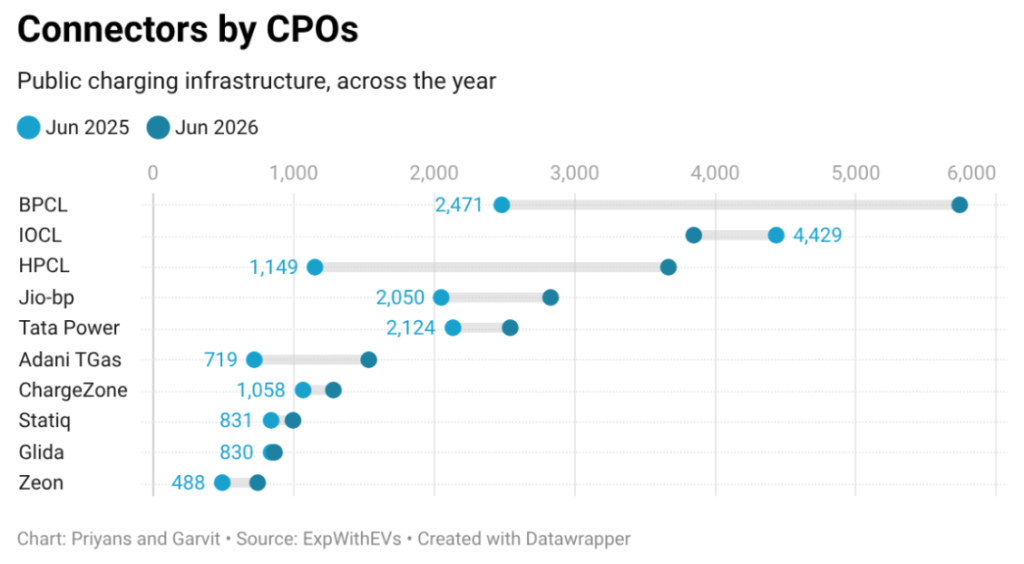
- The top three PSUs have the most number of connectors in India. Ironically, IOCL reduced the total number of connectors from a year ago. While BPCL and HPCL doubled their network infrastructure.
- Among the private players, Jio-bp and Adani TGas saw the highest additions across their network, while Adani TGas registered the highest growth in percentage terms. The chart shows that scaling charging infrastructure without help of a corporate or government backing is slow and gruelling work. Credit to players like ChargeZone, Statiq, Glida and Zeon for sticking out.
Please note: any OEM partnership chargers or aggregated chargers are not counted as a CPO’s chargers.
Also read: EV Charging Infrastructure is a critical component of India’s energy security: Kartikey Hariyani
Subscribe & Stay Informed
Subscribe today for free and stay on top of latest developments in EV domain.