Just in Time (JIT) Delivery of After Sales Support of Automotive Repair Network (ASSARN) to Independent Workshops

Objective:
1. To reduce the waiting time for the repair of cars.
2. Reduce the travel time of parts to the repair centre.
3. Encourage the usage of original spare parts in the automotive market
4. Integrate roadside mechanics and independent workshops with the Online Part Ordering Mechanism
Target Beneficiaries and Actors:
1. Vehicles past the warranty period of cars
2. Vehicle owners whose honeymoon period with their cars is over
3. Vehicle owners calculating the Cost of Retention and Cost of Ownership of their vehicles.
4. Roadside mechanics, independent garages and independent workshops
Scope:
Sub Premium cars, Compact SUVs
Out of Scope:
Premium Cars, Super Premium Cars, EVs, and Vehicles Repaired at Dealerships.
Just in Time (JIT):
After Henry Ford’s innovation of the Assembly Line Technique for Manufacturing (1914), the Toyota Way of Manufacturing was the next big thing added to the Auto Industry. This was not only a turnaround moment in the Auto Industry, but also the platform that raised manufacturing to a new industrial standard. Manufacturing started to get associated with efficiency and waste elimination. Waste identification and elimination became an important tool for improving efficiency. All this became an important pillar of the TPS. Just in Time, the art of delivering parts in ‘The Right Quantity – The Right Time – Right Place’ was an important pillar of TPS.
2014: Come 2014, we saw our entry into the Digital World. From desktop-based applications, we moved to handheld devices and palmtops. Websites and applications crashed on our handheld devices. Larger screens were now miniaturised into smaller applications, retaining their utility and redefining their space. However, another feature that made these devices more useful was GPS. The introduction of GPS sensors and their integration with Google Maps created another Business Opportunity – the ‘Location Specific Delivery Based Services’ like Ola, Uber, Swiggy, Zomato, Instamart, etc. The resurgence and growth of these applications led to fierce competition, driving a willingness to deliver in the shortest possible time. As a result, the delivery of goods waiting period was reduced to 10 minutes. We have all benefited from this service. And it has led to Employment Generation, too.
However, there is another Interesting thing that took place in the Delivery Models – Being able to Deliver, Just in Time. Way back in the 1960s and 70s, when the auto industry was evolving from Mass Production to Lean Production, the just-in-time model was being worked out between suppliers, OEM, logistics, and CBU delivery through various permutations and Combinations. And JIT reached a level where the Right Quantity is available only the Right Way, at the Right Time, at the Right Location. The manufacturing industry mastered this environment in a way that Muda (waste) was always eliminated at every stage, keeping production efficiency at its best. And more or less, all Japanese OEMs followed the same or similar principles to keep the ‘Cost of Muda’ at its lowest.
Today, the efficiency of e-Commerce sites and Quick Delivery Apps has reached a point where they can deliver our orders just in Time. Back in the 60s/70s, who would have thought that the invention of Android and Apple OS in 2010 would actually set the stage for the extension of JIT delivery models across all spheres of life!
Scope for JIT Delivery Model:
After-sales vehicles usually have three kinds of repairs.
(i) Preventive Maintenance washing, cleaning, oil change, filter change, battery check, AC Check etc. It is a routine exercise every vehicle undergoes at minimal expense.
(ii) Breakdown maintenance can be low cost repair of minor to major replacements of parts and functional items. It can be electrical items, mechanical items, or electromechanical parts, engine components, exhaust-related items, etc.
(iii)Repair of body parts, replacement of skin panels, denting, painting, etc.
Our scope of discussion is restricted to (i) and (ii) only. (The reason being, distributors and retailers usually carry a limited inventory of body parts.)
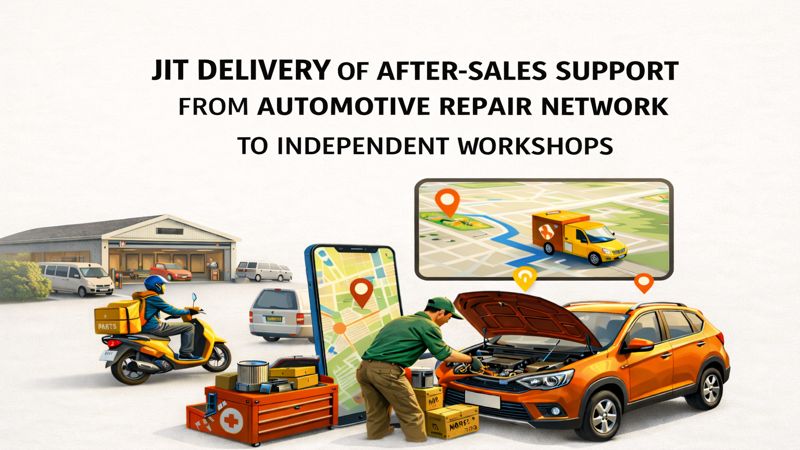
So, we are now exploring a JIT delivery model of Original Spares to Independent Workshops and Roadside Mechanics from authorized auto retailers, by exploring the Services of the Quick Service Delivery Apps – ‘Just in Time After Sales Support of Automotive Repair Network (ASSARN)
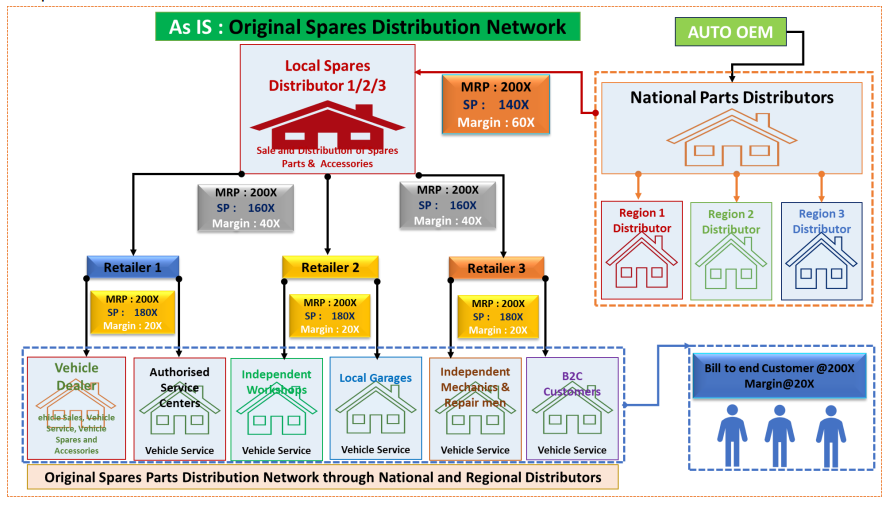
AS Is Model for Local Spare Parts Distribution:
Below is the traditional delivery model of Auto Spares from Dealers and Authorised Distributors across the Industry. This model is widely used, and delivery is secured via local delivery methods or standard delivery agents. But, region to region, city to city, parts delivery and parts distribution vary.
Existing Brands for Online Delivery Platforms:
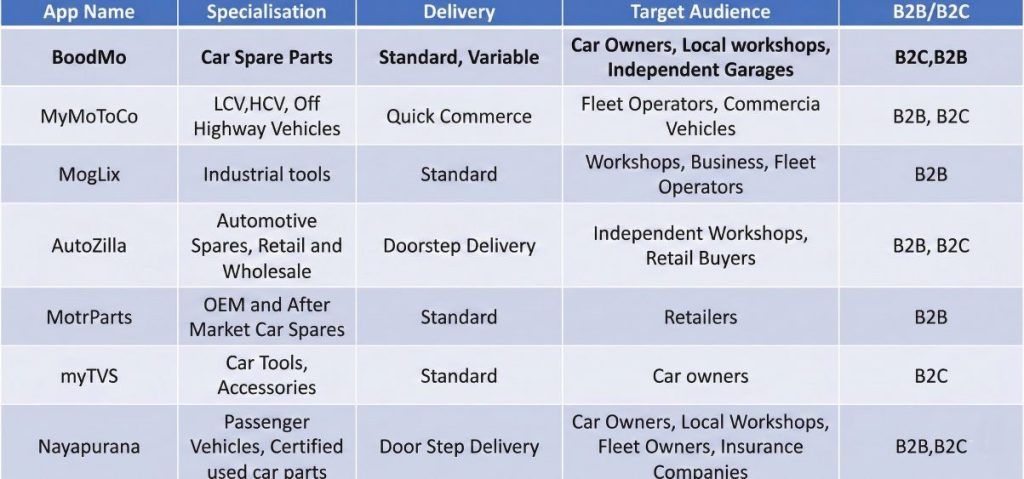
In Metropolitan Cities and Uban Centers, this model has been adopted. Depending on the Business Volume and Region, the rate of adoption and reliance on Quick Service Delivery Apps is very high in some parts of the country (such as Ahmedabad, Surat, Delhi, Bangalore, Pune, Chennai, etc.). There are apps and e-commerce sites that deliver Auto Parts across India within specific time periods. These e-Commerce sites can deliver parts overnight between cities. They deliver the parts on time. But they are not ‘Just in Time’ (10-20 Minutes Target Delivery). There is usually a time lag from Order-to-Receipt Cycle.
To Be Model:
The Objective of this paper is to reduce the waiting time for the repair of cars.
And to reduce the travel time of parts to the repair centre. This would also discourage the usage of spurious parts and non-genuine parts in the market.
To enable the JIT model, we would need to empower the roadside mechanic to order parts online from the nearest retailer. And incentivise the mechanic to order genuine parts. And loop in a delivery partner to make the parts available, Just In Time. The delivery mechanism can be integrated by looping in Quick Service Delivery Partners. And the delivery partners can, in turn, be incentivised to deliver original and genuine spares, just in Time.
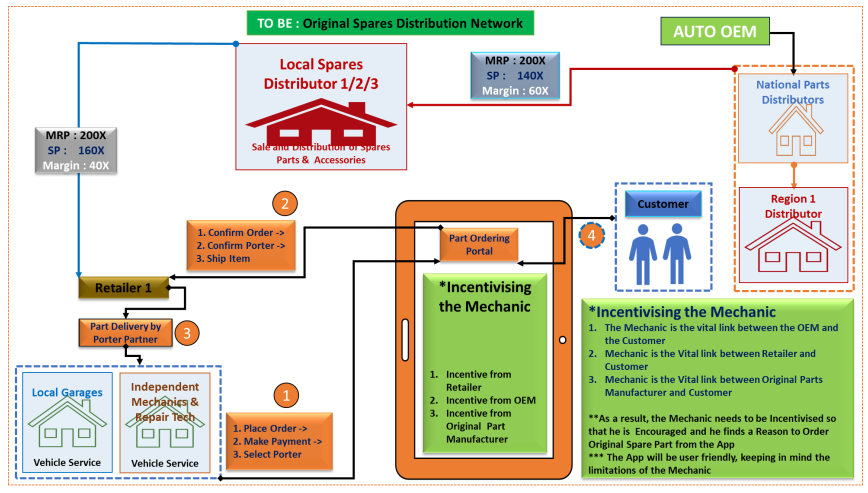
Role of the Mechanic in After-sales Support:
1. The Mechanic is the Vital link between the OEM and the Customer
2. The mechanic is the Vital link between the retailer and customer
3. The mechanic is the Vital link between the Original Parts Manufacturer and the Customer
The Auto Retailer and the OEM must establish a reliable, trustworthy process to include Mechanic and Independent Workshops in the After-sales Support of the Automotive Repair Network (ASSARN). And the Mechanic needs to be incentivised to find a Reason to Order Original Spare Parts from the App. (The App will be user-friendly, keeping in mind the limitations of the Mechanic)
Takeaways from the JIT Model:
1. Eliminate the possibility of usage of Spurious parts/2nd Sales parts/refurbished parts/rejected parts
2. Encourage the usage of Genuine Accessories in the auto industry through Online Transactions
3. Cut down on the idle time of cars waiting for repairs
4. Cut down on Parts Delivery Time (cars waiting for parts to arrive)
5. Enhance usage of Original Spares in the Open Market through Online Visibility
6. Enhance usage of Original Spares in the Open Market through Online Availability
7. Encourage and Incentivize Online Transactions, Reduce Cash Transactions
8. Encourage the usage of Quick Service Delivery Models
9. Expand the scope of the Auto Industry to e-Commerce applications
10. Empower and Legitimise the Roadside Mechanics and Independent Workshops
11. Transparency in billing and transactions, leading to more Tax Compliance
In a Nutshell, if we can integrate and accommodate the Roadside Mechanics and Independent Workshops into the automotive after-sales SCM network, we will start recognising the contribution of the Auto Mechanics and Local Garages to the Industry and legitimise their role. The Take Home Benefits will be accrued by all stakeholders in the Auto Industry’s After-Sales Support Network.
Acknowledgements:
1. MyMoToCo, Nayapuranaonline, Boodmo, AIWA
2. Auto Parts Dealers and After-Sales Support Vendors at Auto Mechanica, 2026
3. Local auto garages, Local automotive workshops, Roadside Mechanics and Technicians
4. Local Auto Parts Stockists, Distributors, Scrap Dealers, 2nd sales market operators
5. Senior Business Leaders in the SCM Industry
6. Retired Business Leader from the Automotive Industry
7. HoD of Premiere Technical Research Institutes in SCM
References:
1. The Machine That Changed the World
2. Toyota Production System
3. Just-in-Time Management
Disclaimer:
The objective of the article is to create an inclusive ecosystem in the Automotive Industry so that Independent Workshops and Roadside Mechanics can serve as a Constructive Aggregator in the Industry’s after-sales support.
About the author

Bhaskar Nandi
He is an ex-Honda, ex-Hyundai, ex-Mahindra and ex-IFB Industries Employee, with 27+ years of experience.
He is currently a Consultant at a Global IT Company.
Also read: Market growth through original spare parts availability and the role of independent service points
Subscribe & Stay Informed
Subscribe today for free and stay on top of latest developments in EV domain.