How CPOs can Protect Margins and Build a Profitable EV Charging Business

Guest article by Gowtham Injamuri
EV sales accounted for almost 8% of overall vehicle sales in India in FY 2024. While this number is significantly below the 30% EV penetration target by 2030, it will only increase. Central government schemes, newer models from OEMs, a big push for charging infrastructure from CPOs, and widely available financing options are positive for EV growth, and that 30% will eventually come.
Given that EVs are growing and charging infrastructure is also being set up alongside them, it made me wonder what it takes to win this market. Especially, when EV charging in India is about to become a margin war.
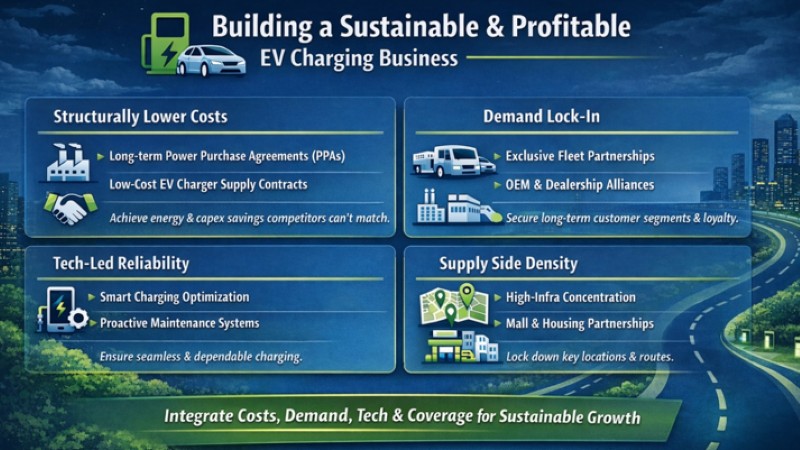
When that happens, only CPOs with structurally lower costs, locked-in demand, and tech-led moats will survive. In this post, I lay out a flywheel approach to building a sustainable and profitable EV Charging business. Let’s dive in.
Structurally Lower Costs that Can’t Be Easily Copied by Competitors
Energy costs often determine the viability of the EV Charging station for a CPO. Interestingly, this also influences the demand generation capability for a CPO. Who doesn’t want a lower price?
If a CPO operates a large network across a state, it can significantly lower its energy costs by securing a long-term PPA (Power Purchase Agreement).
This allows the CPO to:
- Lock in lower electricity rates through bulk purchasing from energy generators compared to DISCOM rates.
- Negotiate fixed-price contracts that insulate against energy price volatility for many years to come.
While all other CPOs continue to pay ever-increasing DISCOM tariffs, you can rightfully offer lower prices and capture market share.
Another idea along similar lines is a long-term EV Charger Supply contract with a reliable EV Charger OEM to significantly reduce Capex.
Lower capex means faster payback or structurally lower costs, which can improve your profit margins or pass the savings to end users. Then the CPO doesn’t have to offer discounts to lure customers into the charging station. Being structurally lower than market cost is enough of a driver for customers to pick your network over others, of course, provided there are stations in the desired areas.
The two-pronged approach creates a pricing advantage that competitors will find hard to match without similar long-term infrastructure investments.
Customer Segment Expansion through Pricing Strategy
I observed the differences in the customer segments each OMC (Oil Marketing Company) caters to in India. Shell India offers the most premium refuelling experience and therefore commands a premium price per litre. While BPCL and IOCL offer lower prices and cater to value-for-money customers. HPCL sits somewhere in between. What if IOCL can offer a Shell-like experience at IOCL costs? Isn’t that a strong motive for Shell regulars to switch to IOCL?
I feel that every 5-10% reduction in charging costs can unlock a new segment of customers. At this point in time, it might even make someone switch from ICE to EV. Although we’re in the early EV adopter phase with high willingness to pay, over time, there will be price-sensitive and price-conscious commuters who can be captured by lowering prices.
Supply Side Locking
Assuming capital is not a constraint (I know it’s a big assumption), I believe a CPO should invest heavily in increasing infrastructure density in a state and/or along popular routes. This ensures that the EV Charging supply in that area is locked for the CPO and thereby locking in EV charging demand for that CPO. When coupled with the long-term lower energy costs via PPAs in that region, it can truly make the CPO a default choice in that region.
Other CPOs will hesitate to enter such areas, since they will have to deploy significant capital to develop infrastructure and secure PPAs. Even after doing all of this, it’s a risky bet because they will then have to market heavily on their differentiation (If any), which increases CAC (customer acquisition cost).
One way to increase density is to partner with malls, office complexes, and residential societies. Go all in on the value proposition for these real estate owners and secure land to build the dense infrastructure.
Technology-Led Moats
As an EV Charging Consumer, one thing I want to be assured of is the guaranteed availability and guaranteed charging (reliability) when I reach the location. The density point addresses infrastructure availability, as you have a large catalogue of locations for EV charging consumers, and a range of interventions can ensure the chargers are UP all the time. The next critical piece is ensuring the EV user can charge their EV when they plug in.
I believe this is a three-layered problem.
- Vehicle-to-Charger Selection Optimisation: You don’t want a Tigor occupying a 180kW Charger. That’s an utter waste of CapEx. Likewise, you don’t want an EV6 lock itself into a 30kW Charger, coz the Tigor is charging at the 180 kW gun. So vehicle-to-charger selection is an optimisation problem that can be solved easily with tech. You want the best bang for buck from the capex you put in, and the customer should get the best bang for buck from the time they spend at the charging station.
I believe that having the user select the vehicle they’re charging, and a simple nudge at the time of connector selection, can influence them to pick a faster/slower Charger based on the selected vehicle. Or go so far as to not show the faster ones to prevent them from charging at those chargers at all. It’s coming to light that faster Charging infrastructure has much better ROI and payback than slow chargers.
- Then the second layer, Charging Initialisation: This is perhaps where many users falter across networks. A few questions to help improve the experience here.
How is the customer paying for the charging session? Is it via an RFID Card or the App?
If it’s an RFID Card, how and when will you notify the user that the card doesn’t have sufficient balance? How do you communicate to the user how to charge via an RFID card?
Should I connect the gun first and then tap, or tap first and then connect the gun?
If it’s via app, would you open the charging station page directly based on their location? Or take them through the usual route: landing page, then search/click on nearby, then navigate to the selection page.
Would you have a QR code there for quick charging? Would you prefill units based on the vehicle? Would you have a wallet or let customers pay as they go? If it’s pay-as-you-go, can you ensure the reliability of payment capture systems so that apps don’t crash after payment is made?
How would you handle refunds after payment is made and the app crashes? How do you prevent app crashes? Do you even need an app? And the list goes on.
But the critical piece here is that it’s a huge opportunity to deploy tech to bring delight to the entire charging process. You can use tech to make the charging initialisation process as simple and straightforward as possible, and that can be a real moat.
- Energy Delivery: Chargers in India are notorious and frustrating to operate. One moment the charger starts charging, and within no time, it stops. And most of it can be attributed to improper implementation of specs, over-engineering of constraints on both ends. The result is a frustrated customer over multiple rounds of charger initialisation.
To add to the frustration, the reasons for failure are seldom shared with the CPO, breaking the critical feedback loop for improving the energy delivery experience. Feedback is important so CPOs can build tech to capture every failed session, demand resolution from the manufacturer and then keep the feedback loop running to improve the overall energy delivery experience.
This leans heavily into the preventive maintenance aspect of the CPO Business. Is the charger good enough to relay critical information to CMS about potential failures? Over time, be so smart that you can stop accepting charging requests if you know a certain session is going to fail. It’s a much better experience to offer than to let a user navigate all the way only to realise that the charger gun is faulted because some RCCB decided to get drunk and trip.
Tech can also reduce load costs by implementing smart load management algorithms, and preventive maintenance tech can lower manpower costs by eliminating the need for service engineers to visit sites unless necessary.
Alongside dynamic pricing based on time-of-day tariffs and real-time weather and demand, subscriptions and loyalty programs, tech can be a real game changer in delivering a delightful experience to users while lowering marketing and operational expenses.
Demand-Side Locking Strategies
I discussed supply-side locking by increasing density in a geographical region. Let’s talk about a strategy to lock in the demand of existing and potential new consumers. At the moment, there are two customer categories. Fleets and retail users. Fleets can be further divided into 2-wheeler, 3-wheeler, 4-wheeler passenger and 4-wheeler cargo transport, intercity buses, trucks, and intracity buses.
Can you lock in exclusive pricing deals for any or all of the above fleet segments? The structurally lower pricing moat and the high density of infra tie neatly into this value prop for a fleet customer. Imagine a fleet operator in Coimbatore planning to expand its EV fleet. If the CPO’s chargers are visible everywhere and the CPO also offers structurally lower costs, it’s a no-brainer for the fleet to enter a long-term contract.
Now, this increased demand can fuel negotiations on power purchase agreements, attracting more and more fleet operators and creating a sustainable flywheel.
Can you take a step further and establish exclusive partnerships with EV manufacturers? Of course, the tech-led moats should be strong to ensure reliable EV Charging.
Lastly, in the retail world, the dealership typically has a lot of influence over the choices a vehicle owner makes. In this regard, a strategy is to tap into all dealerships in the market you operate in.
You can take the next step and sign OEM-level partnerships as a de facto Charging App or network of choice in a given geography. Once you lock in OEMs, you capture every new EV consumer into your funnel by default. That’s a pretty strong moat to have.
About the author

Gowtham Injamuri is a product leader in the electric mobility space with over 9 years of experience across EV OEMs, EV Battery companies, and charging infrastructure. He has led product development at companies like Ather, Log9 and Pulse Energy, working across software, hardware, and operations to scale EV adoption. He currently builds products and strategies focused on solving real-world EV charging challenges.
Also read: Exicom launches new manufacturing facility for EV charging and power solutions in Hyderabad
Subscribe & Stay Informed
Subscribe today for free and stay on top of latest developments in EV domain.