
Could Dark Stores Be the Next Energy Nodes?

Quick commerce has always been about speed and proximity, but as fleets electrify, dark stores are quietly transforming into energy-intensive hubs.
The piece by Sheetanshu Tyagi, CEO of EMO Energy, examines battery swapping versus owned charging, the role of storage in stabilising grid demand, and how network-wide energy visibility can give operators a competitive edge.
What If the Dark Store Is Actually an Energy Node?
Quick commerce built its edge on speed and geography. The next competitive battle is happening in the energy layer nobody thought to look at.
Walk into any operational dark store and the visible activity is predictable: riders collecting orders, cold storage humming, staff restocking shelves. What’s harder to see is the growing pressure on the electrical infrastructure behind all of it. Delivery fleets are electrifying. Charging loads are being added on top of existing store demand. And nobody originally designed these sites to carry both.
For most operators, this crept up gradually. A few EVs got added to the fleet, chargers were installed wherever space allowed, and the grid connection that once handled refrigeration and lighting quietly became responsible for something much bigger. That patchwork approach worked fine at a small scale. As networks have grown, the cracks are showing.
What changed when fleets went electric
The dark store’s original job was straightforward: get product close to customers, fulfil orders fast, repeat. Energy management meant keeping the lights on and the cold chain intact. Fleet charging was someone else’s problem. Riders owned their vehicles, swapped batteries at third-party stations, or plugged in at home.
That model is fraying as operators bring fleets in-house and electrify at scale. A site supporting dozens of EVs cycling through morning, afternoon, and evening peaks is drawing significantly more power than it was designed for. Add the refrigeration load, the handling equipment, and the connectivity infrastructure, and a dark store starts looking less like a small warehouse and more like a medium-sized industrial facility that needs to be managed like one.
The timing of that charging load matters a great deal. Charging a fleet at peak grid hours can push a site past its demand threshold, triggering penalties that quietly eat into unit economics.
Charging intelligently, staggering loads, using stored energy during peak windows, and prioritising vehicles that dispatch soonest can meaningfully reduce that cost. The difference between the two is not hardware. It is software and integration.
The hub and its riders are one loop, not two
There is another dimension to this that tends to get overlooked. In the hub-and-spoke model that most quick commerce operators now run, the dark store is not just a fulfilment point. It is the fixed end of a closed loop. Riders leave, complete deliveries, and return. Then they leave again.
When those riders are on electric vehicles, the loop has an energy dimension that did not exist before. A rider returning to base is not just clocking back in. They are bringing a vehicle that needs to charge before the next run. The store that manages that transition well keeps its fleet moving. The one that does not starts losing throughput, not because of orders or inventory, but because of power.
The numbers give a sense of the pressure. A typical quick commerce dark store manages anywhere between 20 and 60 delivery riders per shift, depending on order density and city. In a fully electrified hub, that translates to ~30 kW of simultaneous charging demand at peak return windows, layered on top of a baseline store load that already runs to ~2500 kWh for refrigeration, lighting, and equipment. Across a network of 5000 stores, that is not a rounding error.
This is what makes site-level energy management so directly tied to operational performance. In a hub-and-spoke setup, the charging turnaround at the hub is part of the dispatch cycle. If ten riders return at the same time and the site cannot intelligently sequence their charging alongside its existing store load, the next wave of dispatches gets delayed. At one store, that is a bad hour. Across a city, it is a systematic throughput problem.
Tying the rider to the hub also creates an opportunity. When vehicles always return to the same location, the operator has complete visibility into usage patterns, charge states, and demand cycles. That data can be used to predict load, pre-charge strategically, and match energy availability to fleet schedules rather than reacting after the fact.
The closed loop, in other words, is actually an asset. But only if the energy infrastructure at the hub is built to take advantage of it.
The case for owning your charging infrastructure
Battery swapping has been floated, and in some contexts adopted, as an alternative to on-site charging. The appeal is obvious: riders pull into a swap station, exchange a depleted battery for a full one in minutes, and get back on the road without waiting for a charge cycle. For individual riders or small fleets operating across a city, it removes the charging bottleneck entirely.
But for a dark store operator running an owned fleet in a hub-and-spoke model, battery swapping cuts against the very logic of the system. It reintroduces an external dependency into what should be a closed loop. Swapping requires proximity to a functional swap network, standardised battery formats across the fleet, and a third-party operator whose uptime and pricing you do not control. When the swap station nearest your Koramangala store is down at 7 am on a Sunday, your morning dispatch is compromised, and there is nothing in your infrastructure to fall back on.
Owned charging keeps the operator in control of the one variable that matters most: whether their vehicles are ready when orders arrive. More importantly, charging infrastructure installed at the hub becomes part of the site’s energy system rather than a separate transaction. It can be coordinated with storage, timed against grid tariffs, and monitored as part of the same operating layer that manages the rest of the site’s electricity.
Battery swapping sits outside that system entirely. The energy cost of each swap is fixed and opaque. There is no peak shaving, no load balancing, no visibility into consumption. Just a per-swap fee and an infrastructure dependency the operator does not own. At one store, the difference is manageable. Across a national network, it compounds into a structural disadvantage.
Storage is what makes site-owned charging viable at scale.
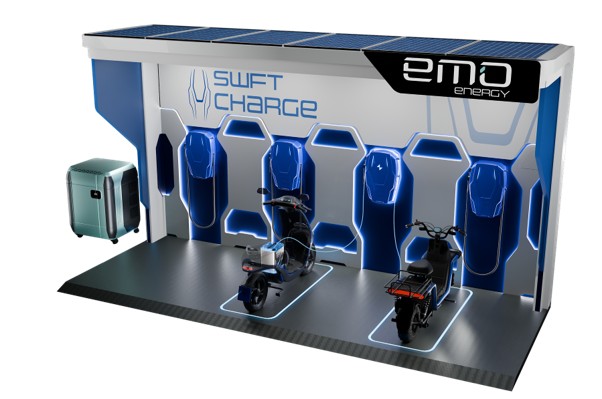
The reasonable objection to owned charging is grid strain. If dozens of vehicles are charging simultaneously, the site’s electrical load spikes, and spikes cost money. This is where energy storage changes the picture.
Batteries installed at the store level allow operators to charge storage during off-peak hours and draw on it when fleet charging demand is highest. The grid connection stays relatively flat. Demand charges stay manageable. The operator retains full control over when and how vehicles charge, without paying the penalty for doing all of it at once from the grid.
This also improves resilience. Indian grid reliability varies considerably by city and by neighbourhood within cities. A site with storage behind it can continue operating, keeping the cold chain intact and keeping chargers running, through interruptions that would otherwise halt operations. For a business where uptime is directly tied to order fulfilment, that has real commercial value.
From site to network
Solving this site by site is one approach. It is also the slower and more expensive one.
The more useful framing, especially for operators running dozens or hundreds of stores, is to think of the entire network as a single energy system. Which sites are drawing the most from the grid? Where is storage being underutilised? Which charging patterns are driving up costs? Where are the reliability risks concentrated? These are not questions that can be answered by looking at one store at a time.
This is the level at which Emo Energy is positioning itself.
The company argues that logistics operators need an operating layer that connects charging infrastructure, storage, site-level energy management, and network-wide visibility, not as separate products from separate vendors, but as a single system.
The charger is one piece of it. The platform that tells you what every charger across your network is doing, and why, is the actual product.
For large quick commerce and logistics operators, the proposition is ultimately about control. Control over electricity costs. Control over fleet uptime. Control over the economics of a network that is growing fast and becoming harder to manage from first principles. Battery swapping outsources that control.
Owned, integrated charging infrastructure keeps it in-house and, done well, turns it into a competitive edge rather than a cost centre.
What the dark store looks like in five years
India’s quick commerce market is projected to reach $57 billion by 2030, with dark store counts expected to grow from roughly 5000 today to several times that as Tier 2 and Tier 3 cities come into play. That expansion will not just be a fulfilment story. It will be an energy story.
Each new store added to a network is a new electrical load, a new fleet charging point, and a new node that either contributes to or complicates the operator’s ability to manage energy costs at scale. The companies that get this infrastructure right early will carry an operational cost advantage that compounds over time. The ones that do not will find themselves retrofitting energy systems into stores that were never designed to handle them, at a time when the economics of doing so are considerably worse.
There is also a regulatory dimension coming into focus. As India’s grid modernises and time-of-use tariffs become more common in commercial and industrial categories, the operators who have invested in storage and intelligent load management will be positioned to benefit from off-peak pricing in ways that others cannot. Energy management, in that environment, stops being a cost control exercise and starts being a revenue-relevant capability.
The dark store of 2030 will look quite different from the dark store of today. It will be more electrified, more connected, and operating under considerably more energy pressure than anyone originally planned for. The question for operators is whether they build the infrastructure to handle that now, when the cost and complexity are still manageable, or later, when the network is larger and the margin for error is smaller.
Also read: Smart Communication Protocols and Grid Intelligence in EV Charging
Subscribe & Stay Informed
Subscribe today for free and stay on top of latest developments in EV domain.