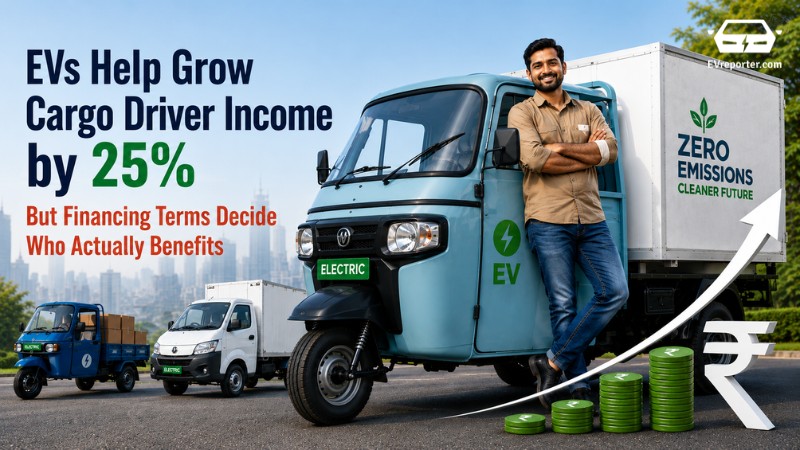
EVs Help Grow Freight Driver Income by 25% — But Financing Terms Decide Who Actually Benefits

A new study finds that owner-cum-drivers saw net income fall 41% after switching to EVs, even as lease-based and salary-based drivers gained. Smart Freight Centre and Shell Foundation say the outcome is decided not by the vehicle, but by how it is financed.
A new report from Smart Freight Centre and Shell Foundation, “Driving Income Uplift: Designing Inclusive EV Financing for India’s Freight Drivers,” finds that switching to an electric vehicle can raise a freight driver’s income by close to 25% on average, driven largely by lower fuel and maintenance costs. But, the report also shows this uplift is far from guaranteed for every driver. For owner-cum-drivers, net income fell by 41% when moving from ICE to EV operations under current, “as-is” market conditions.
The report is based on a survey of over 1,500 drivers across 11 Indian states — Punjab, Haryana, Delhi, Bihar, Karnataka, Maharashtra, Telangana, West Bengal, Madhya Pradesh and Uttar Pradesh — covering both three-wheeler (3W) and four-wheeler (4W) freight segments.


EVreporter looks at the report’s findings on driver income across business models, with commentary from Prof. Dr. Ing. Christoph Wolff, CEO – Smart Freight Centre, and Amresh Sharma, Business Development Advisor for the Transporter Portfolio at Shell Foundation.
Three operating models, three different outcomes
The report groups freight drivers into three operating models, each of which distributes financing obligations, utilisation risk and ownership benefits differently:
- Salary-based drivers earn a fixed monthly wage from a fleet or logistics company. This offers income stability and low risk, but caps their earning potential.
- Lease-based drivers operate vehicles through platform-linked lease agreements, with repayments deducted from earnings and income tied to utilisation.
- Owner-cum-drivers own and operate their vehicles independently, retaining full profits but also bearing full exposure to financing, utilisation and operational risk.
Under the report’s base EV scenario, lease-based drivers gained roughly 25%, from Rs 19,745 to Rs 24,813 upon switching to EVs. Salary-based drivers gained roughly 23%, from Rs 16,851 to Rs 20,809.
Owner-cum-drivers, however, lost roughly 41%, with net monthly income falling from Rs 32,727 under ICE operations to Rs 19,181 under EV operations.
| Driver archetype | Net monthly income – ICE | Net monthly income – base EV scenario |
| Lease-based | Rs 19,745 | Rs 24,813 (+25%) |
| Salary-based | Rs 16,851 | Rs 20,809 (+23%) |
| Owner-cum-driver | Rs 32,727 | Rs 19,181 (–41%) |
The report attributes this divergence to how loan repayments interact with financing terms. Under ICE operations, fuel is typically a driver’s biggest monthly expense. Under EV operations, EMIs become the single largest cost component — a burden the report describes as “especially high for owner-cum-driver[s].” Independent drivers, it notes, often face interest rates in the range of 16–19%, “reflecting lenders’ perception of technology risk and borrower credit risk.”
Market Design Challenge
“The key point is that the challenge isn’t the vehicle technology. It’s the way the transition is financed. Owner-cum-drivers are responsible for sourcing their own freight, managing periods of low demand and servicing often expensive loans at the same time. When interest rates can reach 16–19% and repayment periods are short, monthly EMIs become the largest cost component. In many cases, those financing costs outweigh the operational savings that EVs generate.” — Amresh Sharma, Business Development Advisor, Transporter Portfolio, Shell Foundation
“Independent owner-cum-drivers face a combination of higher financing costs, utilisation challenges and market uncertainty. Unlike drivers operating under structured lease or salary models, they carry most of the financial and operational risk themselves. The encouraging finding is that this is not a limitation of electric mobility itself. It is a market design challenge.” — Prof. Dr. Ing. Christoph Wolff, CEO, Smart Freight Centre
Risk shifts, it doesn’t disappear
Under ICE operations, a driver’s biggest exposure is to volatile fuel prices. Under EV operations, that exposure gives way to a different set of dependencies — financing terms, vehicle utilisation and access to charging infrastructure. The report notes that EVs “do not eliminate risk, they redistribute it.”
“With EVs, that risk profile changes. Risk shifts from the fuel pump to the financing model. A driver with affordable finance, strong trip volumes and access to charging infrastructure can do very well in an EV. A driver without those supports may face repayment stress even though the vehicle itself is cheaper to operate.” — Amresh Sharma, Shell Foundation
“In conventional freight operations, drivers are primarily exposed to fuel price volatility and maintenance costs. Electric vehicles significantly reduce those operating costs, but they also increase the importance of financing, vehicle utilisation, charging access and operational planning.” — Christoph Wolff, Smart Freight Centre
Why mainstream lenders remain cautious
The report calls on financial institutions to move from “cautious participation to active market enablers,” through longer loan tenures, alternative credit scoring based on utilisation and earnings data, and blended-finance mechanisms to de-risk lending.
“Many lenders are still assessing EV freight through a traditional risk lens. They see limited credit histories, informal income patterns and relatively new vehicle technologies, and that translates into higher perceived risk. We think there is a significant opportunity to use alternative data — including verified earnings, trip volumes and utilisation records from logistics platforms — to better understand repayment capacity.” — Amresh Sharma, Shell Foundation
“Electric freight is still an emerging market, and it is understandable that financial institutions are building confidence before expanding lending. As more data becomes available on utilisation, repayment behaviour and asset performance, lenders will have a much stronger basis for developing products that reflect the realities of electric freight.” — Christoph Wolff, Smart Freight Centre
What’s at stake if the gap isn’t closed
Both Sharma and Wolff point to the same risk: if owner-cum-drivers continue to see weak returns, EV adoption could concentrate among organised fleets and platform-linked drivers, leaving independent operators — a significant part of India’s freight economy — behind.
“If independent drivers continue to see weak economic returns, there’s a real risk that the benefits of electrification become concentrated among a relatively small group of fleet operators and platform-linked drivers, while a large section of the market is left behind. India’s freight transition needs to be both green and inclusive.” — Amresh Sharma, Shell Foundation
“Independent owner-drivers are an important part of India’s freight economy. If this segment cannot participate economically, the transition is likely to become slower and less inclusive. We risk creating a market where larger organised fleets electrify successfully while smaller operators struggle to participate.” — Christoph Wolff, Smart Freight Centre
Toward a more even distribution of benefits
The report’s recommendations centre on redesigning financing around driver cash flows rather than standard vehicle-lending templates: longer loan tenures (around six years), alternative credit assessment using platform utilisation and earnings data, stronger demand aggregation through platforms and fleet operators, and catalytic capital — such as first-loss guarantees and blended finance — to bring commercial lenders into segments they currently see as high-risk. It also points to two operating models already showing results in the study: platform-backed leases, and lease-to-own structures that let drivers build toward ownership over time.
“Financing products need to be designed around the realities of driver livelihoods, not around standard vehicle lending models. Longer loan tenures and lower borrowing costs can significantly improve affordability and income outcomes. Ultimately, a successful EV transition is not just about putting more electric vehicles on the road. It’s about ensuring the drivers behind the wheel can earn more, face less risk and build long-term financial security.” — Amresh Sharma, Shell Foundation
“We should expand proven models such as the Platform-backed Lease Model and the Lease-to-own Model, which reduce upfront barriers while creating pathways to ownership. Success should not be measured only by the number of electric vehicles on the road, but by how many drivers are able to build better livelihoods through the transition.” — Christoph Wolff, Smart Freight Centre
About the report
“Driving Income Uplift: Designing Inclusive EV Financing for India’s Freight Drivers” was published in July 2026 by Smart Freight Centre and Shell Foundation, based on a mixed-methods study of over 1,500 drivers across 11 states, supported by mobility platforms MoEVing, Omega Seiki Mobility and Bluwheelz. The full report is available at smartfreightcentre.org.
Also read: Shell Foundation funds $1M to Mufin Green Finance for EV financing
Subscribe & Stay Informed
Subscribe today for free and stay on top of latest developments in EV domain.