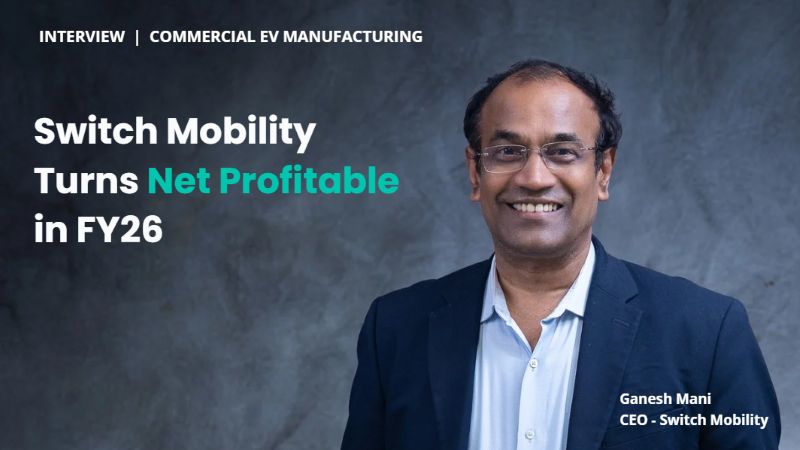
Switch Mobility Turns Net Profitable in FY26 | Interaction with CEO Ganesh Mani

Switch delivered 1,530 electric buses and 1,600 e-LCVs during FY25-26.
Ganesh Mani, CEO of Switch Mobility, discusses the levers behind achieving profitability, including a focus on scaling the right product portfolio across electric buses and light commercial vehicles, localisation levels of 60-70%, and vehicle uptime of around 98%.
Switch Mobility India achieved net profitability in FY25-26. What have been the biggest levers in getting here?
Achieving net profitability in FY26 is an important milestone and reflects the progress we have made in building a sustainable electric mobility business. One of the biggest levers has been our focus on scaling the right product portfolio across electric buses and light commercial vehicles, backed by disciplined execution across manufacturing, sourcing and operations.
We have steadily improved localisation to 60-70%, strengthened manufacturing efficiencies and optimised costs across the value chain. And, we continue to invest in technology and product development. At the same time, our focus on delivering around 98% vehicle uptime, supported by our connected mobility platform, has enabled us to build strong customer confidence and generate repeat business. Going forward, we remain focused on profitable growth by expanding our product portfolio, increasing localisation and continuing to improve operational efficiencies.
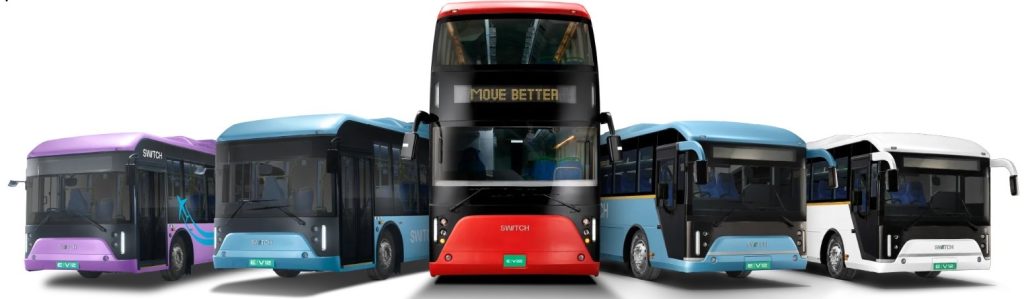
Could you provide a snapshot of Switch Mobility’s production capacity for buses and LCVs in Tamil Nadu, as well as the target for the upcoming facility in UP?
We have a total production capacity of 5,000 buses and e-LCVs across our plants.
Our green-certified manufacturing facility in Lucknow, Uttar Pradesh, has been operationalised and designed to further strengthen our production capabilities in North India. The facility features an automated paint line and a modular assembly framework that enhances manufacturing flexibility, improves supply chain responsiveness and enables us to efficiently cater to growing demand across electric buses and commercial vehicles. The plant is well equipped to handle any order size that will come.
Between the 9m, 12m, and the double-decker buses, how do you see the future demand split between these formats, and corresponding use cases?
We see each platform addressing a distinct mobility requirement. Demand will increasingly be driven by application-specific use cases rather than a one-size-fits-all approach.
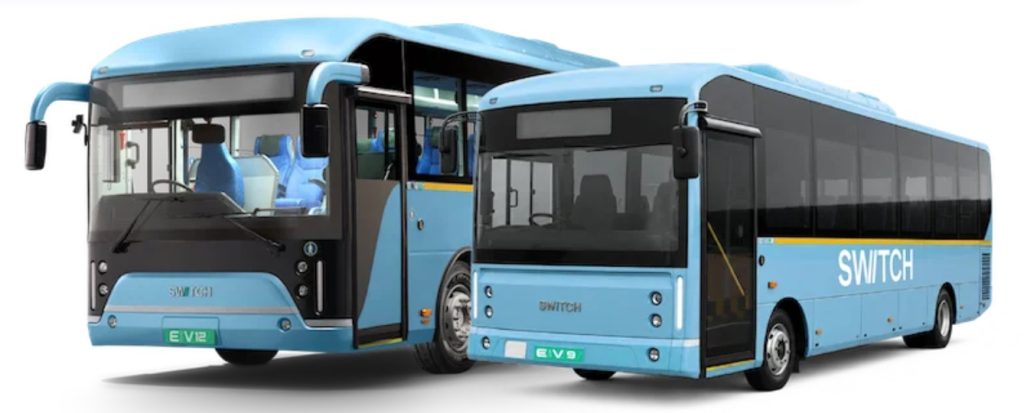
- We expect the 12-metre bus to continue accounting for the largest share of demand, particularly from State Transport Undertakings and high-capacity city operations.
- We see strong growth potential for the 9-metre segment, driven by feeder routes, employee transportation, school mobility and operations in Tier II and Tier III cities, where route flexibility and lower operating costs are important.
- Electric double-decker buses will continue to serve high-density urban corridors and tourism applications. Compared to a conventional 12-metre bus, they consume around 37% less road space and 25% less energy per passenger, making them an efficient solution for cities looking to maximise passenger movement without expanding road infrastructure.
While the double-decker segment will remain more specialised, we expect all three platforms to witness healthy growth as cities increasingly adopt purpose-built electric buses based on operational requirements.
Electric bus adoption is now moving beyond government-tender-driven demand. How do you see the order book composition changing in the next 2-3 years?
We started the current financial year with an order book of over 1,600 buses, providing strong visibility for future growth. Since then, we have added more.
Customer confidence is reflected in repeat orders and expanding deployments. For example, we have delivered 625 electric buses to MTC and have already deployed over 500 electric buses in Delhi as part of a 950-bus order. These are large-scale operations where performance is measured every day.
State Transport Undertakings (STUs), PM e-Drive and Government schemes will continue to remain key drivers of electric bus adoption. Industry volumes are expected to nearly double from around 5,300 buses last year to nearly 13,000 buses and over 25,000 buses by FY30.
At the same time, we are seeing increasing interest from private operators as the total cost of ownership becomes more favourable and electric mobility proves its operational reliability across diverse applications.
Over the next two to three years, we expect the share of private sector orders in our order book to increase steadily alongside STU procurement, particularly across employee transport, intercity, schools and tarmac services. At SWITCH Mobility, we are building a diversified portfolio to address both segments.
Can you share your approach to expanding the export business for e-buses?
The EV market is rapidly evolving, especially overseas. Our international expansion relies on a structured, phased approach. We are prioritising right-hand-drive markets where our existing platforms seamlessly align with local operational ecosystems.
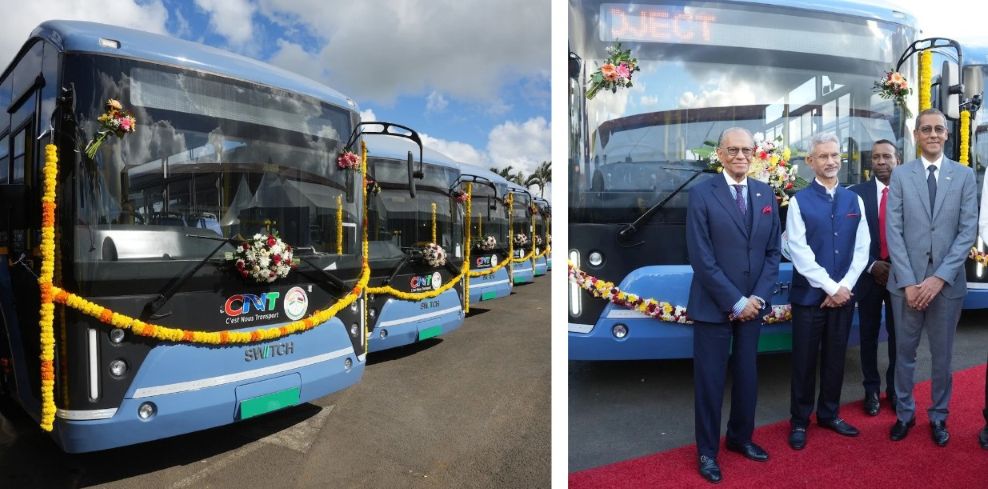
We have already built a proud footprint, delivering 100 electric buses to Mauritius, executing key cross-border deployments to Nepal and Bhutan, and engaging closely with transport authorities in Seychelles and Sri Lanka.
We also see strong demand in markets like the GCC, where we are already present.
Is OEM supply capacity the real constraint for the low volumes of electric bus and commercial vehicle registrations today?
No, OEM supply capacity is definitely not the bottleneck. As an industry, we have built robust, scalable production frameworks. At Switch, we can currently produce around 5,000 buses annually through our facilities in North and South India, which can be doubled quickly as demand increases. The historically slower volume growth was down to early-stage ecosystem challenges. Today, the industry is entering a much stronger acceleration phase. With forward-thinking policies like the ₹10,900-crore PM e-Drive scheme, mapping out long-term demand visibility and backing it up with charging infrastructure support, registrations are projected to scale up significantly. The capacity is ready; the market pull is what is expanding now.
How does the e-LCV business’s path to viability differ from the bus business?
The operational and commercial dynamics between the two segments are very different. The Bus Segment is highly organised and long-term. We have adopted a two-pronged strategy with buses – one is the GCC model and the latter is the retail model. It operates heavily on the Gross Cost Contract (GCC) model with 12-year lifecycle horizons, where state undertakings look intensely at predictable per-kilometre operational savings. Retail market has a different pull where we see increase in demand.
On the other hand, the e-LCV Segment is still at an early 2-3% penetration curve but highly agile and retail-driven. Demand is spread across B2B e-commerce logistics, municipal applications, and specialized formats like our IeV4 Reefer for cold-chain transit. We sold around 1,600 e-LCVs last year and held over 40% market share. Since eLCVs can give lower running costs, viability becomes an immediate possibility. A predictable mid-mile or last-mile urban route turns these vehicles into self-sustaining business assets much faster without relying solely on large institutional tenders.
What would be the one policy or ecosystem gap — beyond financing — that can accelerate e-bus and e-LCV adoption in India, if solved?
If I had to highlight one vital area that needs immediate, coordinated focus, it is power infrastructure readiness and depot electrification.
Under the PM e-Drive scheme alone, the government has provisioned support for 88,500 charging sites, reflecting a deliberate effort to build out charging capacity in step with vehicle deployment. While expanding public charging touchpoints is important, high-utilisation commercial fleets rely heavily on turnaround time and overnight depot charging.
As large-scale operations scale up, dense urban pockets will face exponential power loads. Streamlining utility coordination, securing faster multi-megawatt power approvals from local DISCOMs, and setting up smart, grid-ready infrastructure right inside transport depots will be the ultimate catalyst to unlock the next level of zero-emission transit in India.
This interview was first published in EVreporter Aug 2026 magazine.
Also read: SWITCH Mobility completes export of 100 electric buses to Mauritius
Subscribe & Stay Informed
Subscribe today for free and stay on top of latest developments in EV domain.