A Comprehensive Explainer on Peer-to-Peer Energy Trading in India


India’s peer-to-peer (P2P) energy trading landscape is entering a new phase, with live pilots under the India Energy Stack demonstrating how decentralized electricity markets could function at scale. In this conversation with Akhil JP, CEO & Co-Founder of Pulse Energy Technologies Pvt Ltd, we explore the latest developments in India’s P2P energy trading ecosystem, the role of digital public infrastructure, and how technology platforms are enabling consumers and prosumers to participate directly in energy markets.
What are the most recent developments in P2P energy trading in India?
India’s P2P energy trading journey reached a landmark moment in February 2026. At the India AI Impact Summit held at Bharat Mandapam, New Delhi, REC Limited — the nodal agency for the India Energy Stack under the Ministry of Power — showcased the first-ever live demonstration of a peer-to-peer decentralized energy transaction under the India Energy Stack (IES) framework.
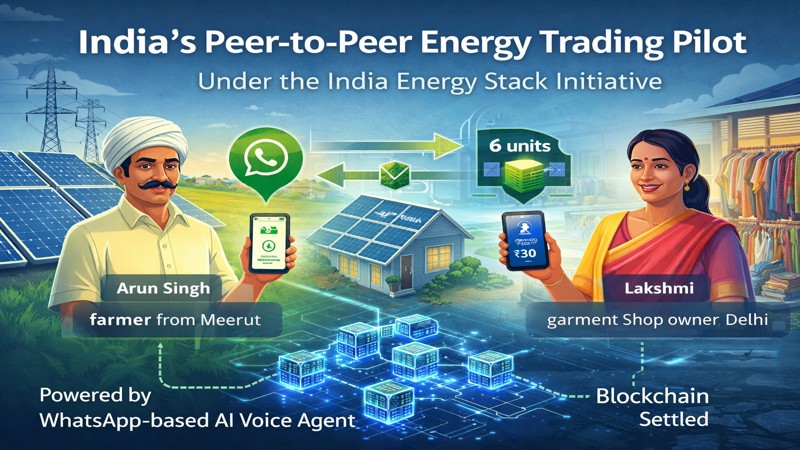
In a powerful illustration of technology meeting grassroots empowerment, Arun Singh, a farmer from Meerut in Uttar Pradesh, used Pulse Energy’s WhatsApp-based AI voice agent to sell 6 units of surplus solar-generated electricity directly to Lakshmi, a garment shop owner in Delhi, earning ₹30. The transaction demonstrated a real-world application of the IES — a Digital Public Infrastructure designed to empower citizens as active “energy agents” rather than passive recipients of electricity.
This demonstration was presented to Hon’ble Prime Minister Narendra Modi on 16 February 2026 during his visit to the MeitY Pavilion, and subsequently to Union Power Minister Manohar Lal on 18 February 2026 at the REC Pavilion. The demonstration was conducted by Shashank Misra, Joint Secretary, Ministry of Power, and Prince Dhawan, Executive Director, REC Limited, alongside one of the first beneficiaries of the P2P pilot.
Key regulatory milestones in early 2026
- DERC approval: The Delhi Electricity Regulatory Commission approved intra-discom, intra-state, and inter-state (Delhi–UP) P2P trading for a six-month pilot. Transaction charges were set at ₹0.42/kWh shared equally between buyer and seller. Wheeling and open access charges within Delhi were waived. The 20% Capacity Utilization Factor cap on solar energy transactions was removed, allowing prosumers to sell as much solar energy as they generate.
- UPERC approval: The Uttar Pradesh Electricity Regulatory Commission approved the interstate P2P renewable energy trading pilot filed by PVVNL under the India Energy Stack framework. Blockchain-based settlement was approved, with a waiver of Cross Subsidy Surcharge during the pilot.
- IES Version 0.3 released: The Ministry of Power released Version 0.3 of the India Energy Stack Architecture and Strategy documents, formalizing digital identities for energy assets, consent-based data sharing, open APIs, and shared registries. The full IES project is scheduled for completion by July 2026.

What is the role of the India Energy Stack initiative?
The India Energy Stack (IES) is best understood as the “UPI for Electricity” — an interoperable digital framework of open standards and protocols designed to enable secure, low-cost data and service exchange across the entire power sector. Just as UPI created a common rail that any bank or fintech could plug into for payments, the IES creates shared infrastructure for electricity markets — enabling any authorized technology service provider to build applications and services on top.
Core building blocks (Version 0.3)
- Digital identities for energy assets — every meter, generator, and consumer gets a Verifiable Credential (VC), functioning like a DigiLocker for energy. This confirms a participant as a genuine DISCOM consumer and enables safe trading without exposing sensitive personal data to third-party platforms.
- Consent-based data sharing — consumers and prosumers control who accesses their energy data, following principles similar to the Account Aggregator ecosystem.
- Open APIs and shared registries — allowing authorized Trade Platform Providers (such as Pulse Energy) to build P2P trading services, demand response programs, and EV charging integration on top of the stack.
- Interoperable settlement — blockchain-based transaction recording with settlement integrated into the DISCOM’s regular billing system, so consumers see P2P adjustments in their normal electricity bills.
Governance structure
REC Limited serves as the nodal agency under the Ministry of Power. FSR Global is the knowledge partner. India Smart Grid Forum (ISGF) provides technical inputs for scaling digital energy solutions. Networks for Humanity (NFH) contributes to the trust-based digital transaction framework. The IES Taskforce is chaired by Dr Ram Sewak Sharma, former Director General of UIDAI and former Chairman of TRAI — the architect behind India’s Aadhaar and digital identity infrastructure.
The IES represents a fundamental structural shift: electricity reform is now being embedded in digital infrastructure rather than relying solely on tariff orders and regulatory amendments. It connects policy, technology, and market architecture in a unified framework.
What does the value chain of P2P energy trading look like?
The P2P energy trading ecosystem involves several interconnected stakeholders, each playing a distinct role:
- Prosumers (Supply Side): Households, farmers, and businesses with rooftop solar installations who generate surplus electricity. In the pilot, Arun Singh, a farmer from Meerut, used Pulse Energy’s WhatsApp bot to list and sell his excess solar generation. Prosumers set their sell price within the regulatory framework and earn income from energy that would otherwise go back to the grid at lower net-metering rates.
- Consumers (Demand Side): Individuals and businesses who want to buy green power directly from prosumers, often at rates lower than the retail grid tariff. Early pilots have shown buy prices up to 43% lower than retail tariffs, creating a strong value proposition.
- DISCOMs (Distribution Companies): The physical backbone. Electricity continues to flow through the DISCOM’s distribution network, and all transactions are verified by them. P2P trading works alongside the DISCOM, not in place of it. In the current pilot, BSES Rajdhani (BRPL), Tata Power Delhi Distribution (TPDDL), and PVVNL are the three participating DISCOMs, together serving approximately 1.25 crore consumers.
- State Electricity Regulatory Commissions (DERC, UPERC): Provide the regulatory sandbox — setting transaction charges, waiving certain fees for the pilot, and framing commercial rules. After the six-month pilot, they will review results and set permanent regulations.
- Trade Platform Providers (TPPs): The technology layer authorized under the IES to build consumer-facing platforms. Pulse Energy is one of the authorized TPPs, bringing its AI-powered interfaces and energy domain expertise to make trading accessible to participants regardless of tech literacy.
- India Energy Stack / REC Limited: Provides the overarching digital public infrastructure — trust framework, Verifiable Credentials, interoperability standards, and open APIs.
- Smart Meters: The hardware backbone recording real-time generation and consumption. DISCOMs verify this data, and the final settlement is based on verified meter readings.
The Transaction Flow for P2P Energy Trading
Prosumer generates surplus solar power → registers on the trading platform using their DISCOM-verified Verifiable Credential → lists surplus energy for sale (e.g., via Pulse Energy’s WhatsApp AI agent) → a consumer agrees on price → transaction is recorded on blockchain → physical electricity flows through the DISCOM grid → settlement is reflected as adjustments in both parties’ regular DISCOM bills.
What is the current status of P2P energy trading in India?
P2P energy trading has moved from concept to live implementation as of early 2026.
Active pilots
- Phase 1 (live): The pilot covers the Delhi-NCR and western UP corridor with three DISCOMs: BSES Rajdhani (BRPL) and Tata Power Delhi Distribution (TPDDL) in Delhi, and PVVNL in western Uttar Pradesh. It launched with approximately 1,000 consumers per service area. PVVNL’s Managing Director noted that consumers from diverse backgrounds are being onboarded — farmers, small business owners, and domestic users.
- Phase 2 (planned): Expansion to include Dakshin Haryana Bijli Vitran Nigam (DHBVNL), extending reach into Haryana.
- Historical precedent: Earlier pilots in Uttar Pradesh (implemented by ISGF and Powerledger) demonstrated feasibility and showed P2P buy prices approximately 43% lower than the retail tariff. BSES also ran a blockchain-based pilot in Dwarka, Delhi, in 2019 covering gated community solar consumers.
Measurable goals
- Technical feasibility: Proving that interstate P2P trading works across state boundaries within the IES framework.
- Prosumer income generation: Demonstrating meaningful additional income for small prosumers — farmers, small businesses — beyond what net metering offers.
- Platform accessibility: Validating that AI-powered interfaces (like Pulse Energy’s WhatsApp bot) can make energy trading accessible regardless of tech literacy.
- Trust infrastructure: Testing the IES’s Verifiable Credentials, blockchain settlement, and DISCOM-integrated billing at scale.
- Regulatory learning: Informing permanent regulatory frameworks. Both DERC and UPERC will review pilot outcomes after six months to frame long-term P2P trading rules.
What is required to make P2P energy trading mainstream?
Scaling from pilot to mainstream requires progress on several interconnected fronts:
- National regulatory harmonization: Currently, each state regulator issues separate orders. The IES (targeted for July 2026 completion) aims to provide a unified national framework. However, interstate issues like transmission charges fall under CERC jurisdiction. A cohesive approach spanning state and central bodies is essential.
- Smart meter deployment at scale: P2P trading requires real-time metering for accurate measurement and settlement. India’s smart meter rollout is accelerating but far from universal. Without ubiquitous smart metering, P2P markets cannot expand beyond pilot zones.
- Expanding the rooftop solar base: P2P trading is only as valuable as the surplus energy available to trade. The PM Surya Ghar scheme (targeting 1 crore households by FY 2026–27) is critical, with over 20.85 lakh installations completed by December 2025. Gujarat, Maharashtra, and UP lead, but deployment remains uneven across states.
- DISCOM alignment: DISCOMs could perceive P2P trading as lost revenue. The current design — where DISCOMs earn transaction and wheeling charges and retain network management — makes them partners. But scaling requires this alignment to hold across dozens of DISCOMs with varying financial health and technical capability.
- Consumer awareness and digital literacy: Most consumers are unfamiliar with P2P trading. AI voice agents and WhatsApp-based interfaces (as demonstrated with Pulse Energy’s bot) lower the accessibility barrier, but mass adoption requires sustained awareness campaigns, especially in rural areas where prosumer potential is highest.
- Grid infrastructure upgrades: Distributed P2P transactions from numerous small prosumers could introduce grid complexities — voltage instability, reverse power flow, balancing challenges — especially in older distribution networks. Advanced load management and local energy storage will be needed.
- Wheeling charge standardization: A clear, nationally consistent framework for network usage charges is essential. The pilot uses ₹1.01/kWh for interstate wheeling, but this needs validation and standardization at scale.
- Platform interoperability: As multiple Trade Platform Providers operate under the IES, interoperability between platforms is critical — a prosumer on one platform should be able to sell to a consumer on another, just as UPI allows transfers between different banks.
How does Pulse Energy’s platform facilitate P2P energy trading?
Pulse Energy is one of the authorized Trade Platform Providers (TPPs) selected under the India Energy Stack initiative. The platform’s core differentiator is its focus on accessibility through AI-driven interfaces — making energy trading as simple as sending a WhatsApp message or downloading the SUPEREV mobile app.
The platform in action
- WhatsApp-based AI voice agent: Pulse Energy has built a conversational AI agent accessible via WhatsApp — India’s most ubiquitous messaging platform. This was the interface used by Arun Singh, the farmer from Meerut, to place his sell trade during the live demonstration to Prime Minister Modi. Rather than requiring users to download a new app or navigate complex interfaces, the platform meets users where they already are. Even participants with limited digital literacy can place trades, check balances, and manage energy transactions through natural-language voice and text interactions.
- SUPEREV Mobile app: Pulse Energy offers SUPEREV, a mobile app that consumers can download to start purchasing green energy directly from prosumers. SUPEREV provides an intuitive interface for browsing available energy, comparing prices, and completing purchases. All transactions are reflected in the participant’s regular DISCOM electricity bill, so there’s no new billing relationship to manage. This dual-interface approach — WhatsApp for maximum reach, SUPEREV for a richer experience — ensures Pulse Energy can serve the full spectrum of users, from rural farmers selling surplus solar to urban consumers buying green power.
- A central transaction layer: Every P2P trade is recorded on trade ledger, ensuring transparency, and trust between parties. The transaction layer handles bid matching, price discovery, and settlement recording, while financial settlement is integrated into the DISCOM’s regular billing system.
- DISCOM-integrated billing: Trades are not settled through separate payments. Energy bought and sold is adjusted in the participant’s regular DISCOM electricity bill, eliminating the friction of managing separate accounts.
- Verifiable Credential integration: The platform integrates with the IES trust framework. A prosumer’s connection details, meter data, and solar capacity are verified by the DISCOM, and this verified identity is used on the trading platform — ensuring only genuine participants transact.
Supporting both demand and supply sides
- For prosumers (supply): The platform enables farmers, households, and businesses with rooftop solar to monetize surplus generation beyond net metering. The WhatsApp AI agent guides prosumers through registration, listing available energy, setting prices, and tracking earnings. For a farmer like Arun Singh, this means additional income with zero incremental effort — the bot handles the complexity.
- For consumers (demand): On the demand side, Pulse Energy offers SUPEREV, a mobile app that consumers can download to start purchasing green energy directly from prosumers. SUPEREV provides an intuitive interface for browsing available energy, comparing prices, and completing purchases. For users who prefer not to download an app, the WhatsApp AI agent offers the same functionality — a consumer can simply ask for the best available rate, and the system presents options. Regardless of the interface used, all transactions are reflected in the participant’s regular DISCOM electricity bill, so there’s no new billing relationship to manage. This dual-interface approach — WhatsApp for maximum reach, SUPEREV for a richer experience — ensures Pulse Energy can serve the full spectrum of users, from rural farmers selling surplus solar to urban consumers buying green power.
How does P2P trading tie up with Pulse Energy’s EV charging network?
This is where Pulse Energy’s positioning becomes uniquely powerful. The company operates one of India’s largest EV charger management and interoperability platforms, with access to thousands of charging points (including a partnership with HPCL’s HP e-Charge, integrating 5,000+ chargers). The convergence of P2P energy trading and EV charging creates compounding value:
EV charging stations as flexible demand in P2P markets
EV charging stations represent significant, controllable electricity demand. In a P2P framework, charging station operators (CPOs) can buy surplus solar energy from nearby prosumers at rates below grid tariffs. This is especially compelling during daytime hours when solar generation peaks and many EVs are parked for workplace or destination charging. Pulse Energy’s platform can intelligently match local solar supply with charging demand, optimizing for price, timing, and grid conditions.
Green energy certification for EV charging
Pulse Energy has been working with the Beckn Protocol team on the Unified Energy Interface (UEI). Through UEI, EV chargers on Pulse Energy’s network can verifiably dispense green energy. P2P trading provides the provenance layer: when a CPO buys solar energy from a prosumer through the IES framework, that energy’s renewable origin is blockchain-verified, enabling credible green charging claims for fleet operators and ESG-conscious consumers.
Shared digital infrastructure
Pulse Energy’s existing capabilities — OCPP-based charger management, real-time energy transaction processing, payment settlement, ML-based demand optimization — are directly transferable to P2P trading. The technology stack for managing a charging session (authenticate user, meter energy flow, record transaction, settle payment) is architecturally identical to a P2P energy trade. Pulse Energy extends the same platform to a new transaction type rather than building separate infrastructure.
Network effects and data advantages
Access to a large charger network, CPO partnerships, and a growing base of EV owners on the SUPEREV app creates demand-side liquidity that plugs directly into P2P markets. EV owners already using SUPEREV for charging can seamlessly access P2P green energy purchasing within the same platform experience. Data on charging patterns, energy consumption, location-level demand, and grid conditions provides a compounding intelligence layer — enabling better price discovery, demand forecasting, and grid-balancing services that benefit both ecosystems.
For more information, contact Pulse Energy.
Also read: Pulse Energy integrates HPCL’s HPe Charge EV network into unified access platform
Subscribe & Stay Informed
Subscribe today for free and stay on top of latest developments in EV domain.