Building EV Charging Infrastructure for Commercial and Industrial Vehicles

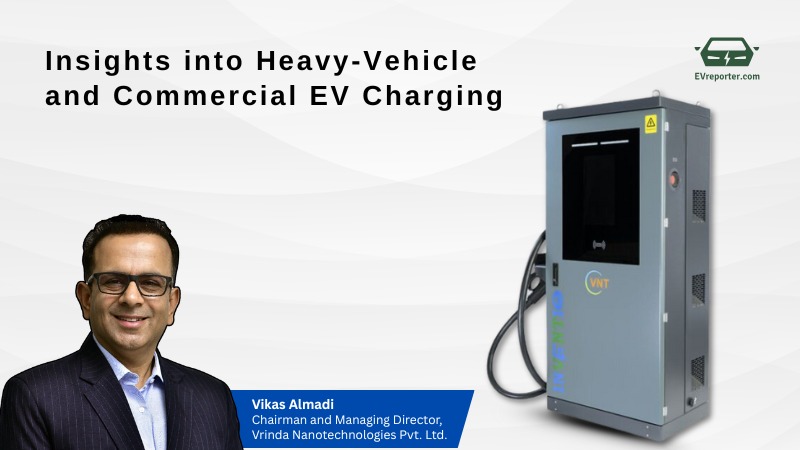
In this interview, Vikas Almadi, Chairman and Managing Director of Vrinda Nanotechnologies Private Limited, discusses VNT Charging Solutions’ growth from AC home chargers to high-power DC and megawatt-class chargers for buses, trucks, and industrial EVs, and the development of a complete nationwide charging ecosystem. The interview covers design differences between heavy-vehicle and passenger chargers, infrastructure needs and factors driving heavy-duty EV adoption, and VNT’s plans to scale production for India’s fleet electrification.
1. What is the current scale of operations at VNT Charging Solutions, and what are your main areas of focus?
VNT Charging Solutions has expanded significantly over the past few years, growing from a provider of AC home and commercial chargers into a company developing high-power DC fast chargers for buses, trucks, and heavy industrial EVs. The product portfolio now includes AC chargers from 3.3 kW to 22 kW, DC fast chargers ranging from 60 kW to 640 kW, and megawatt-class systems designed for the mining industry. Our broader goal is to deliver a complete charging ecosystem for home, commercial, fleet, and heavy-vehicle applications, with a nationwide service network available exclusively through VNT.
2. For heavy vehicles like buses and trucks, what is the typical power rating of DC chargers? Do mining EVs require different ratings?
For public transport buses and long-haul trucks, DC chargers typically range from 120 kW to 640 kW, depending on dwell times and operational needs. Fleet depots commonly use chargers in the 180–240 kW range, while bus charging locations require around 320 kW, and mining applications require chargers in the 640 kW-1 MW range. Mining and construction EVs operate under far more demanding duty cycles and in tough environmental conditions; therefore, to meet these needs, VNT has developed 1 MW fast-charging systems tailored explicitly for large dumpers and industrial EVs.
3. How do design considerations differ between heavy-vehicle chargers and chargers for passenger cars or 2/3-wheelers?
Heavy-vehicle chargers must handle much higher power levels, continuous duty cycles, and harsh environmental conditions. They require advanced liquid-cooling systems for cables and power modules, along with rugged enclosures built to withstand dust, vibration, and extreme temperatures. Their electrical architecture incorporates larger rectifiers, higher current output, and enhanced protective systems to ensure safety and reliability.
4. What kind of grid and civil infrastructure is required for heavy-vehicle charging?
Heavy-vehicle charging depends on the availability of a stable grid, especially at power levels above 400 kW. This typically involves dedicated high-capacity transformers ranging from 500 kVA to multi-MVA, as well as HT/LT panels and switchgear designed for continuous high-current operation. Large chargers require liquid-cooling arrangements to manage heat dissipation. In remote or mining locations, charger availability and serviceability play a major role.
5. What factors will determine the success of EVs in the heavy-duty category?
The success of heavy-duty EV adoption will depend on maintaining high efficiency and high uptime of charging infrastructure, ensuring the availability of high-power charging across depots, highways, and industrial areas, and achieving advancements in battery technology that support faster charging and longer lifespan. Policy support and incentives for fleet electrification will also play a critical role. Reliability and service remain key priorities, as heavy-vehicle operators cannot afford operational downtime.
6. Could you tell us about VNT’s manufacturing setup for EV charging equipment and your plans to grow in the heavy-vehicle charging space?
VNT operates a vertically integrated manufacturing setup where chargers are designed and built in-house using expertise in power electronics, energy systems, and industrial automation. The company manufactures AC wall boxes, DC fast chargers up to 640 kW, megawatt-class chargers for industrial EVs, and advanced energy management and control systems. Growth plans include deeper investment in megawatt-level R&D, building strategic partnerships with OEMs and mining companies, strengthening capabilities to ensure 24/7 uptime, and scaling production capacity to support growing fleet electrification needs. VNT has established itself as a trusted market leader in rugged, high-power charging solutions for commercial and industrial electric vehicles across India.
Also Read: Decoding Neenjas Electric’s Approach to Future-ready EV Charging Solutions
Subscribe & Stay Informed
Subscribe today for free and stay on top of latest developments in EV domain.