Production Linked Incentive (PLI) scheme for automobile and auto component industry

Authored by Gurusharan Dhillon, Director – eMobility at Customised Energy Solutions.
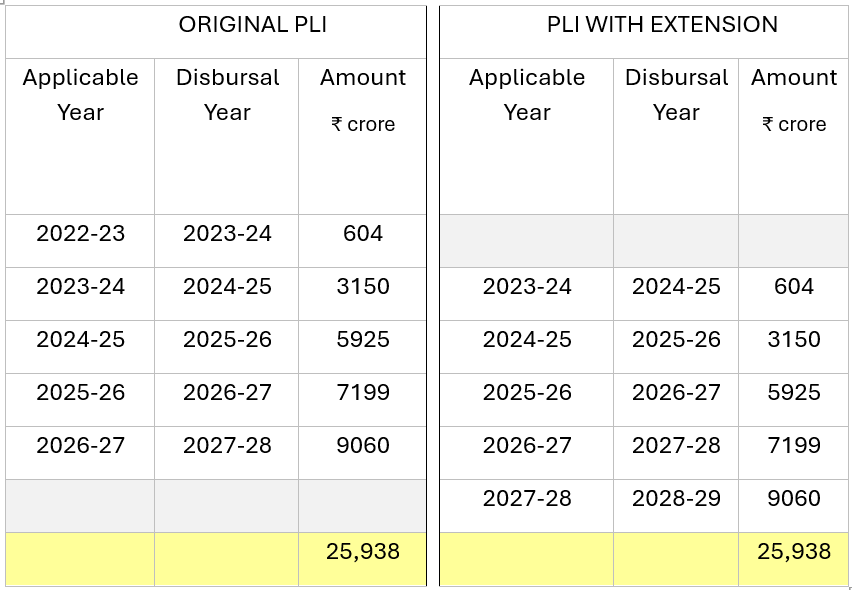
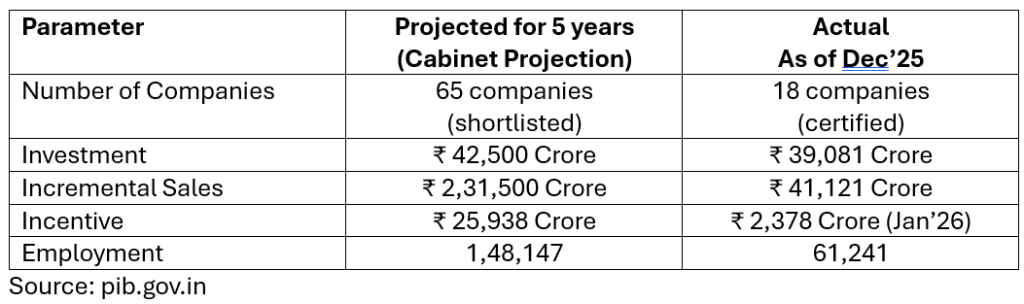
The Union Cabinet approved the Production Linked Incentive (PLI) Auto Scheme in September 2021 for 5 year duration (FY2022-23 to FY2026-27) with budgetary outlay of ₹ 25,938 crore.
Objectives
The scheme offers financial incentives to boost domestic manufacturing of Advanced Automotive Technology products and attract investments in the automotive manufacturing value chain.
The main objectives of PLI are overcoming cost challenges, creating economies of scale, employment generation, building robust supply chain for Advanced Automotive Technology (AAT) Products and facilitating industry to move up the value chain into higher value added products.
Target Segments
The scheme is sub-divided into Champion OEM Incentive Scheme and Component Champion Incentive Scheme.
The Champion OEM Incentive scheme is a sales value linked scheme, applicable on Battery Electric Vehicles and Hydrogen Fuel Cell Vehicles of all segments, 2 wheelers, 3 wheelers, passenger vehicles, commercial vehicles, Tractors, Automobile meant for Military use and any other Advanced Automotive Technology vehicle as prescribed by MHI depending upon technical developments.
Tenure
The tenure of the Auto PLI scheme is for 5 year period starting from FY 2023-24 to FY 2027-28 with disbursal after one year and effective period from FY 2024-25 to FY 2028-29
Eligibility Criteria
While incentive is linked to sales value, companies eligible for shortlisting need to meet both Revenue and Investment criteria.
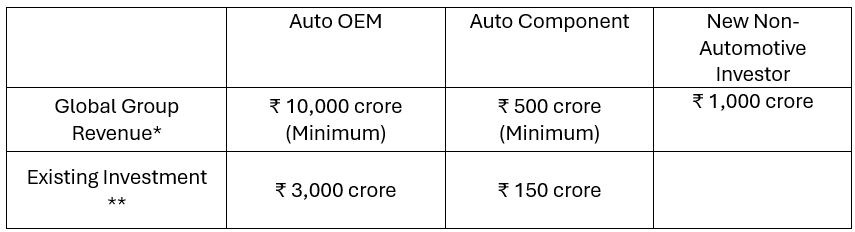
* From automotive and/or auto component manufacturing
** Global Investment of Company or its Group Company(ies) in fixed assets (gross block)
The PLI scheme also encourages applications from Non-Automotive companies or its Group company(ies) provided they present a clear business plan to invest in India and to generate revenues from Advanced Automotive Technology vehicles or Advanced Automotive Technology components manufacturing.
Investment Timeline
One of the main objectives of the scheme is to attract investments in the automotive manufacturing value chain and government plans to attract over ₹42,500 crore in committed investment through the Production Linked Incentive (PLI) scheme for the automobile and auto component industry.
All approved applicants need to cumulative investment condition for each year with investments made from 1st April 2021 duly considered.
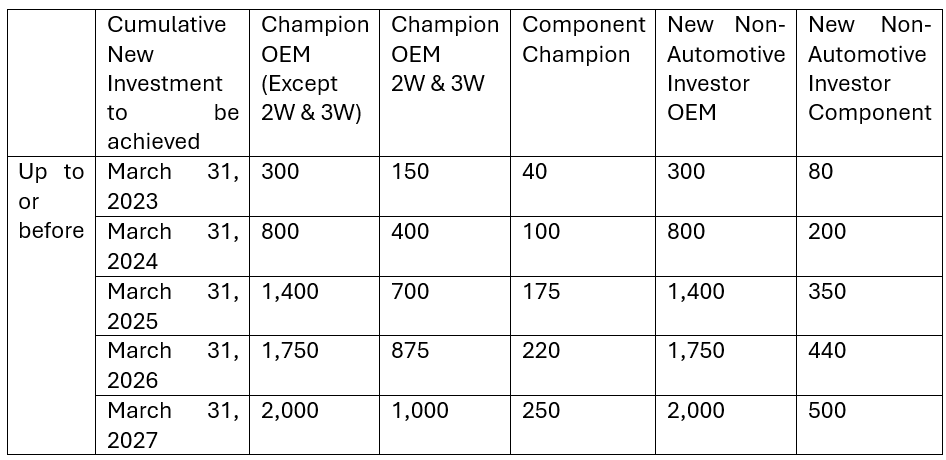
For Non-Automotive Investor, the investment requirements are aligned with the Champion OEM (Except 2W & 3W) threshold, regardless of the specific vehicle segment being manufactured. By pegging investment requirement at ₹2,000 crore, the government ensures that only “Global Champions” or well-funded entities participate in the PLI scheme.
While the investment threshold is higher (matching the 4W/CV segment), the incentive structure allows non automotive investors to manufacture any eligible AAT vehicle (2W, 3W, 4W, or CV) and still claim the benefits of the Champion OEM scheme.
Domestic Value Addition
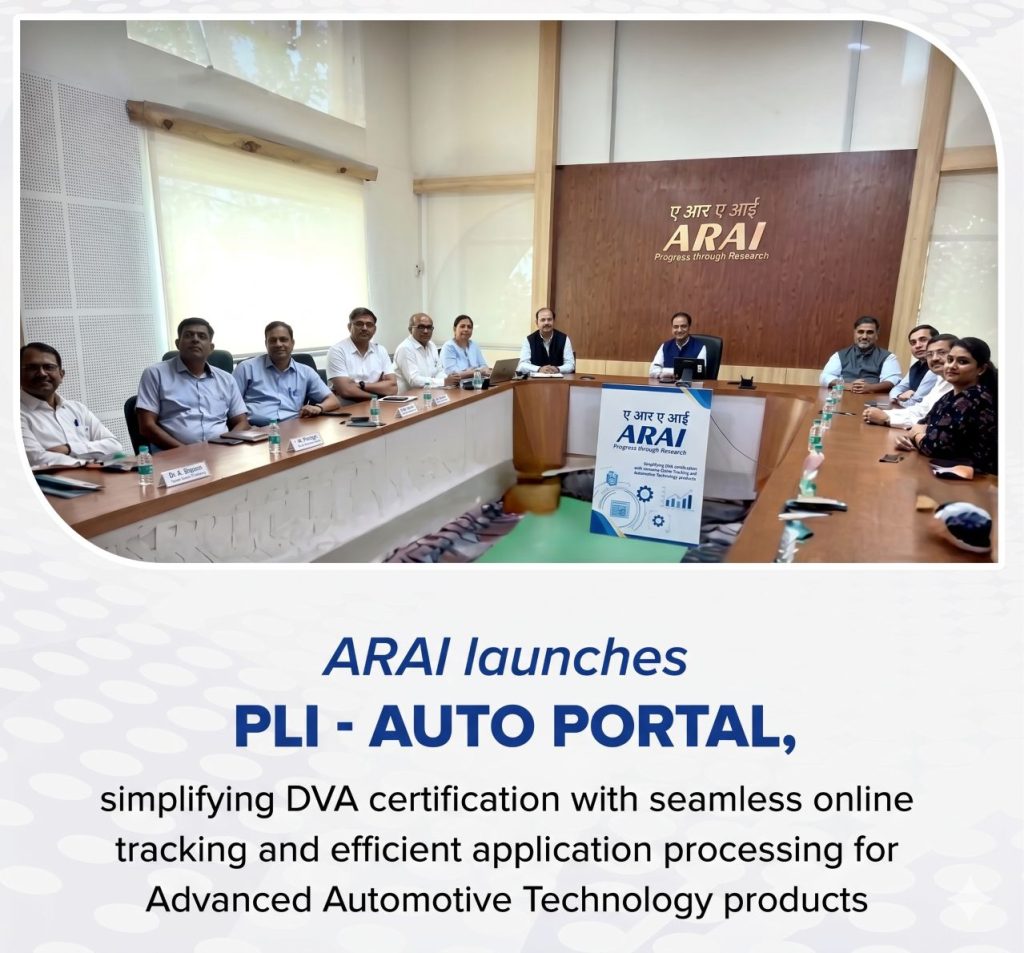
To claim incentives, an approved applicant must prove that their Advanced Automotive Technology (AAT) product achieves a minimum of 50% DVA.

DVA content needs to be certified by Certification agencies designated by MHI (ARAI, ICAT, NATRAX and GARC).
Incentive Structure
Incentive payout is linked to shortlisted companies meeting Investment as well as Domestic Value Addition criteria.
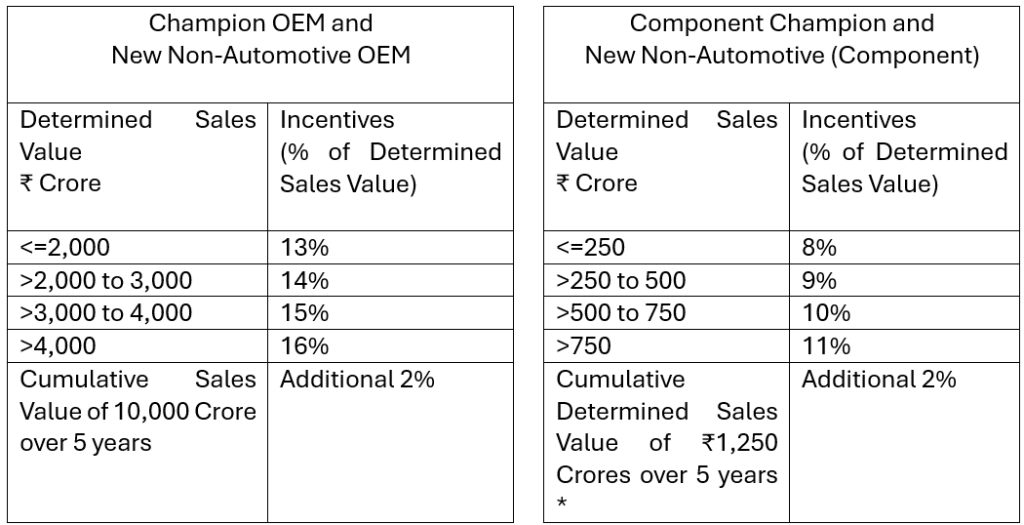
*Battery Electric vehicles & Hydrogen fuel cell vehicles components: Additional 5%
Maximum incentive per company Total Incentive per entire Group company(ies) is capped at ₹ 6,485crore (25% of total incentives outlay under this Scheme).
PLI Shortlisted Companies
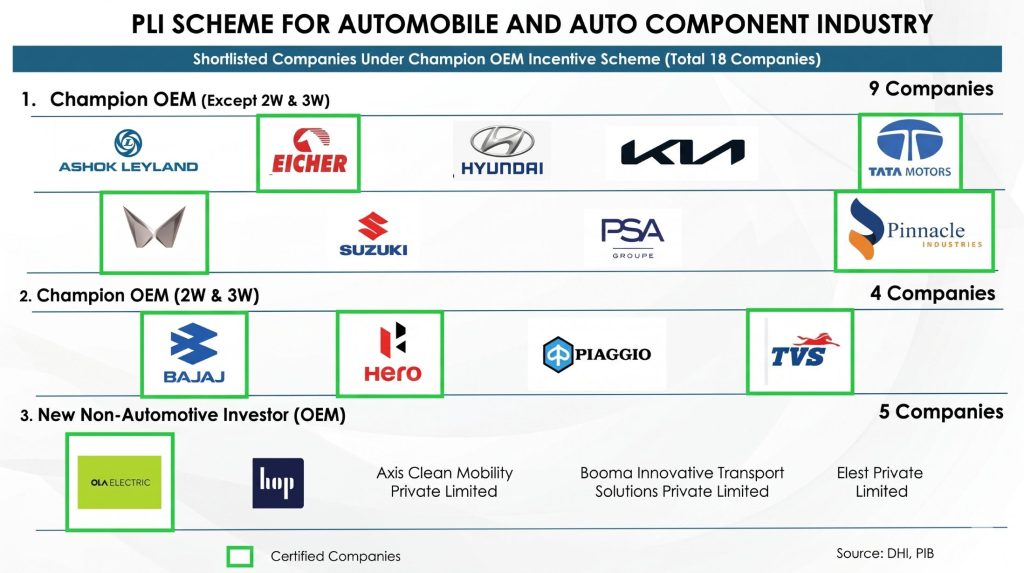
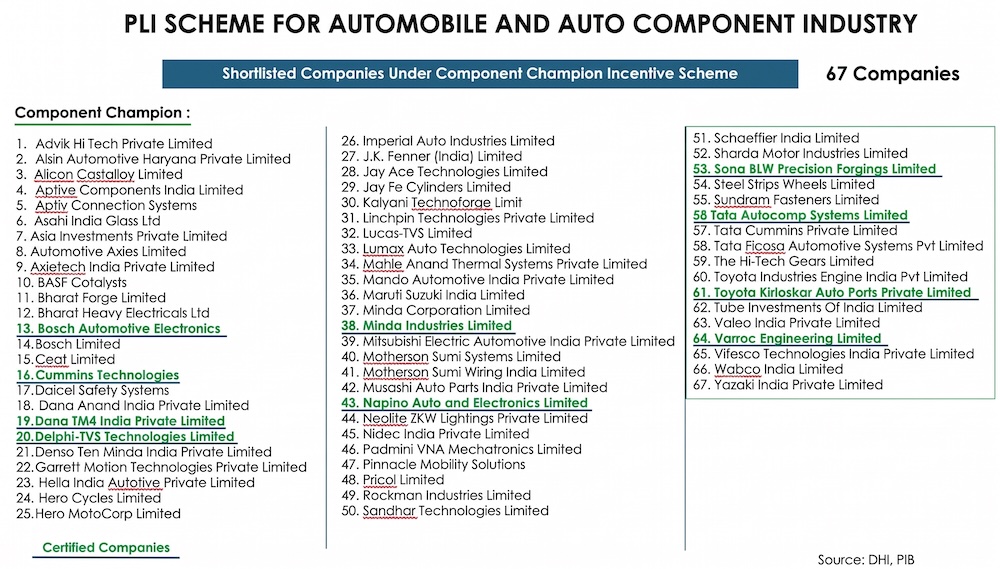
18 Auto OEM and 67 Auto component companies (total 85 companies) shortlisted under the scheme are required to achieve Domestic Value Addition (DVA) of 50% to be eligible for incentives.
Current Situation: PLI Performance Overview
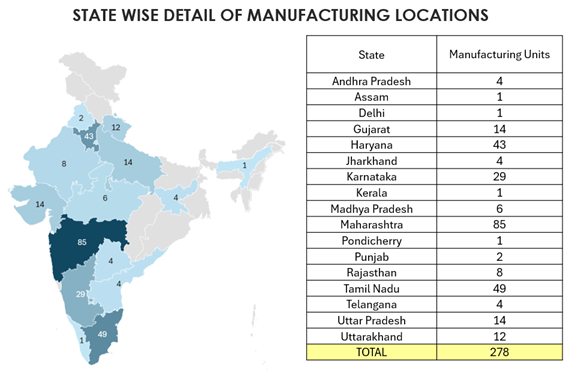
State Wise Manufacturing Investment
The Auto PLI has been instrumental in attracting investment to major states across India equally generating new employment opportunities in the automotive and auto component industry.
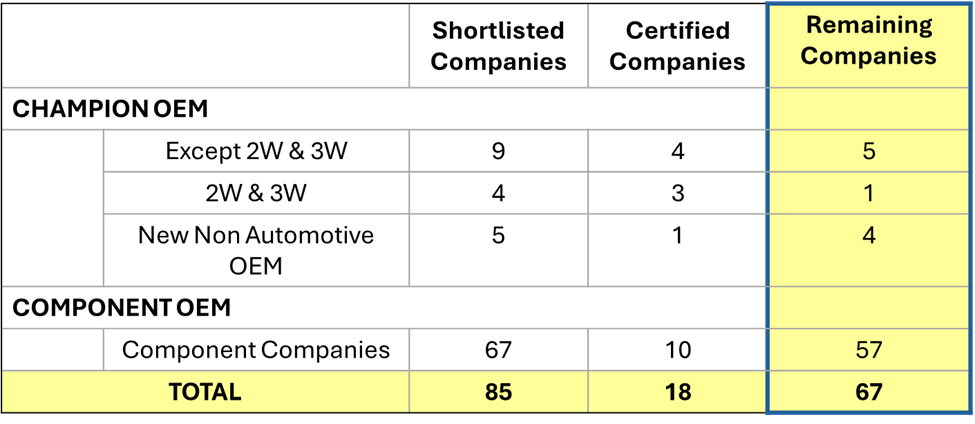
Number of Certified Companies
Of 85 companies shortlisted under the Auto PLI scheme, 18 companies have successfully met cumulative incremental investment and achieved DVA compliance certification as of May’2026.
FY 2023-24 7 companies
FY 2024-25 8 companies
FY 2025-26 3 companies
TOTAL 18 companies
Certification Challenges
Major challenges being faced by companies (mainly component companies) still to be certified (57 companies) include:
- Domestic Value Addition
The most significant hurdle is the mandatory 50% DVA requirement. Many AAT components, especially sensors, power electronics, and advanced semiconductor based modules, still rely either on imported subcomponents or raw materials.
- DVA Certification
Standard Operating Procedure for DVA calculation is quite rigorous, including audit requirement of detailed break up of every sub-component and across entire supply chain (Tier 2 and Tier 3 vendors).
Additionally, certification process is entirely online and integration of existing ERP systems with PLI Auto portal for automated data transfer is taking longer than planned.
- Investment and Sales
The scheme requires meeting both cumulative investment threshold and Determined Sales Value (DSV) of AAT products. Many component OEMs have met their investment targets, however their sales of eligible AAT products have not met year on year growth benchmarks.
Since incentives are only paid on incremental sales over base year (FY 2019-20). If an OEM’s eligible Advanced Automotive Technology (AAT) sales do not meet specified growth thresholds, they don’t get the payout for that year, even though they are approved for the scheme.
Current Situation
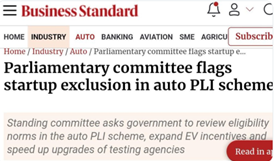
While Ministry of Heavy Industries (MHI) is firm that the PLI scheme is designed to create Global Champions, Department Related Parliamentary Standing Committee on Industry has made the following key recommendations on Demands for Grants (2026-27) of the Ministry of Heavy Industries (MHI) to the Parliament as below:
- Adopt conservative, pipeline-based budgeting with quarter-wise expenditure roadmaps tied to verified applicant claims, avoiding repeat Budget Estimate (BE)-Revised Estimate (RE) slippages.
- Establish a high-level monitoring mechanism with monthly progress reviews of approved applicants’ capacity commissioning, sales scaling and domestic value addition (DVA) certification.
- Analyse and address segment-specific bottlenecks, including OEM eligibility thresholds that may exclude domestic start-ups, through calibrated eligibility relaxations.
- Prepare contingency plans including reallocation of unutilized funds to high-performing segments or complementary schemes.
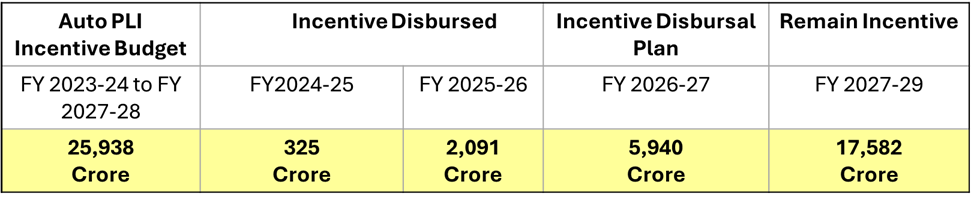
There is still over ₹17,500 crore left in the original ₹25,938 crore budget. This is reserved for the final years of the scheme (FY28 and FY29), where the government expects even more component manufacturers and newer EV entrants to reach full-scale production.
With less than 12 months to go, and with Parliamentary Standing Committee recommendations on hand, there is possibility of calibrated eligibility relaxations to ensure inclusivity, outcome-based monitoring (maturing of supply chain/ease of certification) along with time bound implementation in the final run up to the Auto PLI scheme.
About the author

Gurusharan Dhillon is an automotive professional with 30+ years of expertise in strategy, operations, sales and marketing. He currently serves as a Director of eMobility at Customised Energy Solutions. With a focus on the electric mobility sector, Dhillon specializes in Powertrain, Battery Technology, Charging Infrastructure, and emerging technologies. He has worked with leading automotive OEMs like Toyota, Nissan, Honda and Hyundai.
Also read: EV startups feel left out of PLI scheme for auto and auto components
Subscribe & Stay Informed
Subscribe today for free and stay on top of latest developments in EV domain.