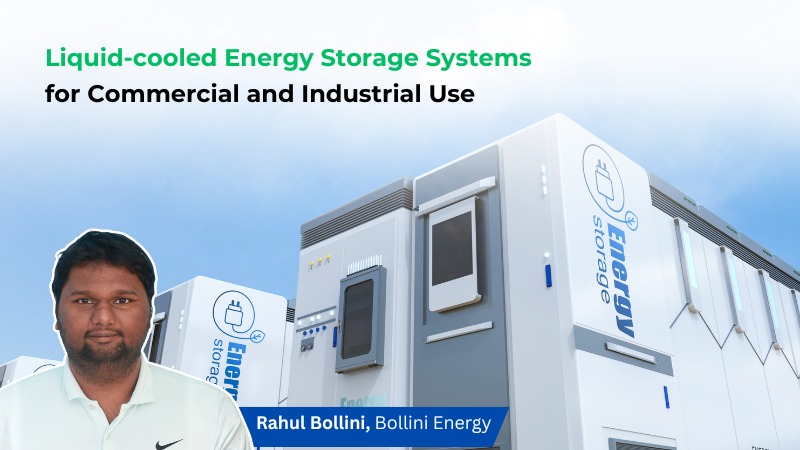
Liquid-cooled Energy Storage Systems for Commercial and Industrial Use

Lithium-ion-based Energy Storage Systems (ESS) have been on the rise for commercial and industrial (C&I) applications. Liquid-cooled ESS have gained popularity and are quickly replacing the traditionally used air-cooled ESS, which was preferred for many years. Liquid-cooled ESSs are widely produced in China and shipped globally, and Indian companies have also begun manufacturing them.
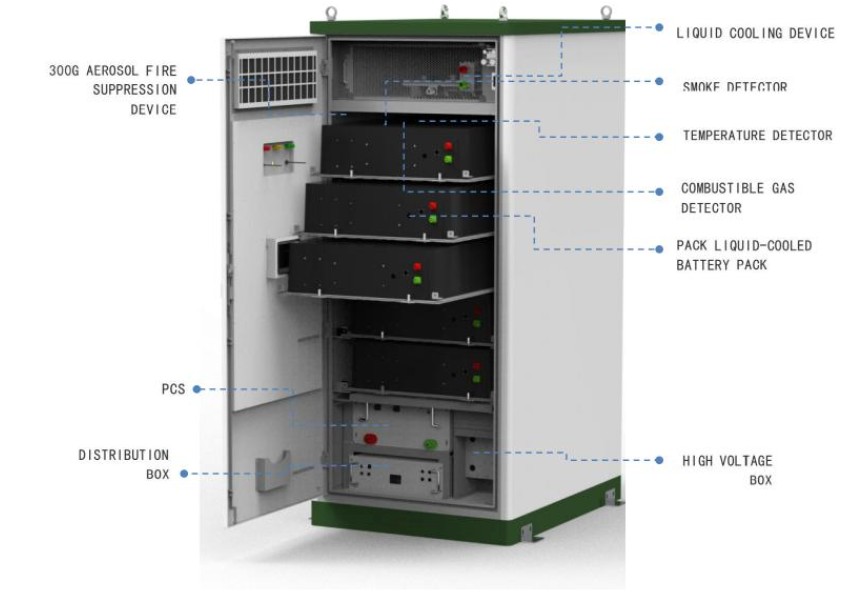
Image: Breakdown view of 125kW/261kWh Liquid-cooled ESS
Advantages of Liquid-cooled ESS
- Low system footprint due to the use of 52S1P battery packs. An all-in-one 261kWh battery system requires only 1.4 m² of floor space.
- Higher precision of cooling control across the whole system. Faster cooling with lower power consumption, enabled by contact-based cooling.
- Battery packs have an IP67 rating, making them more robust. Battery packs used in air-cooled systems have only an IP20 rating to allow air to pass inside, and they use fans as exhaust to remove hot air. The hot air coming out of the exhaust needs to be channelled so it does not recirculate back into the container.
Uses of Energy Storage Systems for C&I Applications include:
- Charge during low-cost off-peak power and discharge during high-cost peak power every day.
- Used for low-cost access to rooftop Solar PV or open access Solar PV energy for on-grid projects.
- For off-grid applications, it is paired with Solar PV. This is popular in remote locations without grid access.
- During a power outage. It can also integrate with a diesel generator (DG), with the ESS operating for the first few hours until it reaches a low battery state, and then the DG can take over. If the power-cut pattern is well known, ESS can even replace the DG entirely.
- During peak power demand, when the grid connection power is insufficient. It comes in handy when the enterprise is running some extra loads for a short period.
Points of Consideration while Using ESS:
- Perform a preventive health check of the battery as per the manufacturer’s recommendations.
- Do not let the ESS remain at a very low SoC (state-of-charge) level for a long time.
- Keep a note of the expiry date of the fire suppression system tank and get it refilled timely.
- Most of these C&I systems have an IP54-rated outer enclosure and can be installed outdoors. But it is better to have a top cover to prevent rain and direct sunlight.
- If using ESS for a power outage application, it is important to note that both PCS (power conversion system) and EMS (energy management system) must support off-grid mode, and the installer must confirm the switchover time requirement for the project. A static transfer switch (STS) can be used when a very low switchover time is required, such as a few milliseconds.
- If integrating ESS and DG, an automatic transfer switch (ATS) would be required.
- Auxiliary power consumption for this system requires 230VAC single-phase power.
- If one project has multiple locations where the battery can be connected, it is important to match the power capability at the connecting point at the LT panel. If the load exceeds the inverter’s capacity, it can cause the power from the ESS to trip.
- In a project, if there are not enough connection points available at the LT main panel to connect multiple ESS, it is recommended to use an AC combiner box to combine all the AC outputs from multiple ESS, with a single output from the AC combiner box connected to the LT main panel.
About 125kW/261kWh ESS:
It is the most popularly produced liquid-cooled model for C&I applications. It uses 314Ah LFP cells. This is an upgrade of the previously produced 100kW/233kWh model that used 280Ah LFP cells.
- 314Ah LFP cells have minimum 8,000 cycles at 0.5C/0.5C at 25°C operation. At the system level, these cells can achieve at least 6,000 cycles or 15 years (whichever comes first) when active cooling is enabled (air or liquid).
- There are 314Ah LFP cells with a minimum of 10,000 cycles at 0.5C/0.5C at 25°C operation, and they can achieve at least 8,000 cycles or 20 years (whichever is earlier) at the system level when active cooling is enabled.
- It uses 5 battery packs in a 52S1P configuration. System nominal voltage is 832V (5×52×3.2V). The battery operates between 650V (5×52×2.5V) and 949V (5×52×3.65V) on the DC side.
- The battery pack has aluminium plates at the bottom where the liquid coolant (a mix of deionised water and glycol) flows to control the cells’ temperature. There is inlet and outlet piping for each battery pack, which leads to the liquid-cooling unit.
- The PCS used in the system has the ability to operate between 650V and 950V and provides 380V/400V/415V AC 3-phase output, and also has a neutral wiring for single-phase loads.
- The 125kW PCS can continuously operate at up to 137.5kW (110% power).
- This product is modular. Multiple units of these systems can be paralleled to increase a project’s capacity. EMS can communicate with each other, with one acting as the master EMS. Sometimes, an industrial computer is used to control all the EMS for a project with multiple ESS.
- EMS used in the ESS has online connectivity and can be remotely controlled.
- The system can also include a UPS to power critical loads, such as a fire suppression system and BMS, for a while.
- These systems come with a 5-year standard warranty for the whole system, and an extended warranty may be available from the manufacturer at an additional cost. An extended warranty may not always cover the entire system.
- A 125kW/261kWh system weighs around 2500 kg.
About the author
Rahul Bollini, Bollini Energy
Rahul is an R&D expert in Lithium-ion cells with 10 years of experience. He founded Bollini Energy to assist in deep understanding of the characteristics of Lithium-ion cells to EV, BESS, BMS and battery data analytics companies across the globe. Contact | +91-7204957389; bollinienergy@gmail.com.
This interview was first published in EVreporter Jan 2026 magazine.
Also read: Understanding energy storage systems for commercial and industrial (C&I) applications | Part 2
Subscribe & Stay Informed
Subscribe today for free and stay on top of latest developments in EV domain.