Charging India’s EV revolution: Bridging the gap between ambition and infrastructure reality

Executive Summary
India’s electric mobility journey has rapidly accelerated in recent years – propelled by supportive government policies, rising environmental consciousness, and a surge in EV adoption across two-, three-, and four-wheeler segments. However, the expansion of charging infrastructure – the backbone of electric mobility – still significantly lags behind the pace of EV uptake. This article explores the current operational charging network, benchmarks expected charger requirements, and examines a real case study from major cities to highlight key gaps and policy implications.
1. India’s EV Penetration and Charging Infrastructure: The Big Picture
Electric vehicles in India are seeing steady adoption, with projections indicating EV penetration well above 7% of new vehicle sales in the near term and trending upward as electrification scales.
However, infrastructure must grow at least proportionally to support this shift:
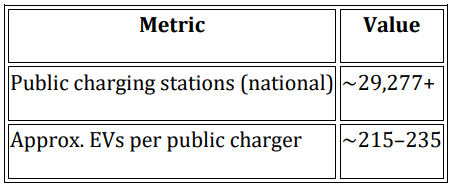
- Official data suggests around 29,000+ public EV charging stations are operational nationwide as of mid-2025.
- Despite this growth, there remains only approximately one public charger for every ~215–235 EVs on the road – a figure that underscores the infrastructure shortfall relative to current EV deployment.
These gaps are more glaring when benchmarked against global leaders in EV infrastructure density and usability.
2. Numbers Tell the Story: What Infrastructure India Has vs. Needs
- Current Operational Infrastructure (2025):
- Projected Requirement by 2030:
Industry and policy estimates indicate that India will need over 1.3 million charging stations by 2030 to match projected EV adoption and future penetration targets.
This implies an annual installation target of 300,000-400,000 new chargers for the next decade – a rate that far outpaces current deployment figures.
3. Operational Realities: Case Study – NCR & Western India
Delhi & NCR: A Stark Example
A recent official assessment reveals that Delhi alone needs ~36,177 charging points to adequately support current and near-term EV owners. Yet, on the ground, it has only about 8,998 operational chargers – a shortfall of over 27,000 points.
Neighboring urban clusters in the National Capital Region (NCR) – such as Noida and Greater Noida – show a similar pattern: existing charging stations are rapidly expanding but still fail to match demand from a growing EV fleet.
Impacts of the Shortfall:
- Longer waiting times at charging hubs
- Planned long-distance EV trips constrained due to uncertain charging availability
- Delay in adoption confidence among potential EV buyers
Tier-2 State Constraints: Madhya Pradesh Snapshot
In Madhya Pradesh, the situation is more acute: there is approximately 1 public charger for every 200 EVs.
This highlights significant disparities between urban centers with proactive infrastructure strategies and states where infrastructure growth is lagging behind EV adoption.
4. Charging Deployment: Quality vs. Quantity
Numbers alone don’t capture the usability of infrastructure. Indian EV users often report challenges such as:
- Chargers reported online but not functional on arrival
- Connectivity outages affecting remote or suburban stations
- Uneven deployment of DC fast chargers vs. slow AC chargers – impacting long-distance travel convenience
These realities emphasize the importance of charger uptime, proper location planning, and maintenance regimes – not just counting installations.
5. Policy Push and Industry Response
Major Initiatives Fueling Growth
Several government schemes, including FAME-II, PM E-Drive and state EV policies, aim to incentivize charger rollout through capital subsidies and streamlined approvals.
Industry players are also stepping up. For example, automotive OEMs and energy firms are planning national fast charger networks, and some aim to scale public chargers dramatically by 2027–2030.
Yet, deployment speed and operational reliability must match ambition to unlock EV adoption fully.
6. Recommendations for EV Infrastructure Scale-Up
Policy and Planning Imperatives
- Targeted Regional Infrastructure Plans: Tailor deployment strategies for metros vs. Tier-2/Tier-3 cities.
- Balanced Charger Mix: Prioritize fast DC chargers on highways and high-traffic zones, complemented by AC chargers in urban neighborhoods.
- Maintenance and Data Monitoring: Implement uptime standards with real-time monitoring to ensure stations stay operational.
- Plug-and-Charge and Unified Payments: Standardize interfaces to reduce friction and enhance user experience.
Private Sector Support
- Encourage public-private partnerships for sustainable business models.
- Leverage retail and hospitality sites for shared charging hubs.
7. Conclusion: Turning Numbers into Reality
India’s EV story is not just about how many electric vehicles hit the streets – it’s about how seamlessly users can recharge them. Despite substantial progress, the charging network still needs amplified focus, higher quality standards, and deeper geographic coverage to truly power the EV revolution.
The current shortfall is not an impediment but a call to action for policymakers, industry stakeholders, and planners. By accelerating charging infrastructure build-out in line with EV growth, India can ensure that its clean mobility ambitions translate into everyday reality for drivers across the nation.
About the author

Satyendra Pal
EV Mobility Enthusiast | Enabling Sustainable Transport |DGM-Sales & Marketing,
Evall Mobility Ltd
Also read: In the new era of EVs: Young India drives acceptance
Subscribe & Stay Informed
Subscribe today for free and stay on top of latest developments in EV domain.