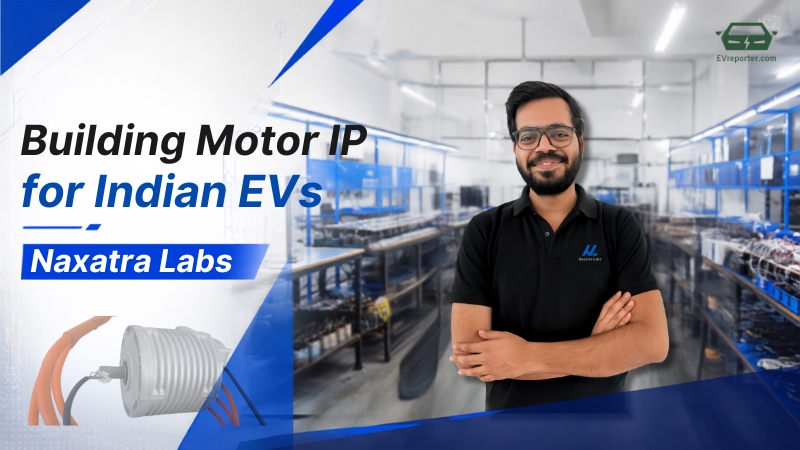
Building India’s EV Motor IP In-House | Naxatra Labs

Founded in 2021 by Abhilash Maurya, Arnav Biswas, and Piyush Verma, Naxatra Labs is a Gujarat-based manufacturer of axial and radial flux motors and controllers for electric vehicles.
In conversation with CTO Piyush Verma, we explore Naxatra’s journey, its technology edge, and how it is navigating challenges of validation, supply chains, and rare-earth independence to engineer India’s EV future.
Could you share a brief overview of Naxatra Motors’ current offerings and portfolio?
Naxatra Labs was established in 2021. Having spent more than 5 years in R&D, our offerings today include a wide range of powertrain specifications, purposely built for applications.
We have both motor families, radial flux (the Antarix RF line) and axial flux (the AF line), plus a controller platform. The reason we do both halves is simple: if you buy a motor from one place and a controller from another, you’re leaving efficiency on the table because nobody tuned them to each other. The power range covers everything from sub-1 kW to the 15 kW bracket, suitable for all types of 2W and 3W EVs, agri equipment, material handling, and industrial applications.

Can you also share about your current manufacturing setup?
We’re based in Ahmedabad; we do everything from design to manufacturing completely in-house. The majority of our entire supply chain is localised, with in-house manufacturing for winding, rotor-magnet assembly, assembly and end-of-line testing. That’s deliberate, because those are exactly the steps where quality walks out the door if you outsource them. Standard machined parts come from a local supplier base we’ve qualified.
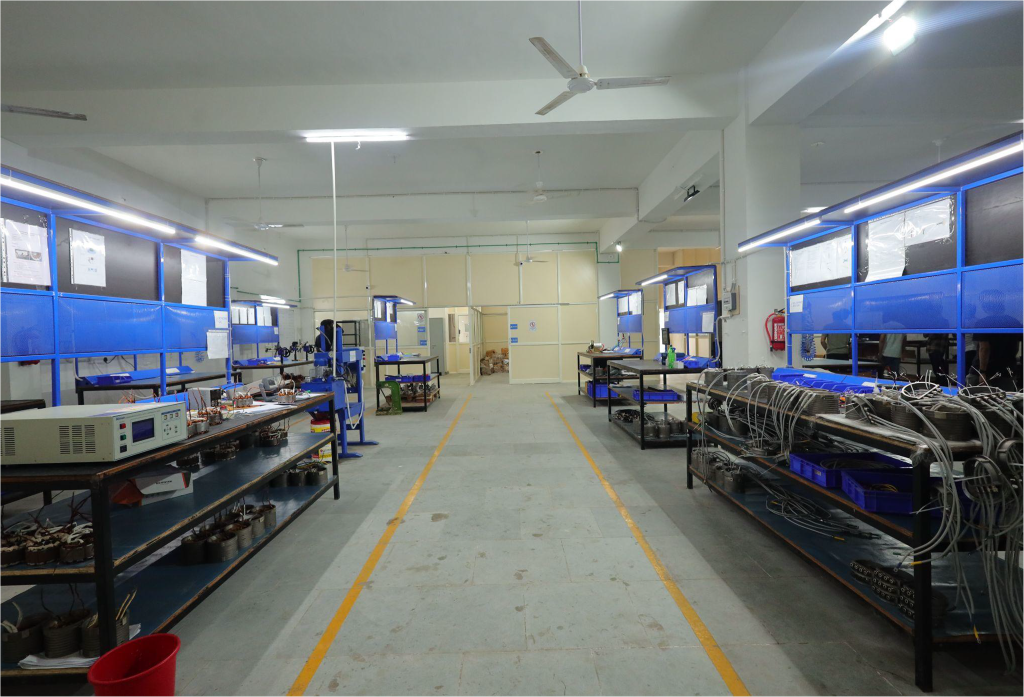
In terms of capacity, we currently have a capacity of 50,000 motors and are rapidly scaling to 500,000 motors annually by 2028. We aren’t capacity-limited for the order sizes on our desk today, and scaling up is not a problem for us.
Naxatra offers both axial and radial flux motors. What are the factors that determine which topology you’d use for a given application?
In real-world applications, there is no one shoe that fits all kinds of solutions for motors. At the end of the day, we determine based on the end application what kind of technology would work the best and give the most value to the consumer; therefore, we do both Axial and Radial platforms. For certain applications, Axial motors shine due to the less weight, high torque density and less axial length; however, for some other applications, Radial flux motors would give the best value for money.
The choice comes down to factors like performance, efficiency, packaging, cost, and volume.
If weight and top-tier performance are the main priorities, like in aerospace or performance vehicles, we lean toward axial flux motors. When these are not the primary drivers, radial flux topology is typically our choice.
We understand Naxatra Motors has ARAI certification and NATRAX validation. Could you share the current customer/OEM qualification status for the different motor types you have developed for different applications?
Correct. Our platform has cleared type approval testing at NATRAX, under AIS norms.
On the customer side, we have motors running in the field with paying customers across multiple segments, and multiple OEM programs at different stages – some in series production, some at sample and bench evaluation, some already in vehicle-level testing.
Our customer base includes companies from 2W, 3W, Agri, and Industrial applications, where our motors are already deployed and running. And onboarding more customers as we speak.
How do you structure OEM engagements, do you co-design motors into a vehicle with an OEM, or supply more standardised variants that OEMs integrate?
We do both, but it almost always starts standardised.
Most OEMs take a variant off an existing platform first because they want a running vehicle quickly, and they don’t want to fund development to find out if the concept works. Once it does, we go deeper. Stack length changes, different winding, custom shaft and mounting, controller calibration to their actual duty cycle rather than a generic one.
Full clean-sheet co-design we do selectively. It only makes sense at volumes that pay back the engineering time, and I’d rather say no upfront than take on a program that starves the rest of the roadmap. The platform approach exists precisely so we can customise a lot without re-validating from zero every time.
You’ve positioned Naxatra Labs around minimum import dependency. Given how exposed the EV industry is to rare-earth magnets and semiconductor supply chains, how real is that independence today?
It’s a direction we’re moving in, not a finished state. What’s genuinely ours and genuinely here is the design, the control software, the magnetics design, the winding, assembly, and testing.
Where nobody in this industry is independent, including us, is rare-earth magnets and power semiconductors.
We’ve reduced the exposure; we specifically used HRE-free grades since the initial design and have multiple qualified sources across geographies, so we are not dependent on one country. Designs that aren’t fixed to one specific magnet grade or one semiconductor package, so a substitution becomes a re-validation exercise instead of a redesign. That’s the practical version of independence, not zero exposure, but short recovery time when something upstream breaks.
Additionally, we are already working on multiple approaches with organizations that are now localising rare-earth magnets in India; however, that is a long-term bet we are working towards.
What’s the biggest bottleneck between where Naxatra Labs is today and true mass commercialisation of your solutions?
The gap right now is between product validation and supply chain at OEM scale. The major bottleneck today that we see is that most OEM qualification cycles are measured in quarters, sometimes years, and that clock isn’t ours to speed up. It sets our pace far more than our engineering does. Understandably, the OEM brand reputation is at stake when involved in any new product launches; however, that delays our entire sales cycle.
Behind both of these sits working capital, because you have to build tooling and inventory ahead of orders that haven’t landed yet.
India’s EV motor space now includes many players, from established component makers to other deep-tech startups. What do you see as Naxatra’s core edge that would be hard for a competitor to replicate?
No single thing on this list is unbeatable. It’s the combination that’s slow to copy.
- First, motor and controller together. Our efficiency numbers come from the pair being tuned
as a system. You can’t reverse-engineer that from a spec sheet, because it doesn’t live in
either component individually.
- Second, manufacturing know-how on axial flux. The concept isn’t secret; you can read the papers. Building one that yields consistently on a real production line is a completely different problem, and that’s several years of learning what goes wrong, which is not information that anybody publishes.
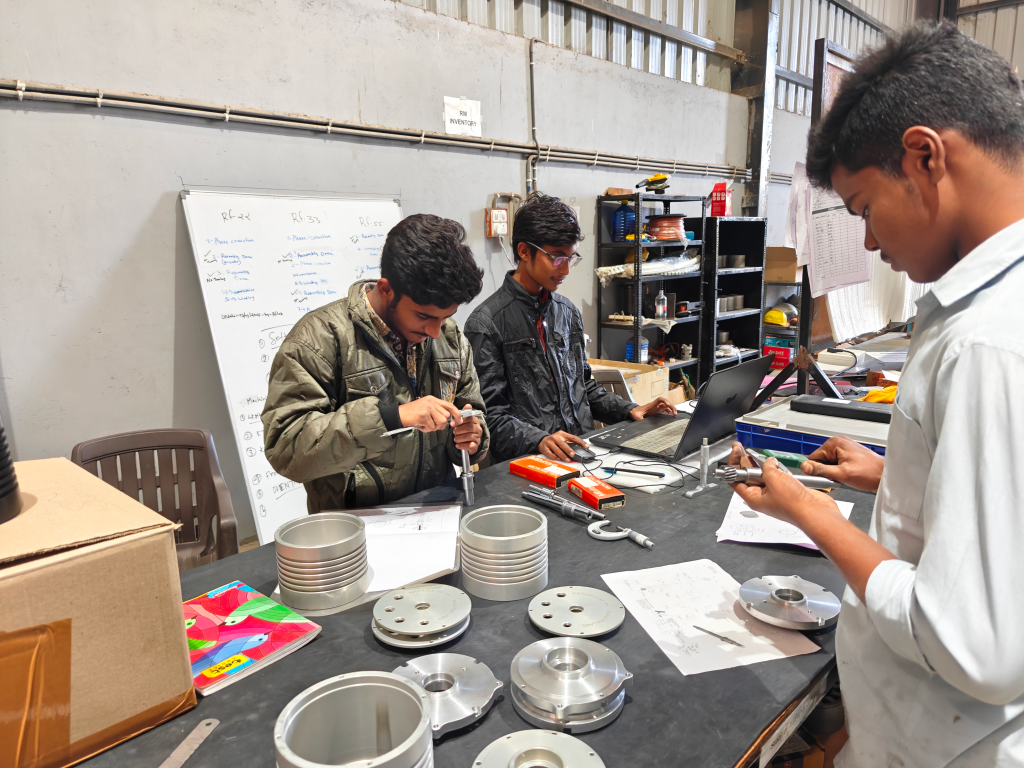
- Third, we hold granted IP on the design side.
And the part people underestimate, everything is in-house, end to end. We are not a completely knocked down (CKD) assembly operation, and we are not somebody else’s technology with our sticker on it. The design, the winding, the control software, the testing, all of it is ours. On top of that sit years of R&D tuned specifically for Indian conditions: dust, heat, load cycles, road quality, the way vehicles actually get used here rather than how they get used in a Chinese test schedule. You cannot import that.
Can a competitor build a motor? Of course. Can they build one that comes off the line repeatably, at a cost an Indian OEM will actually pay? That’s where most attempts stop, and that’s the gap we’ve spent years closing.
Axial flux has been technically superior for years but has never taken over the market. What has to change, in cost or in manufacturing, before it becomes the default rather than the premium option?
Axial flux is a well-known technology that has existed for a fairly long time; there is no doubt about the performance advantages that you get; however, the reason it has not taken off yet is primarily manufacturing constraints, since the topology itself requires specialized designs of components, which is the reason why mass production is difficult.
On the other hand, for radial flux motors, the supply chain and the manufacturing ecosystem have already existed for a long time. Therefore, comparatively, it is much easier to manufacture. The same goes for the supply chain network, availability of parts, etc. Ultimately, these challenges drive up final product cost, making axial flux a difficult sell in cost- sensitive markets. That said, it is only a matter of time before this technology becomes mainstream. We are seeing more companies enter the domain now, and we welcome that competition; it is what ultimately matures the ecosystem for everyone.
You sell both the motor and the controller as a tuned pair. What happens when an OEM wants your motor but has already standardized on someone else’s controller? Do you walk away from that business?
Our motors do not need a special type of controller architecture; we have made sure to make it compatible with standard hardware architectures. It’s the firmware layer that changes to deliver the requirements. And at this point, we have spent enough time in the industry to have worked with almost every major, reliable controller manufacturer out there. We partner directly with both the customer and the controller manufacturer to ensure everything is tuned for maximum efficiency.
Also read: Euler Motors Inaugurates Dedicated 4W Manufacturing Line at Palwal, Haryana
Subscribe & Stay Informed
Subscribe today for free and stay on top of latest developments in EV domain.