How Edge AI Can Enable Smarter, More Efficient Vehicles: Saharsh Singhania, Ambient Scientific

Edge AI is increasingly being positioned as a foundational layer for the next generation of automotive features. To understand what this actually means for EVs, EVreporter spoke with Saharsh Singhania, Head of Product Marketing at Ambient Scientific, a company building AI chips based on an in-memory computing architecture.
In this conversation, he explains why always-on features like parked vehicle guardian and battery monitoring need to run at the edge rather than the cloud, where Edge AI fits into a centralized-versus-distributed compute architecture, and why EVs — with their larger batteries — may be better positioned than ICE vehicles to adopt these systems at scale.
What makes Edge AI particularly relevant to the automotive and EV space today?
What is Edge AI – Generally, when we say Edge AI, we mean that AI applications and computing for AI features run at the edge, not somewhere far away on a cloud server. Before we talk about how it benefits automotive and electric vehicles, let’s quickly recap the key benefits of running AI at the edge versus in the cloud.
Benefits of Edge AI –
- The first benefit is reliability. If your computing is dependent on something far away, what happens when the network connection breaks, even for a second? With Edge AI, computing happens on the device itself, so it isn’t dependent on a network connection.
- The second benefit is low latency. When you send data to the cloud and wait for it to come back with an insight, there is always some latency. But if you process the data right where the sensors are, latency comes down significantly.
- The third benefit is privacy and data security. If you send all your sensor data to the cloud, it can be susceptible to interception during transmission. But if you keep the processing right where the sensors are and process the data locally without storing it, it becomes much more secure and private.
- The fourth benefit is total cost of ownership. Setting up large cloud servers, virtualised environments, computing and storing all that data comes with a significant cost. If you can do the computing on a small board or microcontroller close to the sensors, the total cost of ownership comes down significantly.
Example use cases in the automotive domain:
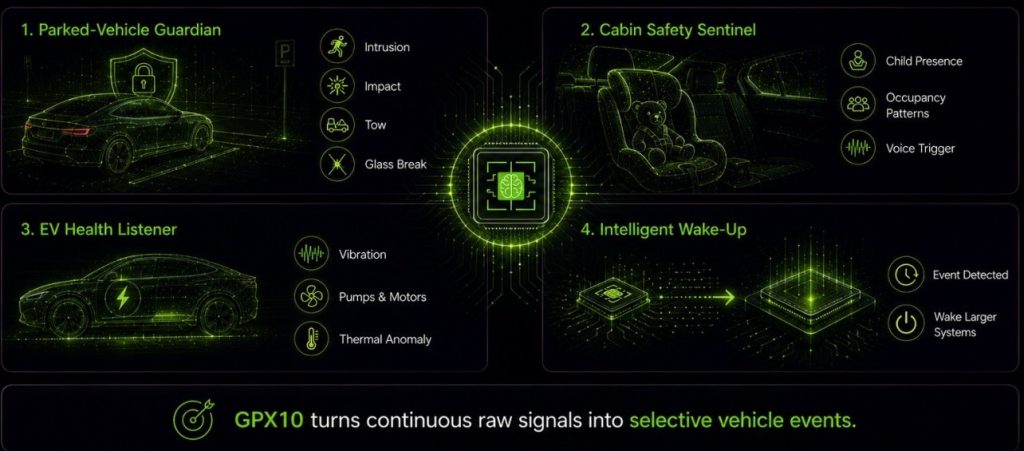
- Parked vehicle guardian – Once the vehicle is parked and the owner is not inside, always-on AI features can detect not just glass breakage, but also if someone is towing the vehicle away or if the vehicle is suddenly impacted. Imagine if your vehicle is smart enough to understand that someone has keyed your car and automatically turn on the camera to record who did it. Or, if someone bumps into your car and tries to drive away, it can detect the event, record it, and keep the footage for insurance purposes. It can also detect when someone is trying to illegally break into the vehicle.
With a traditional microcontroller or chip, the power consumption can be high enough to put the vehicle battery at risk of being drained. With a technology like ours, which enables accurate recognition through dedicated AI cores at very low power consumption, you can rely on the system being always on without significantly affecting the battery.
- Driver monitoring system. Vehicles can travel through routes with patchy or limited network connectivity, so the system has to operate on-device. It also needs to work within thermal constraints, power budgets and memory footprints so that it is always on, accurate, and power-efficient. As long as the driver is driving, the system needs to be reliable.
- Always-on acoustic anomaly detection – Sometimes people may accidentally leave their pet or baby inside the car, so always-on acoustic anomaly detection can be very useful.
- Infotainment and voice control—the ability to play music, make calls, and do all of that with your voice, so you don’t have to take your hand off the wheel and can continue focusing on the road.
- EV Health Listener—this includes battery monitoring, predictive maintenance of other vehicle components, and detecting thermal or vibration anomalies that may indicate a component is going wrong.
What is the current readiness level, or TRL? How close are you to implementing Edge AI in on-ground vehicles?
From a TRL perspective, we’re at the level where the technology is going into mass production and being used in the real world. We’re already implementing it in a number of products, mostly in wearables and predictive maintenance systems in industrial automation.
We already have AI models ready for glass-break detection and various kinds of acoustic anomaly detection. We are working with a couple of automotive OEMs. Unfortunately, we are under strict NDAs right now, so we can’t reveal their names because the applications are not finalized yet.
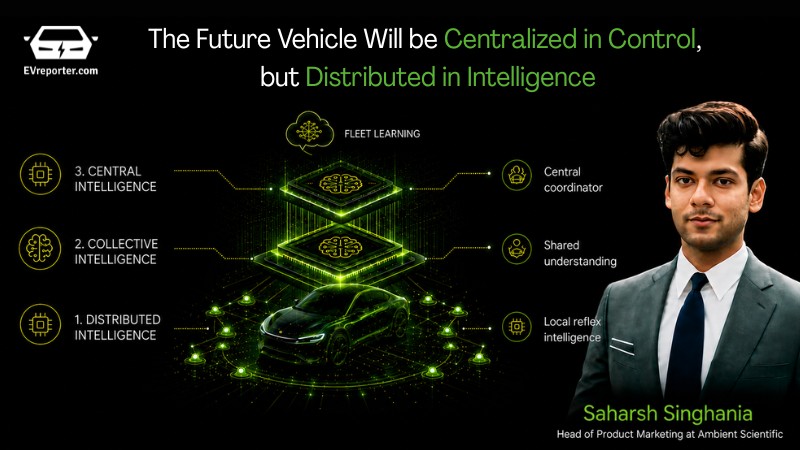
You described this as a system that is centralised in control but distributed in intelligence. What kinds of tasks are better suited for always-on, distributed nodes versus a central compute platform?
Whenever it comes to always-on sensing, it is best to have it at the edge, localised at the nodes. But more complex decision-making, making sense of the environment and reasoning capabilities, is better suited to a centralised brain that is more powerful and capable of taking time to process things.
What kind of features and applications make sense at the edge?
Glass-break detection is one example. Another is tire pressure monitoring. Edge AI can detect a small, gradual loss of tire pressure, which traditional pressure systems may not detect effectively. It can also identify when a tire is seriously worn out and at high risk of getting punctured during a long trip, allowing you to get it serviced or replaced earlier.
Battery monitoring is another important use case. Batteries come with various risks, including fires and chemical leakages. These systems should ideally be monitored at the edge from a safety and security standpoint. You cannot depend on a network connection that could break and potentially put someone’s life at risk. It has to be foolproof, and therefore, at the edge.
So, these are some of the use cases best suited for Edge AI, where always-on operation is a must, security is paramount, and latency matters a lot.
On the other hand, applications such as autonomous navigation and certain types of driver monitoring systems can be handled by a centralised brain using a much larger chip. They can also be cloud-based or partially processed at the edge, depending on the application.
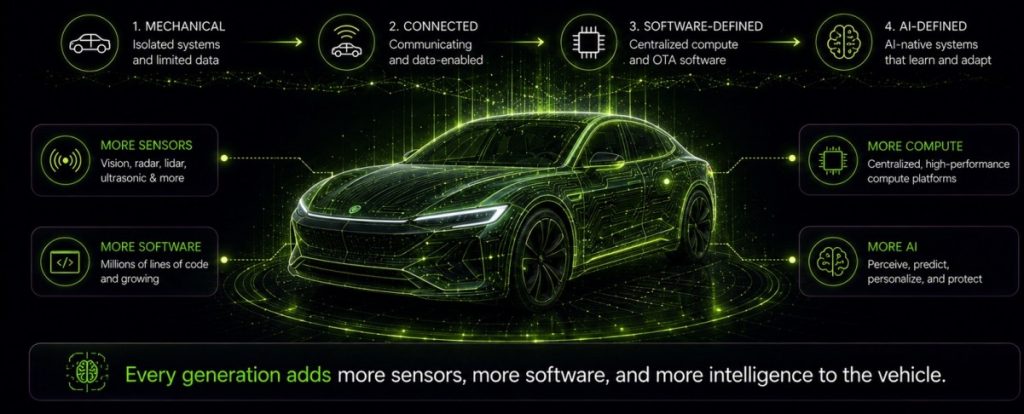
You also spoke about efficiency and power consumption, particularly how Edge AI can reduce the load on the main battery. Systems like tire pressure monitoring systems and glass-break detection already exist, so how much more energy-efficient would an Edge AI-based system be?
I’ll add some more colour to what you said. Some of these systems are available today. TPMS is available, and glass-break detection is available. But most of these are not very intelligent systems.
For example, the TPMS systems available today basically provide a simple sensor reading and threshold-based detection. They don’t offer much intelligence in terms of tire wear and tear, the remaining useful life of the tire, or, in the case of battery monitoring systems, whether the risk of fire is low or high or when the battery needs to be maintained.
With Edge AI, efficiency is not really the key advantage. The key advantage is timely intelligence that you otherwise don’t have access to.
In order to make that timely intelligence possible, the current types of chips available in the market come with a compromise on efficiency. We fix that compromise, which has been preventing product makers from really implementing Edge AI and making it useful and valuable for customers.
We bring together intelligence with efficiency, which has been missing in the market so far.
Do you think electric vehicles are more conducive to adopting these systems faster than ICE vehicles?
Yes, and the only reason is the bigger battery. Electric vehicles generally have larger batteries than ICE vehicles, so there is more scope to integrate and keep these always-on features running in the background, even when the car is turned off, without worrying about the battery getting completely drained.
Other than that, there is no real advantage that EVs have over ICE vehicles.
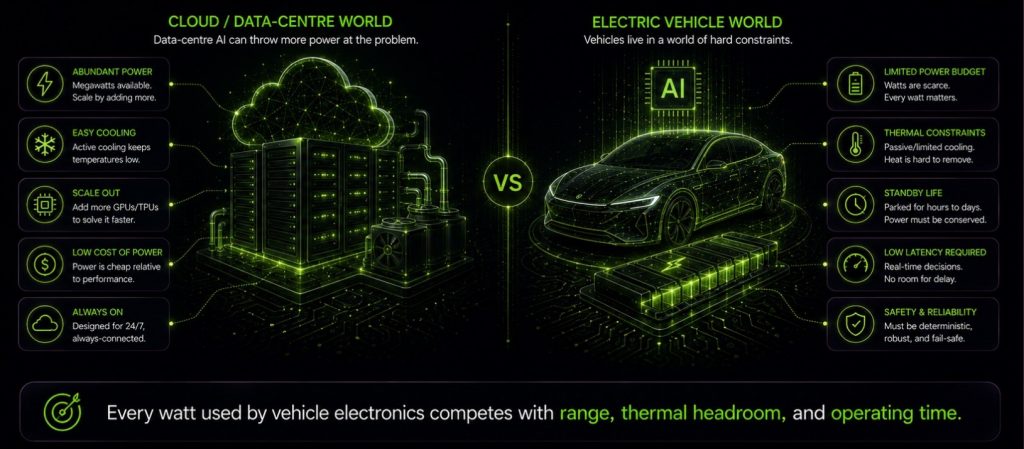
What enables a system like yours to operate at ultra-low power?
AI consumes a huge amount of power because of the nature of the computations required. This problem exists because the chips we’ve had so far were never built specifically for AI. AI is a relatively recent phenomenon, and because of the memory-to-compute bottleneck and how digital circuits are constructed, we see this AI and power problem.
We’ve flipped the script by building a new AI core with a new compute architecture called in-memory computing. We solve the memory-to-compute bottleneck by bringing the compute to where the memory is.
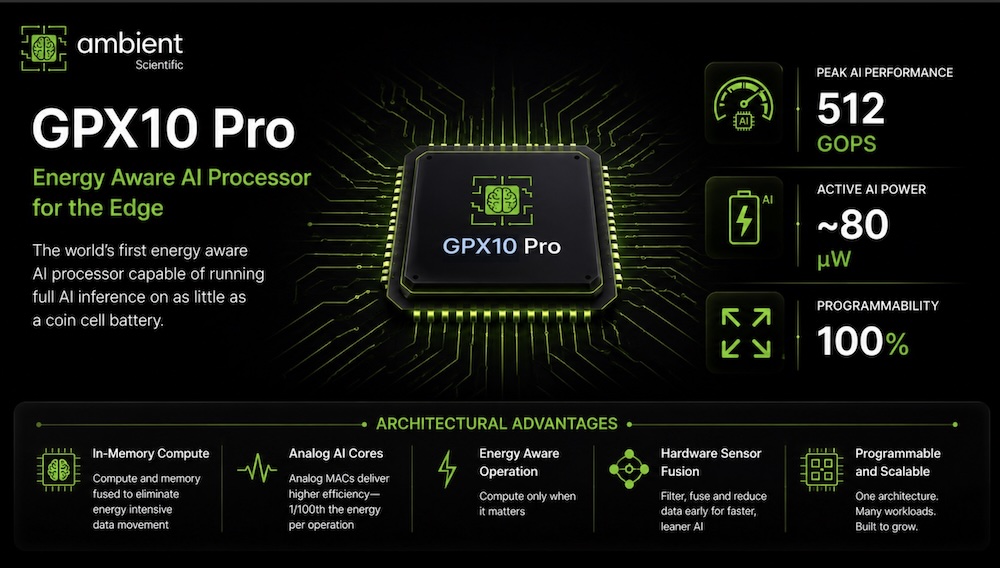
We use analog circuits very cleverly to almost let physics do the computing for us. We use fundamental principles such as Ohm’s law and Kirchhoff’s law and the physical properties of electronics to perform the multiplications and additions required for AI compute.
So, in a nutshell, by completely reinventing the compute architecture and how AI cores work, we are bringing something very different to the market that breaks the trade-off between AI and power consumption, bringing both intelligence and efficiency together.
This is extremely proprietary and spans multiple layers of the semiconductor stack. It includes our own new kinds of circuits, a new instruction set architecture—which you can think of as the blueprint for how software interacts with circuits—our own software stack, and our own new kinds of SoC chips.
So, there are many different innovations across the stack, resulting in more than 100 patents so far.
Apart from automotive, which are some of the other industries where you’re seeing demand for your products?
I think the two major industries where we’re seeing the biggest demand are wearables and industrial.
Wearables are a very natural use case because they have the biggest power constraint. Whether it’s smart rings, smart bands or smartwatches, they have very small batteries and a very limited power budget to work with. But today, users increasingly want more and more intelligence on these devices.
We want real-time stress detection, activity tracking, heart-rate-based anomaly detection—all of it has to happen on-device. You cannot really do it on a smartphone or somewhere far away. So, we are bringing the combination of intelligence and efficiency that wearables have lacked so far, to really shake up and innovate the industry.
The second would be industrial applications, where predictive maintenance has been a very popular use case. But again, it has been somewhat limited by dependence on cloud connectivity and expensive infrastructure.
We’re bringing intelligence and efficiency together, where you can simply attach a battery-powered module to a large piece of machinery and start doing predictive maintenance instantly, without needing to connect it to a cloud server or set up an expensive system.
Also read: AutoVRse raises $2.4 million to expand AI and VR training for automotive manufacturing
Subscribe & Stay Informed
Subscribe today for free and stay on top of latest developments in EV domain.