Building for trucks: A ground-level view of electric commercial vehicle charging


Hitender Vigamal, Head of Sales & Strategy, Planet3 Energy
Hitender is Head of Sales & Strategy at Planet3 Energy, with 17+ years of experience in industrial automation and electric mobility. A former leader at ABB India, he has been instrumental in building India’s early EV charging infrastructure. He brings deep expertise in DC fast charging, CPO ecosystems, and fleet electrification. An EV user himself, he combines real-world experience with strategic industry insight.
Planet3 Energies, the e-mobility venture of MAK Controls & Systems, is a global engineering organisation, and DCPP partners with DRDO with over 50 years of legacy in aerospace ground support systems, precision power equipment, and mission-critical defence technologies. Built on this foundation, Planet3 is focused on delivering aviation-grade EV charging solutions where uptime, reliability, and lifecycle performance are non-negotiable.
Infrastructure Planning for Electric Truck Charging
To set the context, electric trucks in India span a wide range—from small commercial vehicles with payloads of 1 to 1.5 tonnes, to 3.5-tonne and 5-tonne trucks, and up to 28-tonne, 50-tonne, and even 55-tonne heavy-duty trucks. The highest-capacity electric truck I have seen operating on Indian roads over the past year is around 55 tonnes. Overall, electrification across these segments is still relatively low, currently ranging between 2.5% and 5%.
Truck charging infrastructure is fundamentally different from passenger EV charging infrastructure and needs to be planned accordingly right from the beginning.
Layout
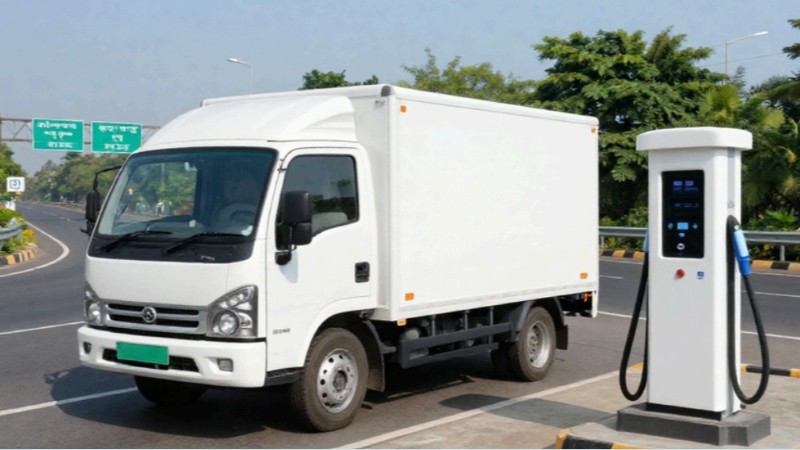
The charging site should be designed to accommodate three to four trucks simultaneously, with some vehicles charging while others wait for their turn. The canopies need to be significantly taller than those used for passenger car charging stations and should be designed to cover the front portion of the truck when it pulls up to the charger.
It is equally important to provide basic amenities for drivers. Since trucks may require one to two hours to charge, drivers need access to facilities where they can rest, eat, or sleep during the charging session.
Electrical Infrastructure
An HT electrical connection should be planned from day one. A typical highway truck charging hub would require approximately a 1,200 kVA transformer with a sanctioned electrical load of around 1 to 1.5 MW, supporting approximately three 240 kW DC fast chargers on-site.
Redundancy
Every truck charging hub should be designed with redundancy built into three critical areas.
- Grid Failure – Grid outages shouldn’t be addressed through a diesel generator (DG) backup. The industry is gradually moving towards integrating Battery Energy Storage Systems (BESS) and solar energy, which will eventually reduce dependence on DG sets.
- Network Failure – If the Charging Station Management System (CSMS) does not support offline charging, any network outage can immediately make the charger unavailable. Therefore, every site should have two or three independent redundant internet connections with auto switchover to ensure uninterrupted operation.
- Charger Equipment Failure – Hardware or software failures can significantly impact fleet operations. To minimise downtime, operators should always maintain one spare high-power charger on-site. Considering that 240 kW has now become the standard charging rating for trucks and buses in India, it is advisable to permanently keep one spare 240 kW charger available at every fleet charging location
Interoperability
A truck charging station cannot be designed around a single OEM. Vehicles from manufacturers such as Switch Mobility, Ashok Leyland, Volvo, Olectra, IPL Tech (Montra), and others should all be able to charge reliably at the same location.
Interoperability testing, therefore, becomes a mandatory requirement and should be thoroughly
validated before deployment.
How is the charging infrastructure for electric trucks evolving? Is it primarily captive, or are CPOs actively building infrastructure for multiple operators?
Most major Charge Point Operators (CPOs) initially focused on public charging infrastructure for passenger EVs and, in some cases, captive charging solutions for electric buses. However, combining passenger vehicle charging and heavy truck charging at the same location has proved to be challenging.
For truck charging specifically, Yahhvi is a good example of a dedicated fleet charging CPO. I have personally visited their hub in Manesar and a couple of locations in Bengaluru. Their infrastructure is designed almost exclusively for electric trucks, and their commitment to achieving near-100% uptime is clearly evident. In fleet operations, even a minute of charging delay can have a significant operational impact. Their charging hubs are also increasingly being integrated with Battery Energy Storage Systems (BESS) and solar energy.
On the OEM side, companies such as IPL Tech, EIM, and Ashok Leyland have established captive charging stations at strategic highway locations along their operating routes. ChargeZone has been doing commendable work in supporting BillionE electric truck operations.
Other CPOs—including Zeon, AARGO EV Smart, JioBP, Tata Power, and Statiq—also operate charging stations where trucks can be charged. However, for heavy-duty commercial vehicles, the most effective approach remains either a dedicated captive charging model or a specialised fleet charging network. A hybrid semi-public, semi-captive model is generally not sustainable for large commercial truck operations.
Dhabas have traditionally served as rest stops for truck drivers. Do you see them becoming natural locations for truck charging infrastructure?
Absolutely. Dhabas that primarily cater to truck drivers are among the most suitable locations for developing truck charging infrastructure.
If I am an electric truck OEM trying to convince a fleet owner to transition from diesel trucks—which often cost two to three times less than an electric truck—my first priority is to ensure reliable charging infrastructure along the exact routes where those trucks already operate.
These truck-centric dhabas naturally become the first locations to consider. There are two practical approaches:
- The first is to lease adjacent land, develop the required electrical infrastructure, and establish a properly designed multi-charger charging hub that operates as a captive or semi-public facility.
- The second approach is to install DC fast chargers directly at the dhaba to serve as an emergency top-up charging point
This is particularly important because trucks carrying high-value cargo usually operate on fixed logistics routes, and drivers often have very limited flexibility to deviate from their assigned path.
Battery Swapping, Standardisation, Mining Applications & AutoCharge
Companies like EIM are pursuing battery swapping for trucks. Where does battery swapping make sense compared to fast charging?
Battery swapping for heavy-duty trucks is undoubtedly a promising concept. EIM has already moved ahead with this approach, Blue Energy Motors is actively working on it, and IPL Tech is also in the process of deploying its own battery-swapping infrastructure.
The typical battery-swapping configuration follows an N+1 architecture—such as 3+1, 5+1, or 7+1 —where N fully charged battery packs are available while one empty slot receives the depleted battery from the incoming truck. The entire battery swap can be completed within 60 to 90 seconds using a robotic arm.
A fully loaded 55-tonne electric truck typically carries a battery pack ranging from 280 to 350 kWh. A 6+1 battery-swapping station designed for such trucks requires a megawatt-scale electrical connection, making the infrastructure investment extremely significant.
Based on my assessment, you would need at least 50 to 70 trucks operating regularly on the same route before the economics of battery swapping become commercially viable.
Behind the scenes, the depleted battery packs are recharged via CCS2 connectors or the OEM’s proprietary charging interface, depending on the system architecture. Most heavy-duty truck battery packs currently being imported into India already support dual charging arrangements to facilitate this flexibility.
For transporters operating relatively small fleets on fixed routes, however, a dedicated DC fastcharging station continues to make better financial sense. A larger population of electric trucks must first be deployed before battery-swapping infrastructure can become commercially sustainable. The encouraging trend is that electric truck sales are growing consistently month after month.
Can charging infrastructure be standardised across different commercial vehicle types, or does it need to be purpose-built for each application?
The first step towards standardisation is adopting a common charging standard. Most OEMs have now transitioned to CCS2. Manufacturers such as Tata Motors, Euler Motors, and Mahindra have already adopted CCS2 across their electric commercial vehicle portfolios.
However, having a common connector alone does not guarantee interoperability. Every truck OEM implements CCS2 communication slightly differently, which means interoperability testing remains essential.
Any CPO planning to deploy truck charging infrastructure should obtain a formal declaration from the charger manufacturer confirming that interoperability testing has been successfully completed with every major electric truck model available in India. If a charger fails to communicate with even one truck model at a live site, the consequences extend well beyond a single failed charging session. The CPO loses the transporter’s confidence. The transporter loses the fleet owner’s confidence.
Eventually, the fleet owner may decide to return to diesel vehicles.
Charging Ratings
From what I currently observe in the Indian market, 120 kW has become the preferred charging rating for smaller commercial vehicles, while 240 kW is increasingly becoming the standard for larger trucks and tippers.
However, I would like to clarify an important technical misconception. Most chargers marketed as 240 kW DC fast chargers in India are equipped with 250 A charging cables. At the typical operating voltage of heavy-duty electric trucks—approximately 650 to 700 V—a 250 A cable connected through a single charging gun can practically deliver only about 120 to 130 kW. Therefore, describing such equipment as a true 240 kW single-gun charger is technically inaccurate. In reality, these systems function more like 2 × 120 kW chargers, each served by an individual charging gun.
A genuine 240 kW output from a single charging gun requires charging cables rated at approximately 380 A continuous current with 500 A peak capability. We demonstrated this during our deployment for Volvo Trucks India, where the vehicle successfully drew nearly 236 kW from a single charging gun.
How does charging infrastructure differ for off-road and mining applications?
Off-road and mining environments introduce an entirely different set of challenges. Several mining OEMs have informed us that many of their mining sites lack a stable electrical grid. In some locations, there is no proper earthing system, while in others, even a reliable neutral connection is unavailable. To address these challenges, we have been working with OEMs to configure chargers capable of operating without active earthing.
One such deployment by Planet3 Energy has now been operating successfully for over a month without active earthing. Although the charger has performed reliably, the quality and stability of the incoming electrical grid continue to remain the primary concern at such sites.
EV users often face the inconvenience of managing multiple CPO apps. Why do you think AutoCharge hasn’t been widely implemented?
AutoCharge has been technically feasible for several years. The concept originated in Europe, and my own involvement with its implementation in India dates back to around 2021, when we worked with Zeon and MG Motor, followed later by Tata Motors.
The key enabler for AutoCharge is the unique Vehicle Identification Number (VID) assigned to every electric vehicle. Once manufacturers began shipping vehicles with unique VIDs, large-scale AutoCharge implementation became technically possible.
How does AutoCharge work? The user simply links the vehicle’s unique ID with their registered mobile number and wallet within the CPO’s mobile application. Whenever the charging connector is plugged into the vehicle, the charger automatically reads the vehicle ID, sends it to the CSMS, completes the authentication process, and starts charging automatically within a few seconds. No mobile application needs to be opened. No RFID card is required.
The Volvo Trucks deployment is a good example. Over nearly 4 months, not a single charging session required manual driver intervention. The driver simply plugged in the connector, and charging started automatically every time.
The reason AutoCharge has not yet become universally available is a combination of factors.
There is still limited awareness across the industry. Many new CPOs understandably prioritise expanding their charging networks and building brand visibility before investing in advanced software features such as AutoCharge.
There are also legitimate concerns around data privacy. CPOs should always obtain explicit user consent before linking a vehicle’s identification number to a customer account. The larger challenge, however, is the fragmented charging ecosystem.
In my opinion, India ultimately needs a single unified charging platform that not only displays charger locations but also provides real-time charger availability and recent charging history, enabling users to assess charger reliability before arriving at a station.
Underperforming chargers should be clearly identified and, where necessary, removed from the unified platform until performance improves. A transparent scorecard that also reflects the performance of charger OEMs would also improve customer confidence and accelerate EV adoption.
CPOs can continue operating their own applications for payments, subscriptions, and loyalty programmes, but charger discovery, availability, and operational reliability should ultimately be accessible via a single common platform.
What are the fundamental reasons small CPOs fail, and what would be your suggestions for new entrants?
Having interacted with numerous Charge Point Operator (CPO) founders over the years, I’ve observed a few recurring patterns that explain why many smaller CPOs struggle.
Poor Location Selection – The biggest mistake is selecting the wrong location. Many new CPOs choose to install their first charging station at tourist destinations such as Agra, Varanasi, Ooty, or Tirupati. However, the revenue generated from tourist traffic is highly seasonal. In contrast, business corridors provide much more consistent utilisation throughout the year. If you are targeting tourist destinations or business hubs, I recommend installing chargers at 3-star and 4-star hotels, rather than focusing exclusively on 5-star properties.
Overly Scattered Deployment – With EV penetration in India still around 6%, spreading chargers across too many locations results in low utilisation and weak financials. The better approach would be to build dense charging corridors — covering origin, key stops, and destination along specific routes — rather than placing isolated chargers every 100 km.
Ignoring AC Charging – DC fast charging gets the attention, but AC charging remains critical at hotels, offices, and residential complexes where vehicles sit parked for hours. Many leading CPOs are now expanding into apartment societies, where residents can’t get individual electrical connections — creating captive, recurring revenue opportunities.
My Advice for New CPOs – Onboard onto an established network first. It gives you instant visibility, user traffic, and revenue. Build your own branded app once you cross ~15 stations.
Choose the Right Charger Rating. Most modern passenger EVs already charge well above 60 kW. For public highway charging, the new baseline should be 120 kW.
Go Deep Regionally Before Going Wide Nationally. It’s better to dominate one or two states than to spread thin across the country. In this business, local knowledge is a genuine competitive edge.
Pick One Segment and Execute It Well. Fleet, highway, residential, workplace, and truck charging are fundamentally different businesses — different economics, infrastructure, and customer expectations. Trying to serve all simultaneously leads to diluted execution. Pick one segment, scale responsibly, and expand only after building operational excellence.
This interview was first published in EVreporter July 2026 magazine.
Also read: 72% of Indian truck fleet operators ready to go electric – If key barriers are addressed
Subscribe & Stay Informed
Subscribe today for free and stay on top of latest developments in EV domain.