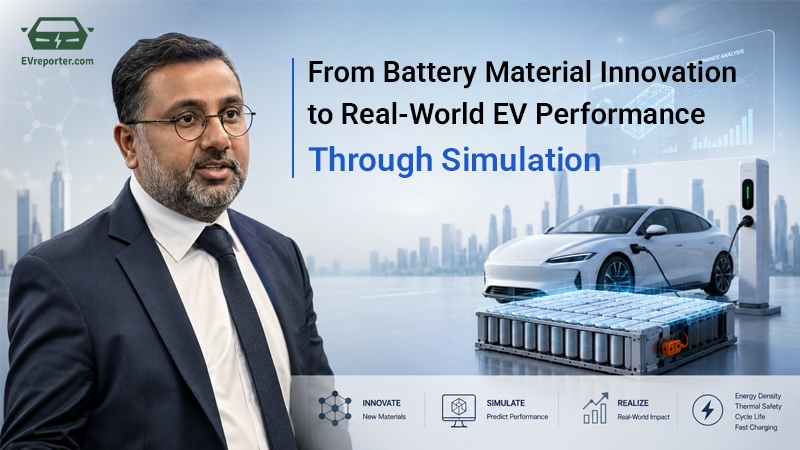
Bridging the Gap between Battery Material Innovation and EV Performance

New battery chemistry makes headlines every few months. A research lab announces that it has built a sodium-ion cell with an impressive energy density. A startup claims they’ve solved the silicon anode issue. An OEM says it is moving from regular LFP to LFMP chemistry to achieve better low-temperature performance. The headlines are true, the science behind the reports is often real, and the intent behind the company’s communication is genuine. Despite this, the timeline for developing this promising lab finding into a real-world, deployed battery pack still takes years and hundreds of millions in capital.
Innovation is not the bottleneck. What is the bottleneck is taking what a material can do in the clean, quiet, perfectly regulated confines of a lab and realizing what it has to do in a battery pack driving 100 kmph at 45-degrees celsius on a warm summer day in a nation where charging infrastructure is just being deployed, and which requires its batteries to handle far deeper discharge cycles than its chemistry was ever intended to support.
Using only physical prototypes to bridge this gap between lab and real-world performance is slow, expensive, and has a very limited predictive power. It is simulation that has become the key component that speeds up, reduces the cost and increases the predictability of this crossing.
The Stakes in the Indian EV Market
India is indeed undergoing an inflection point for the EV market, not just in a marketing sense, but structurally. The demand for batteries in India is projected to climb from around 10 GWh today to between 100-200 GWh in 2030, depending on which adopted EV curve takes hold. That demand will be met by an array of chemistries, cell formats and pack architecture, optimised for a unique market segment.
At the top of the market, pack integrators are already experimenting with silicon-anode cells, pushing energy density past graphite’s levelling off.
On the mass market, the sodium-ion chemistry is being proposed as an affordable, less volatile alternative to lithium, by eschewing critical supply chains and focusing on abundant raw materials.
Finally, for the predominant two and three-wheeler market that has already adopted LFP chemistry, LFMP represents the next evolutionary step with a moderate increase in the voltage plateau, which will have a meaningful impact on range, with minimal battery pack redesign required.
All three are genuine engineering challenges. None of these problems will be solved by reading the chemistry literature and building ten thousand cells just to test what happens. This paradigm worked when the supply chains were simpler and the chemistries fewer and production centralized. Today, the complexities multiply. There are multiple chemistries being tried out in parallel, the supply chains are highly fragmented, and the time-to-market pressure is reducing the evaluation timeline from 3 years to a mere 18 months.
This is precisely the domain where multi-scale simulation can step into the engineering stack.
What Simulation Actually Does
It’s important to clarify the term simulation: as a component of battery design and development, it includes, at a minimum, three levels of modelling occurring at different physical scales and addressing different engineering questions.
– Electrochemical models predict lithium and sodium ion movement through the electrode and electrolyte during charging and discharge at the cell level. The most widely validated structure in this space is the Doyle-Fuller-Newman model and extensions. Electrochemical models can tell a user whether changing electrode thickness, particle size, or electrolyte formulation will shift cell capacity, internal resistance, and thermal performance.
If I have a new LFMP cathode and I’m interested in its behavior at high discharge rates, an electrochemical model will give me a first-order prediction in days rather than the weeks it will take to build and test physical cells.
– At the module level, simulation is primarily concerned with thermal management. Different cells in a module will behave differently based on where they’re located within the module, how far they are from a heat sink, and how neighbors are performing. Thermal simulation helps predict thermal distribution within a module under a specific load profile, and thus likely “hot spots”, and will focus future degradation studies on cells under the most thermal stress. For somewhat different thermal characteristics of sodium-based batteries, predicting behavior under different operating regimes at the module level can inform initial cooling architecture.
– At the pack level, simulation is about coupling mechanical, vibratory and electrical behaviors among hundreds of cells. When a pack integrator must determine how their design will react to mechanical stresses in Indian roads, how quickly thermal runaway will propagate through the pack using a new chemistry, or whether the BMS settings for a lithium based battery can carry over to the new cell format, the simulations at the pack level answer these questions without building and crashing, cycling, or aging a prototype pack.
The Silicon Anode Problem as a Case Study
Silicon anodes serve as a powerful illustration of why simulation isn’t just an option in frontier chemistries. Silicon promises an order of magnitude more lithium storage per unit weight than graphite. However, silicon increases in volume by up to 300% upon lithiation, leading to significant mechanical stress that fractures electrode structures and adds new solid-electrolyte interphase layers to the particles on each cycle. The management of silicon expansion is arguably the single engineering hurdle to overcome for the commercialization of silicon anodes.
A physical test-based approach cannot hope to cover the design space efficiently. The number of design parameters is very large; Si particle size, the ratio of Si to graphite, the type of binder, the selection of an electrolyte additive, limitations on charge rate, etc. A physical test plan that would cover a reasonably sized sample of that space would likely take years to execute and require millions of dollars to fund a cell-fabrication and test infrastructure.
Simulation is a means by which to reduce this design space to a manageable size. Multiphysics simulations can link the electrochemistry with the evolution of mechanical stresses and help to predict the combinations of design parameters that will result in acceptable swelling and those that will fail within a few hundred cycles.
The simulation cannot replace physical test. Instead, it is used to distil the available design space into a handful of choices, which then need to be verified by physical testing. Simulation acts as a filter, not a replacement, for physical verification.
LFMP and the Transition Problem
This type of question will be phrased differently for pack integrators who already work with LFP. Because the two chemistries are so closely related, it’s tempting to believe existing designs can be carried over with little or no modification, and it’s often not the case.
LFMP has a slightly higher operating voltage and a different state of charge curve, and the BMS designed for LFP would not properly interpret the SOC of the LFMP cell, either leaving available capacity unused or over-charging the cell unintentionally. LFMP also has a different thermal signature under high charge rate, and a cooling system design for an LFP pack might not be sufficiently sized for a fast-charged LFMP pack.
This simulation can tell pack integrators, before any hardware is locked in, what modifications to their BMS design will be needed, as well as whether they have enough cooling power, based on a validated electrochemical model of the LFMP cell paired with the pack thermal model. This can give a physical validation program an informed prediction of the problem areas to focus on, rather than an open-ended study of what the problems are, a very different process.
Building Simulation Competency as an Institutional Capability
There’s a repeating pattern in the development of EVs in India. Simulation is approached as a vendor service, not an internal competency. The engineering teams use consultants or work with their software vendors to run the models on their behalf. The deliverable comes in as a report; the models are lost when the vendor engagement ends, and the knowledge generated is quickly forgotten.
This worked well enough when chemical change rates were slow, and physical prototyping was the chief determinant. It is simply not architecturally suited for a period in which many new chemical compositions are being assessed in parallel, and speed of assessment is a source of competitive advantage.
The companies that advance the most in the next 5 years will approach multi-scale battery simulation as a central engineering task: they will invest in calibrated cell models for all chemistries in use, maintain them over time against physical test results, and utilize them as evolving resources (which get better after each test cycle) rather than finite deliverables.
This should not be interpreted as a plea for infinite R&D dollars. A cell supplier that wants to make itself valuable to a pack integrator evaluating a new chemistry doesn’t need to own a supercomputer and a staff of physicists. What it does need are calibrated, cell-level models that can be turned over to the pack integrator, thermal modeling at the pack level (built into the pack design process), and the ability to predict BMS parameters from state of charge characterization.
For companies already engaged in physical characterisation of cells, most of the required input data already exists; the lack of modelling infrastructure to transform this data into predictive power needs to be addressed.
From Lab to Field: The Realistic Path
While a simulation model can never replace physical validation, the most finely tuned electrochemical model will be unable to accurately capture the full suite of failure modes that arise under actual road conditions. Indian road conditions, poor power quality, individual driving patterns, and the range of operating temperatures make it impossible to accurately capture synergistic combinations of stress in a simulation model.
Simulation can only serve to significantly reduce the physical prototypes required until a design is validated in the field. Design candidates are screened early to be tested more efficiently in the physical domain and to provide analytical methods to understand why failures occur under the conditions encountered. For India’s rapidly growing EV market, which is both trying to fast-track adoption of chemistry while learning about local manufacturing capabilities, reducing the iteration cycle for physical prototypes will yield real-time savings and real capital savings. Companies that can utilize simulation effectively rather than as an addition to the process of development will accelerate to field validation.
Chemistry transition in India is technically feasible. It is true that there is a gap between what happens in the lab, and what is seen in the field, but this gap is not uncrossable, and only few tools other than simulation can bridge the divide. Simulation’s ability to allow the efficient exploration of design choices will speed development for both the chemist and the engineers building the devices that use them. Mastery of simulation is quickly becoming a prerequisite for competitive battery development.
About the author

Pradyumna (Prady) Gupta, Founder & Chief Scientist, Infinita Lab | Founder & CEO, Infinita Materials. He leads pioneering work in materials characterization, reliability engineering, and advanced manufacturing. With more than two decades of experience spanning semiconductors, electric mobility, and aerospace systems, he focuses on bridging material science with practical reliability needs. Dr Gupta’s work centres on enabling high-performance, safe, and sustainable material architectures for next-generation technologies.
Also read: Exploring battery modelling and simulation using data & AI
Subscribe & Stay Informed
Subscribe today for free and stay on top of latest developments in EV domain.