Battery Passport 2027: what makers exporting to the EU actually have to do

For Indian battery and electric vehicle makers that ship to the EU, a date is approaching that decides market access. From 18 February 2027, no EV or LMT battery may be placed on the EU market without a digital battery passport. For most makers, the open question is not the why; it is the how, writes Niels van Veen.
India has become one of the world’s most important production bases for electric two- and three-wheelers, and some of these vehicles and their batteries find their way onto European roads. This is exactly where the EU Battery Regulation applies. It makes the passport a condition for sale, not a voluntary label. Anyone who cannot provide the passport loses market access, regardless of how good the product is.
The good news first: the effort is manageable if it is started early. The passport is primarily a data task, not an IT project. And a substantial part of the required information is already available or can be obtained from cell suppliers with sufficient lead time.
Why does the passport decide the export
The legal basis is the EU Battery Regulation (EU) 2023/1542. From the effective date, it requires a digital passport for every newly placed traction battery, every battery for light means of transport and every industrial battery above 2 kWh.
In India’s export economy, the first two categories matter most: traction batteries for electric vehicles and LMT batteries, the kind used in e-bikes, e-scooters, and similar light vehicles. Device batteries from laptops or smartphones are explicitly excluded.
The passport is not a label but a structured, machine-readable data set. Every affected battery carries a QR code that points to a unique product identifier. Behind it sits a record whose mandatory fields are defined in Annex XIII of the regulation and detailed technically in DIN DKE SPEC 99100.
Swappable packs for electric two- and three-wheelers count as batteries for light means of transport and, once placed on the EU market, also need a passport. Anyone exporting such systems should check early which of their product lines fall under the obligation.
What the passport actually contains
The mandatory data falls into a few groups. These include the unique identifier with QR code, the carbon footprint of the battery, the material composition together with the share of recycled raw materials, supply-chain due diligence data, performance and durability figures, safety and dismantling information, and the responsible economic operator.
Access is tiered: part is public via the QR code, another part is visible only to notified bodies, market surveillance and persons with a legitimate interest.
For Indian makers, this list is less a hurdle than a checklist. Technical figures and conformity documents are usually already at hand.
The real effort concerns the data that depends on the cell, above all, the carbon footprint and the recycled-content share. The carbon footprint, in particular, is more than a single number. It must be calculated and documented according to a prescribed methodology across the battery’s life phases, from raw material extraction through cell production to assembly. For makers, this means knowing and being able to prove the origin and energy input of their cells. Once this chain has been built cleanly, the value can be carried forward for each series.
Who is responsible in the supply chain
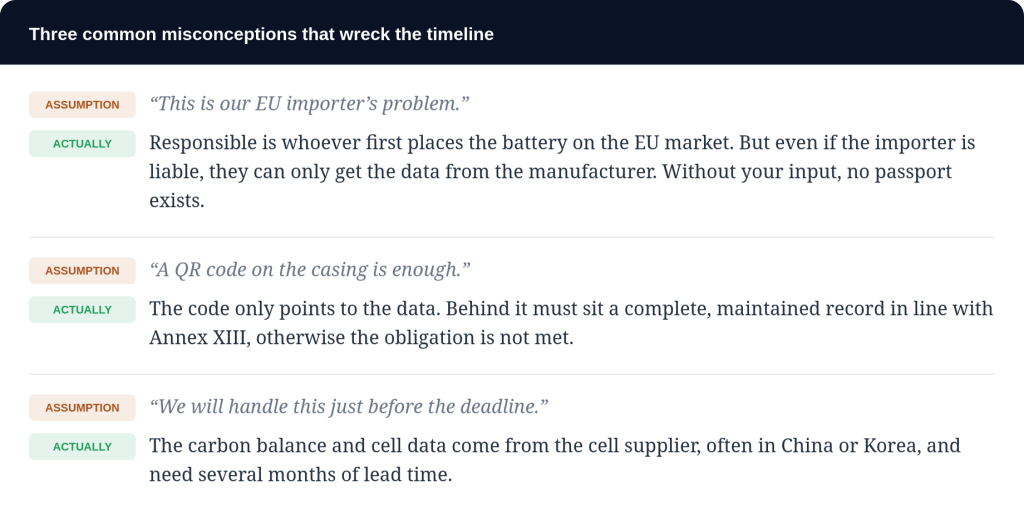
The obligation attaches to placing on the market, not to manufacturing. Responsible is whoever first offers the battery on the EU market, whether the European importer or the maker’s own EU entity. In practice, the data work flows back to the manufacturer anyway, because only the manufacturer knows the cells, materials and origin of the product.
From this, a noticeable imbalance arises. Large cell producers have sustainability teams and connected data rooms. The mid-sized vehicle or battery maker carries the same obligation without such structures. For them, it is not the system architecture that counts but an orderly procurement of the data, which is manageable given an early start.
From obligation to sales argument
The battery passport is not only a regulatory requirement, but it also changes the conversations with European buyers. Importers, distributors and fleet operators in the EU must collect passport data anyway to sell legally with certainty. A maker who can deliver these figures early and in full becomes a preferred supplier, while others are still looking for their cell data.
Demand shifts even before the deadline. The first European buyers already ask about passport readiness in tenders. For Indian exporters, preparing in time is therefore less a burden than an opportunity to stand out from competitors who keep postponing the topic.
Achievable without an IT department
A data infrastructure of your own is not required by the regulation. It sets out what the passport must contain and how it must be accessible, but leaves running the technology to the market. Makers and importers can have the passport generated through a compliant service provider that maps the attributes of DIN DKE SPEC 99100, issues the identifier and QR code, and manages the tiered access rights.
The focus thus lies not on technology but on data. The earlier the requests to the cell suppliers go out, the more reliably the answers come back. Just before the deadline, when every maker needs the same figures, it gets tight.
In practice, it pays to treat the data work as a recurring process, not a one-off project. Models and cell suppliers change, and every new series needs its own passport. A clear, established routine for who delivers and maintains which figure, therefore, carries well beyond the first deadline.
The roadmap to February 2027
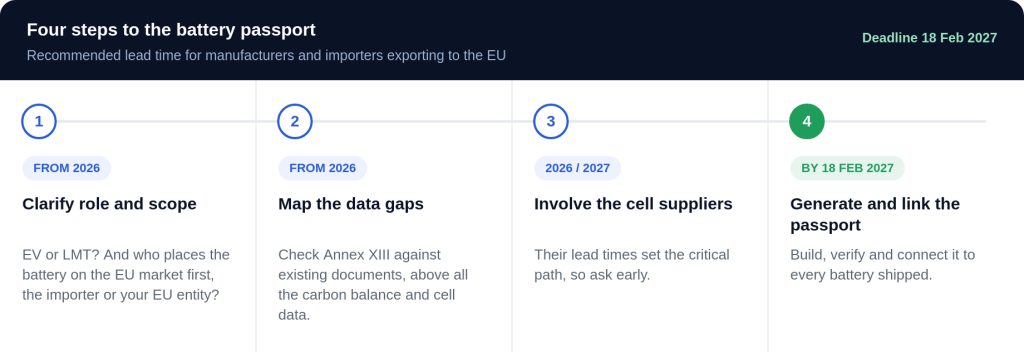
Four steps lead reliably to the goal. Anyone who tackles the first two in 2026 keeps room to manoeuvre until the deadline; anyone who only starts in January 2027 depends on the cooperation of third parties, which by then can hardly be steered.
For makers exporting to the EU, the battery passport is decided not by the size of the IT department but by timely data work. The legal framework and data model are in place, the deadline is set. Those who start early secure not only market access but turn the obligation into a robust basis that carries well beyond 2027.
Sources: Regulation (EU) 2023/1542 (EUR-Lex); DIN DKE SPEC 99100; Battery Pass Project (thebatterypass.eu).
About the author:

Niels van Veen is the founder and CEO of DPP Hero in Hanover, a GS1 Germany Solution Partner and provider of battery passport software compliant with DIN DKE SPEC 99100 for small- and mid-size manufacturers and importers.
Also read: India’s emerging upstream EV battery ecosystem | Whitepaper excerpt
Subscribe & Stay Informed
Subscribe today for free and stay on top of latest developments in EV domain.