Electric Bus Charging Depot Design in India: Understanding the Grid Interconnection and DISCOM Engagement Aspects

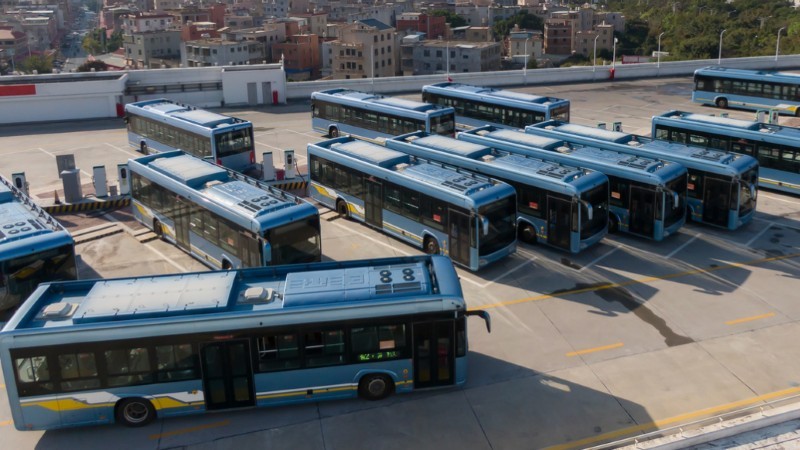
A robust, streamlined grid interconnection process is essential to enable the reliable, scalable deployment of electric bus charging depots. High-capacity charging requirements of electric buses often mandate dedicated High Tension (HT) connections, timely transformer installation, and dynamic coordination with state distribution companies (DISCOMs).
This excerpt from ‘Optimal Charging Depot Design For Electric Buses Handbook 2026‘ by Grid Integration Lab, IIT Bombay, provides a structured overview of the regulatory, technical, and procedural aspects of establishing grid connectivity for public electric bus depots in India.
High Tension (HT) Connection Process for EV Charging Depots
Electric bus depots typically demand connected loads exceeding 500 kW, often ranging into multiple megawatts depending on fleet size and charging strategy. As a result, DISCOMs categorize these depots under HT industrial connections (generally 11 kV or 33 kV). The step-by-step HT connection process is summarized below:
Step 1: Load Estimation and Application Submission
- Calculate peak and aggregate demand based on bus count, charger ratings, and simultaneity factor.
- Submit an application to the local DISCOM along with a load justification report, site plan, and necessary clearances.
Step 2: Feasibility Study by DISCOM
- DISCOM evaluates nearest substation capacity, feeder availability, and augmentation needs.
- Load flow and fault-level studies may be conducted for large depots (>1 MW).
Step 3: Approval and Quotation Issuance
- Upon technical clearance, a sanctioned load is approved.
- Cost estimates for infrastructure (e.g., dedicated feeder, metering, substation bay) are provided.
Step 4: Infrastructure Development and Inspection
- Civil and electrical infrastructure is developed by the applicant or the DISCOM (based on the agreement).
- DISCOM conducts the final inspection to verify safety and compliance.
Step 5: Metering, Agreement Execution and Energisation
- Trivector metering is installed as per HT supply norms.
- Power purchase agreement (HT supply) is executed.
- Connection is energized and regular billing begins.
Role of Flexible Interconnection
If multi-megawatt connection is required, this may take years to be connected to the grid. This time lag may also determine the stage-wise deployment of the vehicles, which may be combined with a stationary battery buffer until the full interconnection capacity is available. In California, they have introduced a flex-interconnect where, after an analysis between the DISCOM and the depot owner, it is determined that a flexible interconnect can be achieved much faster than a full guaranteed capacity interconnect.
For example, the DISCOM can provide the required capacity except for a few days/weeks of the year. If the depot owner can live with that, they can interconnect using the current available grid capacity but observing the limitations a few times a year. This arrangement may also require that the DISCOM installs measurement equipment at the connection point to the depot and has the right to limit the electricity flow to/from the depot if it exceeds the contractual amount.
Adding stationary battery buffer capacity also allows faster interconnect, however this is usually an expensive proposition. If the value of faster interconnection (electrification of the fleet) is higher than battery cost this may be a solution until the grid interconnection capacity is built out.
DISCOM Coordination Requirements
Effective depot commissioning requires proactive coordination with DISCOMs on the following dimensions:
- Sanctioned Load Upgrades: As fleets expand, depots must request sanctioned load enhancements well in advance.
- Infrastructure Synchronization: Charging infrastructure timelines must be aligned with grid infrastructure readiness.
- Protection and Metering Standards: Meter types, CT/PT ratings, and breaker specifications must comply with state electricity distribution codes.
- Data Sharing and Monitoring: DISCOMs may require depot-side Energy Management System (EMS) integration to monitor peak demand, load profile, and voltage quality.
Time-of-Day (ToD) Tariff Structures for EV Charging
State electricity regulatory commissions (SERCs) offer preferential Time-of-Day (ToD) tariffs for EV public charging stations. These are designed to incentivize off-peak charging and flatten the demand curve.
Key ToD Features:
- Off-peak tariff (e.g., 11 PM to 6 AM): 15–25% lower unit rates.
- Peak tariff (e.g., 6 PM to 10 PM): Higher tariffs to discourage charging.
- Fixed Demand Charges: Based on sanctioned kVA or maximum demand.
State Examples:
Delhi (BYPL/TPDDL): Dedicated EV charging tariff with off-peak benefits.
Maharashtra (MERC): ToD-based EV supply tariffs notified for HT users.
Depot planners should factor ToD advantages into charger scheduling, especially for nightparking fleets.
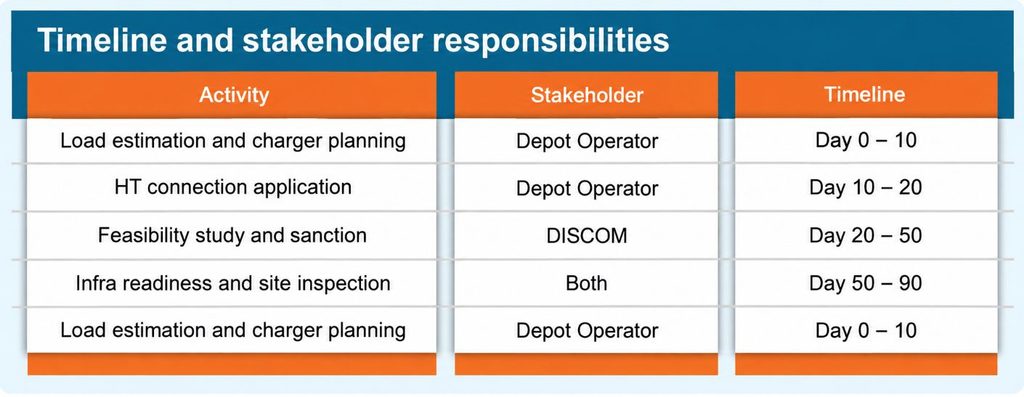
Timeline and stakeholder responsibilities for Electric Bus Charging Station deployment.
Source: OPTIMAL CHARGING DEPOT DESIGN FOR ELECTRIC BUSES HANDBOOK, GRID INTEGRATION LAB, INDIAN INSTITUTE OF TECHNOLOGY BOMBAY 2026.
Checklist for DISCOM Engagement: Important Documents
- Load sheet and charging simulation
- Single-line diagram (SLD)
- Fire and electrical safety NOCs
- Site access permissions for infra works
An excerpt outlining the critical elements of electrical system design for electric bus charging depots will be included in the next issue.
We thank the Grid Integration Lab, IIT Bombay, for contributing this excerpt from their handbook. You can access the full report here. The Grid Integration Lab, IIT Bombay, prepared the publication under the Vehicle to Grid (V2G) project commissioned by the Federal Ministry for Economic Cooperation and Development (Germany) through Deutsche Gesellschaft für Internationale Zusammenarbeit.
This article was also published in EVreporter Oct 2026 magazine.
Also read: BEYOND THE CHARGER | Building India’s Software-Defined EV Charging Network
Subscribe & Stay Informed
Subscribe today for free and stay on top of latest developments in EV domain.