Cable theft at EV charging stations is a silent threat to India’s clean mobility transition

Guest article by Jaideep Saraswat and Nikhil Mall from Vasudha Foundation.
India’s EV revolution is picking up speed — but the road ahead is getting rougher, thanks to a new and unexpected obstacle: charging station vandalism. It is clear that security innovation must keep up with expanding infrastructure.
India’s journey toward sustainable transportation is gradually gaining momentum. In FY 2024–25, Electric Vehicle (EV) sales accounted for approximately 7.8% of total vehicle sales — an encouraging step toward the national target of 30% EV penetration by 2030. This progress has been supported by a combination of factors: favourable central and state-level policies, the expanding range of EV models across two, three, and four-wheeler segments, and, crucially, the increasing presence of Public Charging Stations (PCS) across urban and semi-urban landscapes. From just 1,800 PCS in 2022, India now boasts over 29,277 PCS, with a projected need of 3.9 million chargers by 2030.
While this growth is commendable, it brings with it an emerging and often overlooked challenge — vandalism and cable theft at public EV charging points. The cost of prevention may seem high, but the cost of inaction is higher.
Cable Theft: A Global Problem Gaining Ground in India
Even in countries with more mature EV markets like the United States, theft of EV charging cables has emerged as a concern. Many PCS are now unusable due to stolen cables. The trend is now gaining roots in India as well. Media reports and first-hand Charge Point Operator (CPO) accounts indicate that theft of charging cables is becoming increasingly frequent, especially in semi-urban zones, highways, and even metropolitan outskirts.
The Growing Threat of EV Charging Infrastructure Vandalism
Imagine arriving at a charging station only to discover the charging cable is missing or cut. Unfortunately, such incidents are no longer isolated. The primary driver? Copper theft.
Charging cables often contain 1.5–5 kg of pure copper (depending on charger capacity of 60kW to 240kW and considering the standard cable length of 5 metre), with copper prices hovering around ₹1,200 per kg, which means a single cable could fetch ₹1,800–6,000 for thieves — an attractive target requiring only basic tools like bolt cutters and a low-risk environment.
The issue is exacerbated by low utilization of PCS, especially during early morning and night hours; sparse security and surveillance in remote or highway locations; minimal awareness or intervention by local law enforcement.
Vandalism and Theft Incidents in India: Trends and Projections
Based on various media reports and PCS surveys, several instances of theft have been reported across multiple regions, some of which are highlighted below:
- Chandigarh — March, 2024: Theft of 9 charging-gun cables along with power electronics equipment with a loss of ₹1 crore.
- Delhi — August, 2024: Several EV charging stations found non-functional due to theft, vandalism, low utilization, and inadequate operations and maintenance (O&M).
- Hyderabad — November, 2025: Vandalism at around 10 EV charging stations involving theft of charging-gun cables and connectors, causing significant inconvenience to EV users and prompting the Greater Hyderabad Municipal Corporation to consider stronger security measures.
Economic Impact Modelling of Each Cable Theft Incident
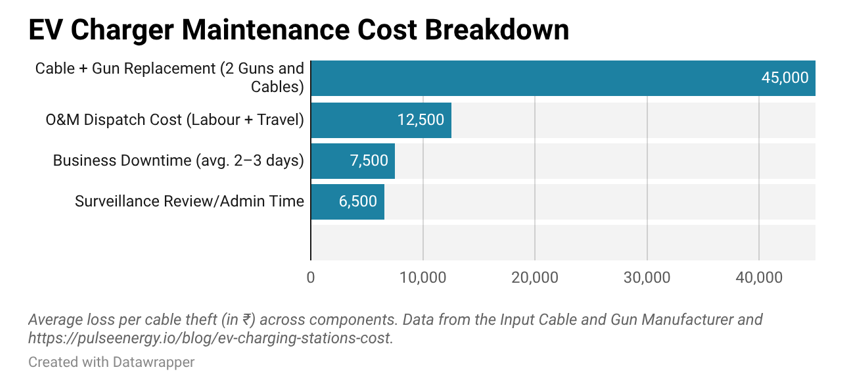
Figure 1: Average loss per cable theft across components. Data from the Input Cable and Gun Manufacturer and https://pulseenergy.io/blog/ev-charging-stations-cost.
If not addressed, cumulative losses from theft incidents could reach ₹crores by 2030, even without accounting for indirect impacts such as reputational damage and the erosion of user trust in public EV charging infrastructure.
Why This Matters for EV Adoption
Such incidents can trigger a negative feedback loop.
One, CPOs may scale back or reconsider future investments in certain areas due to recurring O&M expenses.
Two, users may lose trust in the reliability of the PCS infrastructure.
Lastly, slower PCS growth may limit EV adoption in Tier 2/3 cities and along highway corridors.
Comprehensive Strategies to Prevent Charging Cable Theft
To address this growing threat, CPOs, policymakers, and city administrators must work together on multi-layered interventions. Here are some actionable strategies:
1. Use Armoured, Cut-Resistant Cables: Deploy high-tensile armoured cables that resist mechanical cutting tools like saws and bolt cutters. This increases the time required to steal and offers a critical window for alarm systems to activate and surveillance teams to intervene. Moreover, the new materials added reduce their scrapyard value owing to the added effort required to extract copper.
2. Secure Cable Enclosures with Access Control: Redesign charging hardware so that the cable is only accessible upon authenticated user verification (e.g., QR code, RFID, app unlock). While storing large cables for high-capacity chargers in compact spaces is challenging, modular compartments or retractable mechanisms can be explored. Accessibility for persons with disabilities must also be ensured in the design process.
3. Conduct 24×7 Surveillance and AI-Based Monitoring: Install CCTV cameras with remote streaming, AI-driven motion detection, and 180-degree coverage. Integrating alert systems that flag unusual activity in real time can significantly reduce theft risk. However, these systems may be economically viable only in high-utilisation areas.
4. Embed Sensors and Real-Time Tamper Alerts: Equip charging cables with sensors that instantly send alerts when physical tampering or cutting is detected. These alerts can be connected to nearby command centres and police control rooms, mobile apps, or on-site sirens.
5. Deploy Security Personnel in High-Risk Zones: While human security is cost-intensive, it may be practical in high-risk urban centres, highway pit stops, or key transit hubs. Security guards offer both a visual deterrent and the ability to respond immediately.
6. Implement Anti-Theft Legislation and Legal Reform: Introduce state and national laws that categorise theft or vandalism of EV infrastructure as non-bailable offenses with strict penalties. Clear mandates will also empower law enforcement to register FIRs and actively pursue offenders.
7. Adopt DyeDefender Technology: Adopt innovations like Tesla’s DyeDefender system, a stainless-steel hose around the cable filled with blue, non-toxic dye. If the cable is cut, the dye marks the thief and is extremely difficult to remove. Such a system adds cost but may be deployed strategically in zones with frequent theft instances.
8. Engraved Traceable Cables: Manufacture cables with engraved serial codes or name markers tied to CPO ownership. This can help scrap dealers and recyclers flag stolen components, deterring resale. A minor modification in cable manufacturing can yield a major impact.
9. Geo-Mapping and Risk-Based Deployment: Segment city zones into high-risk and low-risk areas using past theft data. Deploy stronger theft deterrents (like armoured cables, surveillance, or guards) in hotspots, while using basic deterrents in safer zones. Also, work with local police to spread awareness about the importance and value of PCS infrastructure.
EV Growth Needs Infrastructure Security
EV cable theft may seem like a niche issue, but its ramifications extend far beyond lost copper. It threatens infrastructure reliability, investor confidence, and user trust, all of which are crucial to India’s EV transition. As both developed and emerging economies face challenges in safeguarding EV infrastructure, security innovation must meet the needs of infrastructure expansion.
About the authors

Jaideep Saraswat (Associate Director – Clean Power, Electric Mobility & Emerging Technologies) leads the Electric Mobility vertical at Vasudha Foundation, where he focuses on addressing key barriers to EV adoption and advancing sustainable mobility solutions.

Nikhil Mall (Senior Manager – Clean Power, Electric Mobility & Emerging Technologies) is also part of the Electric Mobility vertical, contributing to research, stakeholder engagement, and initiatives that promote the transition to clean transportation.
Also read: 72% of Indian truck fleet operators ready to go electric- If key barriers are addressed
Subscribe & Stay Informed
Subscribe today for free and stay on top of latest developments in EV domain.