100,000 swaps a day — and counting: Inside SPIRO’s plan to electrify Africa’s roads

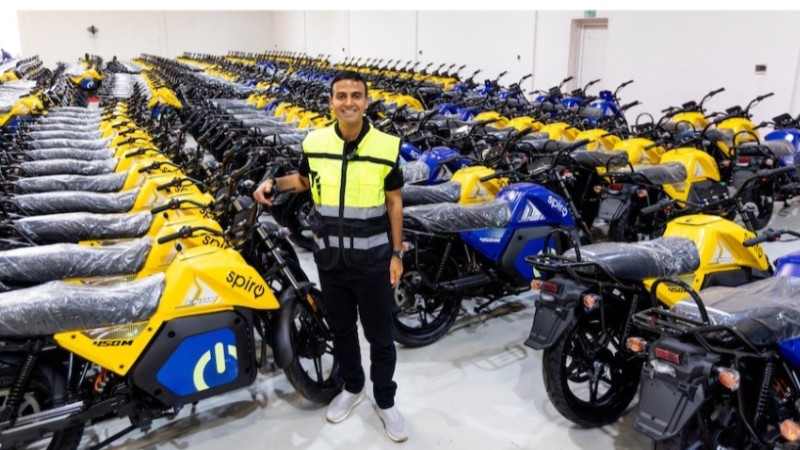
Spiro has built something rare in the EV landscape — a company that does not just sell electric vehicles in Africa, but has constructed the infrastructure layer that makes mass adoption possible. As Founder of SPIRO, Africa’s largest electric vehicle company, Gagan Gupta has overseen a network that now spans over 2,500 battery-swapping stations across Africa, completing upwards of 100,000 swaps every day — a number growing at 15% month-on-month.
In this conversation with EVreporter, Gupta speaks about what it takes to run a high-frequency energy network at scale, why battery swapping is the model that works for Africa’s motorcycle taxi economy, and what the continent’s EV transition looks like from the inside.
Congratulations on the recent $215 million fundraise for Spiro*. You’ve now raised over $343 million. What has changed in the company’s approach since you started?
*The interview was conducted on 10 Jun 2026. The company has raised an additional USD 55M since then.
I think we started this company and got it to a pretty significant stage before we started attracting capital. From Spiro’s perspective, what we are trying to achieve is to build the entire EV ecosystem — the swapping infrastructure, the right dealership network, the right O&M network — all with one purpose: to ensure that the customer gets the best experience and is able to save compared to what they were spending on ICE bikes.
The additional capital allows us to accelerate — in terms of densifying the network and opening new markets — but the trajectory remains the same. We are growing at about 15% on a month-on-month basis, and that continues.
In which areas do you find the most acceptance and viability for electric mobility?
EVs are quite viable compared to ICEs. Today, a Spiro bike is cheaper than an ICE bike, and its operating costs are lower — I would say in 90% of the markets we operate in.
The challenge with adoption is that people need assurance that they can get energy for their bikes without waiting 2.5 hours. A boda-boda driver wants to do his business. So we had to build something that would give the customer the same experience they have when driving an ICE product. And, the total cost of ownership has to be lower.
What Spiro has done is put the network first, so the users will come. In Rwanda, where we have a dense network, 90% of all bikes sold are electric — and 90% of that 90% is Spiro. In Kenya, 20–30% of all bikes sold monthly are now electric, and our share of that is close to 90%. Network requires significant capital to deploy, but deploy first, and the customers follow.
You’ve completed over 30 million battery swaps across 2,500-plus stations. What does it take to run a reliable swap network — the parts that aren’t obvious from the outside?

At Spiro, we are currently doing about 100,000 swaps a day, growing at about 15% month-on-month. We expect that to go close to a million swaps a day next year. In any high-frequency business like this, a few things are critical.
- First, ensure the wait time for users is very low.
- Second, your entire tech stack needs to work — you have integration with mobile money platforms, with the battery, with the swap session itself. That requires significant investment in backend technology.
- Third, you need to be able to guide riders to where they should be going to charge — where battery availability is, which station, which network.
- And you have to manage your entire battery ecosystem. You have so many batteries in the float, and managing that requires significant operational depth, aided by technology.
That’s why we have invested heavily in the tech side. We have close to 200 people in the Pune office and development centres in Kenya and Nigeria, to ensure we’re updating and improving based on everything we learn.
On the subject of float — what kind of ratios do you work with? For example, the number of bikes in a location versus the number of batteries you need to keep at swapping stations?
These ratios evolve over time. When you go to a market, you want to ensure good availability because you may not be operationally efficient at that point. But as the market matures, the ratios completely change. In the beginning, you’re still not sure which swap station users will come to most, or what the offtake pattern will look like. So you populate on a standard basis and keep adjusting. It takes about 18–24 months to arrive at the right ratio for a given market.
There’s also the dependency dynamic in battery swapping — once a rider is on your platform, they need your batteries and your stations. How do you think about openness versus lock-in in the ecosystem?
We are very clear that we will open our ecosystem. If another bike player wants to come and use our batteries, we are happy. That said, we will not allow the ecosystem to be compromised because someone wants to plug and play with a lesser or incompatible battery. Imagine a battery incident — a fire — and the entire sector takes a hit. We have no problem with openness; we just have a responsibility to protect the ecosystem.
You’ve been explicit that most EVs deployed in Africa were designed elsewhere, without a full understanding of local conditions. What were the design failures that made this a concrete problem for you — and what led to the acquisition of Coexlion?
When we first launched, we launched with a product that was not fully suited for the market. We got a lot of feedback from customers, and we modified the product. The current product design belongs to us — it is based entirely on that customer feedback. Our first real market test was in Togo and Benin, and we like to test at scale to ensure we’re launching the right product.
With the acquisition of Coexlion, the idea is to build an in-house product team that constantly thinks about what we can do better for customers and which other products we can bring. As we expand into more geographies, customisations will be required, and having that engineering capability in-house means we can move faster.
What does Spiro’s market performance look like across your leading markets?
Currently, we sell about 10,000 bikes per month. I don’t look at market share versus electric — I look at market share versus the entire motorbike sector.
In Rwanda, we have about 80% market share in new bikes sold. In Kenya and Uganda, we are at about 20–25% of all new bikes sold, and that’s what’s relevant to us. Going forward, I see EV adoption growing much higher. The tailwinds from fuel prices are really helping.
Africa imports $180 billion worth of mobility products, of which $150 billion is fuel alone, and these countries are 100% dependent on fuel imports. That makes the case for e-mobility very compelling.
You have assembly plants in Kenya, Rwanda, and Uganda. What does “Made in Africa for Africa” mean in practical terms?
I am a very strong believer in ensuring we add all the value in the countries and the continent we operate in. My other business, ARISE IIP, is built around exactly that — value addition within the continent. Today, we are already producing some components locally. By Q2, all our components will be made on the continent. We are building four mega factories to ensure every component is manufactured in Africa.
More importantly, because of the scale of batteries Spiro needs, two cell manufacturers have agreed to build cell manufacturing plants in Africa. Spiro is not just deploying EVs — it is driving the entire EV manufacturing ecosystem. Next year, every component will be made on the continent. Within 24 months, cells will be produced here as well. This will be the biggest transformation from a materials and industrial perspective that Spiro would have driven.
Can you share more about how you are looking to support local Cell Manufacturing?
Spiro will not be doing it directly. It will be our partners through a platform called A2MP — the Africa Mineral Metal Processing Platform — which I founded and focuses on mineral and metal processing on the continent. That platform is partnering with current global suppliers to come and set up a manufacturing base in Africa. By the end of September, we should be able to say more.
How significant is India as a supply base for Spiro?
We have some IoT suppliers from India, but I haven’t seen any other significant component supply come out of India yet. For us, it is very important that they are willing to relocate their supply base, not just fulfil orders. I have had discussions with some players in the past, but all of them were interested only in getting orders and supplying from India — not relocating. We want people to manufacture in Africa.
What are your plans for expanding the product portfolio — perhaps into 3Ws or cargo?
We will be bringing some new form factors. We haven’t announced it yet, but come Sep–Oct, I think you’ll be surprised by what we’ve been working on. It will be a game-changer for the industry.
How does the Pune Global Technology Centre fit into your engineering efforts?
Pune is the EV hub of India — the best talent is available there. The whole idea was to build a centre where all software development can happen. We have the development centre in Pune, and development centres in Kenya and Nigeria. Pune develops the products; Kenya and Nigeria implement and feed back local knowledge. It plays a very important role in our technology journey.
What else should people know about Spiro?
First, we are very open to partnerships with companies that want to use our battery-swapping network. We are happy to partner with them. Second, Spiro is not just about motorbikes — it is about an ecosystem we are developing, and that is really pushing the boundaries of how you look at the EV space. And lastly, you should go ahead and put money in Spiro. It’s going to be the most successful EV company.
This article was first published in EVreporter July 2026 magazine.
Also read: Spiro closes $270 million funding round with $55 million investment from NewTrails Capital
Subscribe & Stay Informed
Subscribe today for free and stay on top of latest developments in EV domain.