The Rise of 587Ah Cells and 6.25MWh Battery Energy Storage System

This article discusses the next trend in the BESS industry – 587Ah/588Ah cells and 6.25MWh BESS in 20ft container.
For the last two years, the 314Ah LFP prismatic cell has been the trending cell in containerised BESS (Battery Energy Storage System). Cell capacities have been increasing over the years, and with higher capacity, volumetric energy density has improved in a 20ft ISO high cube container. The larger cells reduce components in the container system, lower overall system costs, and reduce project costs, such as lower civil costs and lower land requirements due to higher capacity in a given container.
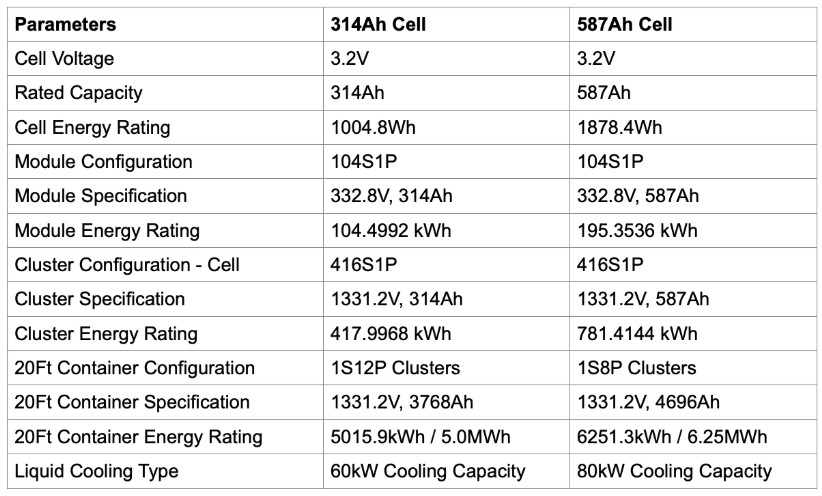
Comparison of the Latest 587Ah Cell with the Existing 314Ah Cell
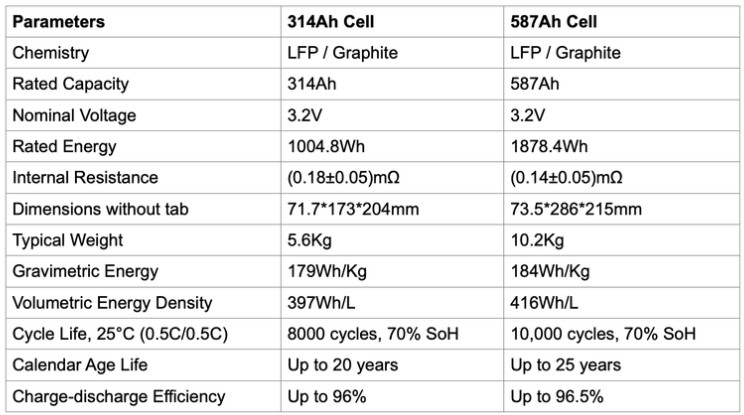
Advantages of shifting from 314Ah cell to 587Ah cell
- Cell cost per kWh will be cheaper.
- BESS containerised solution will be cheaper.
- Projects will require less land to accommodate the same BESS capacity.
- Lower civil costs for BESS.
- Better ROI/TCO on energy storage projects, especially with the ability to work up to 25 years.
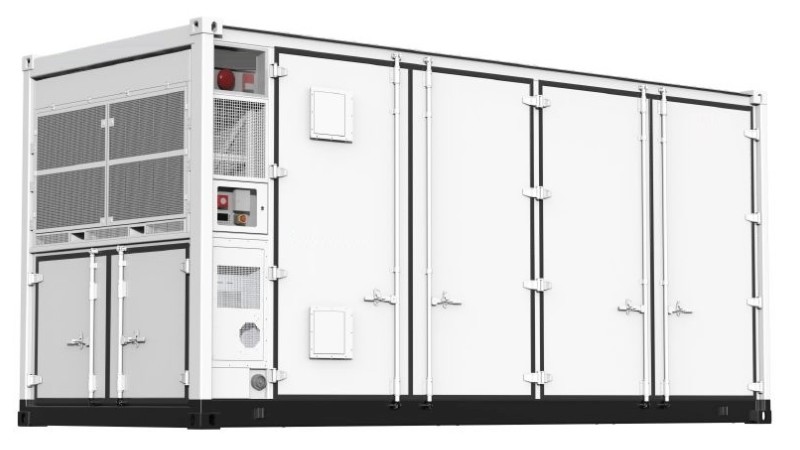
- 25% more energy can be stored in 20 feet container, up from the traditional design of 5016kWh to 6251kWh.
- Higher BESS capacity to allow for lower auxiliary power consumption and hence improve the overall round-trip efficiency of the project.
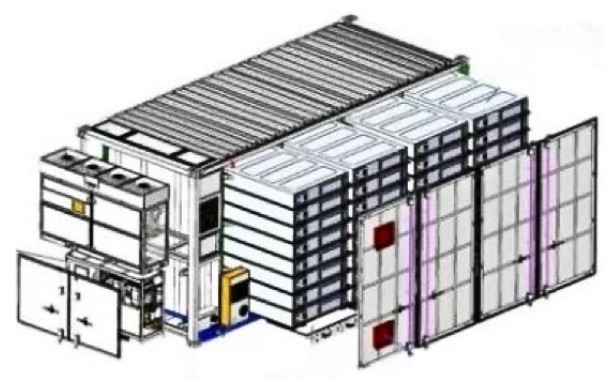
Comparison of 20 Feet Liquid Cooling Container Design for Both Type of Cells
Market Updates
587Ah/588Ah LFP prismatic cells are expected to enter mass production before the end of 2026, with companies conducting trial projects and certifications.
It will be difficult for 587Ah cells to overtake 314Ah cells in residential and C&I (commercial and industrial) batteries. There are many applications where 314Ah cells have a market, and it is difficult to phase out 314Ah cells as 280Ah energy storage cells were phased out of the market.
By the way, 280Ah cells still exist in the market, and they are being produced for power applications and used for higher than 0.5C application uses.
Moreover, 587Ah cells require investment in new cell manufacturing equipment and cannot be produced on the same equipment used to produce 314Ah cells. However, this was not the case when 280Ah cells were replaced with 314Ah cells. The transition was easy due to the same cell dimensions, and the existing cell manufacturing equipment did not require changes.
Some companies have planned 392Ah cells, which can be produced on the existing cell manufacturing equipment used to produce 314Ah cells. 392Ah cells follow the same 12-cluster architecture and can achieve 6.26MWh, which is a similar capacity to the 587Ah-based BESS.
Compared to 600Ah+ series, 587Ah cells have better thermal management properties and are more suitable for 0.5C (2 hours) projects due to their smaller size.
While a 5MWh BESS was coupled with a 2.5MW PCS (Power Conversion System) for a 2-hour project, a 6.25MWh BESS needs to be coupled with a 3.125MW PCS, and PCS companies are planning its launch soon.
About the author

Rahul Bollini, Bollini Energy
Rahul is an R&D expert in Lithium-ion cells with 10 years of experience. He founded Bollini Energy to assist in deep understanding of the characteristics of Lithium-ion cells to EV, BESS, BMS and battery data analytics companies across the globe. Contact | +91-7204957389; bollinienergy@gmail.com.
Rahul had written about the rise of 314Ah Cells and 5MWh BESS in February 2024.
This article was first published in EVreporter Mar 2026 magazine.
Also read: Liquid-cooled Energy Storage Systems for High Tension Industrial Use
Subscribe & Stay Informed
Subscribe today for free and stay on top of latest developments in EV domain.