Smart Communication Protocols and Grid Intelligence in EV Charging

EV CHARGING TECH SERIES – ARTICLE 1(B)
Article 1 of this Series can be accessed in EVreporter Mar 2026 issue or our website.
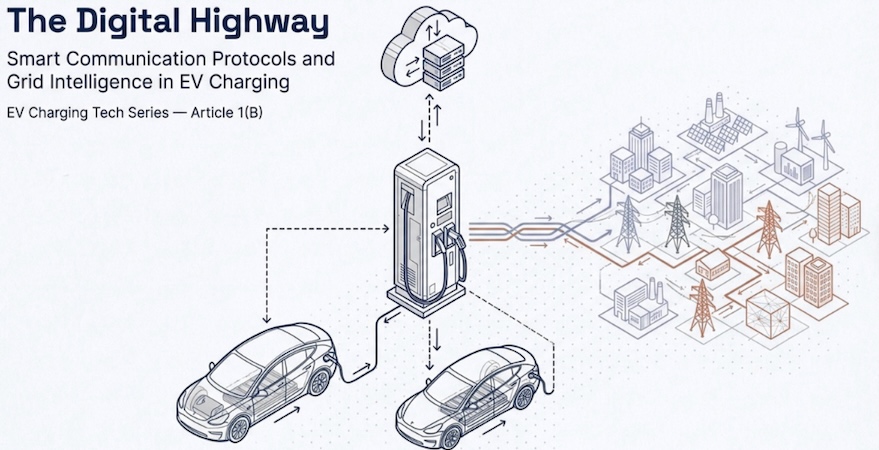
EV charging is evolving beyond simply installing more plugs. The focus is now on creating a digital energy network that coordinates vehicles, chargers, utilities, and the grid in real time.
This shift from hardware alone to integrated intelligence means that smart chargers, which communicate with vehicles, respond to grid conditions, and manage power dynamically, are becoming as essential as the charging cable itself.
This article by Alekhya Vaddiraj examines communication standards and protocols that transform chargers from passive outlets into active, intelligent components of the grid.
Why Communication Matters
A charging station today is a networked IoT device — governed by multiple overlapping communication layers. Communication transforms basic charging hardware into smart, connected, and efficient chargers.
Modern networks, with more renewables and connected devices, require:
- Load management: Distribution and management of energy without overloading feeders.
- Authentication: Verification and authorization of devices and sessions.
- Payment & Billing: Secure user transactions.
- Data Logging: Track usage, performance, and predictive maintenance.
Today’s charging stations function as networked IoT devices, managed by multiple overlapping communication layers.
Core Family of Protocols Enabling EVs
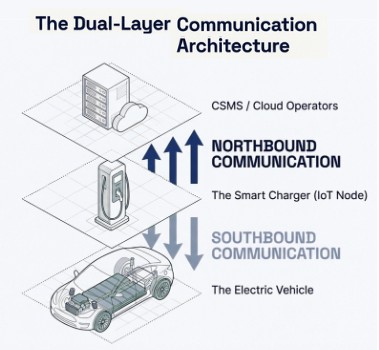
Protocols and standards for EV charging can be broadly categorized into two communication layers.
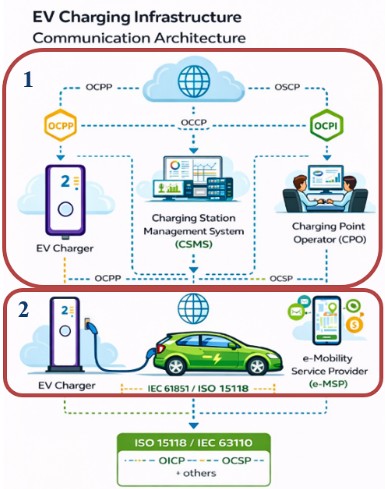
- The first layer is charger-to-backend communication, which allows operators to monitor performance, control sessions remotely, and manage billing and diagnostics.
- The second layer is charger-to-vehicle communication, enabling features such as Plug & Charge, real-time charging schedules, and future bidirectional energy flow.
1. Charger to Backend Operator/s
OCPP — Open Charge Point Protocol
- A De facto global open standard enabling chargers to communicate with the CSMS (Charging Station Management System). Developed by the Open Charge Alliance, versions 1.6 & 2.0.1 are widely used.
- Communicates via WebSocket-based JSON data exchange.
- Functions:
– Remote start/stop of sessions
– Smart load management
– Diagnostics and fault reporting
– Energy usage records
– Firmware updates
OCPI — Open Charge Point Interface
- This open protocol supports EV roaming, data exchange, and interoperability, allowing drivers to use any charger regardless of their subscription, similar to mobile network roaming.
- Developed by the EVRoaming Foundation, it enables EMPs and CPOs to collaborate, enhancing user convenience.
- OCPI, combined with the Open Clearing House Protocol (OCHP), establishes a roaming network by defining a centralized clearing house and outlining how multiple charging stations or operators exchange information such as location, availability, pricing, authentication, session details, and billing.
OSCP — Open Smart Charging Protocol
- This emerging protocol is designed to support EV grid integration.
- It manages electric flow between the distribution network and charging stations.
- The protocol focuses on energy management between grid operators and charging providers.
- It transmits future capacity data in 15-minute intervals, helping to prevent overloads and support grid load management.
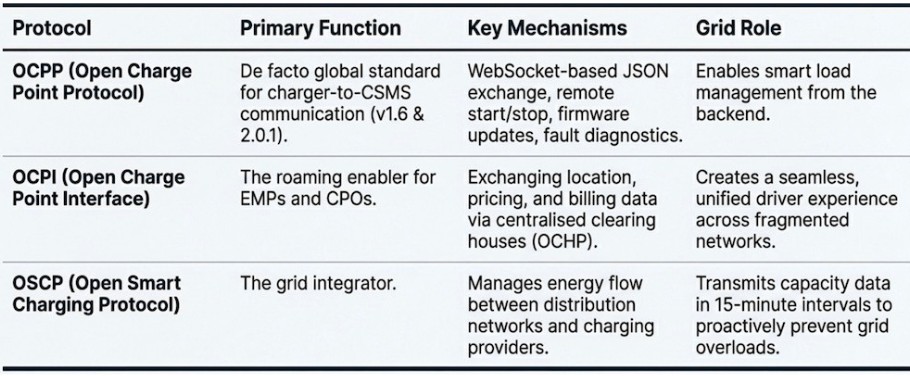
These protocols define northbound communication between the charger and the cloud, rather than between the charger and the vehicle.
2. Charger-to-Vehicle Protocols
- IEC 61851 – This standard provides low-level electrical safety and signalling through a basic control pilot signal, using Pulse Width Modulation (PWM).
- ISO 15118 – ISO 15118 enables high-level communication between EVs and charging equipment (EVSE), supporting Plug & Charge and vehicle-to-grid (V2G) capabilities.
These standards enable EVs to function as smart devices that can provide grid services.
- Plug & Charge: Vehicle auto-authenticates via digital certificate; no cards/apps needed.
- Smart Charging: Exchanging real-time charging schedules.
- Bidirectional Energy Flow (V2G): Communicates grid state, battery SOC, and desired power direction.
Smart Charging & AI Integration
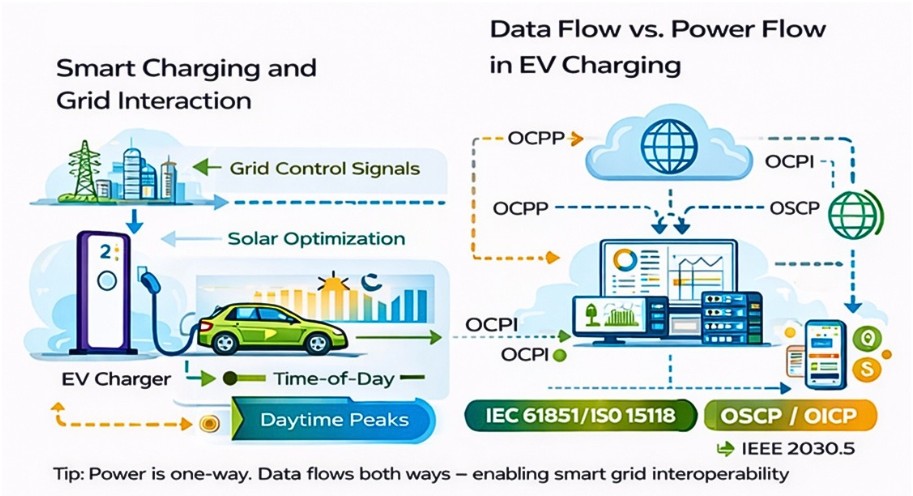
Smart charging combines energy management logic with user demand forecasting.
- Dynamic load balancing: Charging rates are adjusted so that if one vehicle requires less power, others can utilize the available capacity.
- Time-of-day optimization: AI shifts charging to periods of low demand or lower tariffs.
- Predictive maintenance: Voltage and temperature sensor data is analyzed in the cloud to anticipate maintenance needs.
V2G and V2H (Vehicle-to-Home):
EVs serve as mobile energy storage assets:
- Feed power back into a home, reducing grid purchases.
- They can respond to utility frequency regulation and grid balancing events.
Cybersecurity and Data Privacy
As chargers become more advanced, cybersecurity becomes increasingly important.
- TLS 1.3 Encryption in OCPP 2.0.1 prevents man-in-the-middle attacks.
- Digital certificates authenticate chargers and vehicles in ISO 15118.
- Firmware signing & verification prevent malicious updates.
- Edge security modules enable anomaly detection and hardware-level access control.
Future standards may incorporate blockchain-based identity management for fully distributed networks. Cybersecurity remains an evolving field with dynamic stakeholders and roles.
Grid Integration and Energy Intelligence
The primary benefit of smart charging is enhanced grid intelligence. Rather than treating each EV as a fixed load, modern systems can shift demand to off-peak hours, reduce local stress, and help utilities manage power more efficiently.
EV chargers have become integral components of smart grids:
- Load Forecasting: Predict how many chargers will be active across regions.
- Demand Response (DR): Reduce or defer charging during grid stress.
- Renewable coupling: Solar-powered stations adjust their output based on irradiance data.
- Digital twins: Simulate grid load behaviors and the impact of charging sessions.
- Examples – Europe’s IOWN project and the Netherlands’ ElaadNL research are developing city-wide charging grid simulation platforms.
- Utilities in California use AI to coordinate charging times based on renewable output forecasts.
Emerging Frontiers
- Edge Computing Gateways: Handle local decisions with low latency (no cloud dependency).
- 5G Integration: Enables fast, deterministic communication for V2G clusters.
- Blockchain Payment Architectures: Peer-to-peer (P2P) transactions without central operators.
- Cloud APIs for Energy-as-a-Service (EaaS): Utilities provide open data for developers to build custom EV energy apps.
In Summary
The future of EV charging will not be defined solely by the number of chargers, but by how intelligently they communicate, adapt, and cooperate with the grid.
The champions will be the systems that combine interoperability, cybersecurity, and energy awareness into a single platform. In a market like India, the smartest charger will not just dispense power — it will help manage the future of the power system itself.
Next in the series: India’s Electric Leap — A Tech-Powered Charging Ecosystem in Action.
About the author

Alekhya Vaddiraj is a clean energy strategist and engineering leader with over a decade of experience driving grid modernization, distributed energy integration, and infrastructure resilience initiatives. She has worked in multidisciplinary teams and multi-stakeholder collaborations across utilities, research institutions, and industry consortia, contributing to DOE- and CEC-funded programs in EV infrastructure, demand response, and energy cybersecurity.
Currently pursuing a PhD in Electrical Engineering, Alekhya combines deep technical expertise in Power Systems with strategic program execution — translating complex engineering challenges into scalable, policy-aligned solutions that accelerate the transition to reliable, low-carbon energy systems.
This article was first published in EVreporter April 2026 magazine.
Subscribe & Stay Informed
Subscribe today for free and stay on top of latest developments in EV domain.