From Range Anxiety to Residual Value: Where AI Is Extending EV Battery Life

Giovanni Rossi, CMO of ELECTRA AI, shares his insights about how AI is reducing uncertainty in EV batteries, tackling range anxiety, residual value concerns, and battery lifecycle management.
Three problems, one cause
Survey the market, and the same objections come back from private buyers and fleet operators alike. AAA’s most recent annual EV consumer survey, conducted in March 2025, found that only 16% of US adults said they were likely to buy a fully electric vehicle next — the lowest reading since 2019 — while 63% said they were unlikely to. The barriers they cited are revealing:
- Battery repair cost — 62%. Now the single largest deterrent, ahead of everything else.
- Purchase price — 59%.
- Charging convenience — 56%.
- Range anxiety — 55%.
Note what has happened there. The most-cited obstacle to EV adoption in the world’s second-largest car market is no longer charging infrastructure or sticker price. It is fear about the battery.
Range expectations do not help. Independent real-world testing has repeatedly shown official homologation figures overstating what drivers actually get: What Car? found an average shortfall of 14.8% against WLTP figures across ten EVs, and in cold-weather testing, shortfalls reached 38%. The Australian Automobile Association’s on-road programme found real range averaging 11.6% below official figures. So, the driver’s mental model of their own vehicle is routinely wrong by ten to fifteen percent, and considerably more in extreme temperatures.
On the fleet side, the anxieties are financial rather than emotional. The battery pack represents a substantial share of total vehicle cost, and the industry still plans around an assumed seven-to-eight-year pack life. More than half of fleet operators and asset managers flag EV residual value as a concern, and McKinsey’s work on fleet decarbonisation identifies poor asset visibility as a direct drag on operational efficiency.
Treat all of these as separate problems, and you get separate fixes: bigger packs, cheaper cells, longer warranties. Look closer, and it is one problem wearing several costumes.
Nobody knows the true state of the battery. And that uncertainty gets paid for three times over.
- It is paid at design, in pack oversizing — extra kilowatt-hours bought purely as insurance against estimation error, which becomes capital cost passed to the customer.
- It is paid in operation, as reserved buffer and pessimistic range display, which drives exactly the behaviour that destroys a battery fastest.
- And it is paid at end of life, as a resale discount on an asset whose condition cannot be credibly evidenced.
Almost every serious use case for AI in EV batteries is an attempt to reduce that uncertainty.
The vicious circle nobody designs for
The nastiest version is a feedback loop, and it explains why range anxiety is not merely a marketing problem.
A driver does not trust the range figure – and with good reason, given the numbers above. So they charge to 100%, and they charge often, usually fast. Sitting at high state of charge and charging at high power are the two largest controllable accelerators of battery degradation. The pack ages faster than it needed to. Real range falls. The driver becomes more anxious, charges to 100% more often, charges faster still.
The anxiety causes the degradation that justifies the anxiety.
Break the loop at the estimation step — give the driver a range figure they can actually trust — and behaviour changes with no hardware intervention at all. That is why accurate state estimation is not a dashboard nicety. It is the upstream lever on everything downstream.
A battery is not a semiconductor
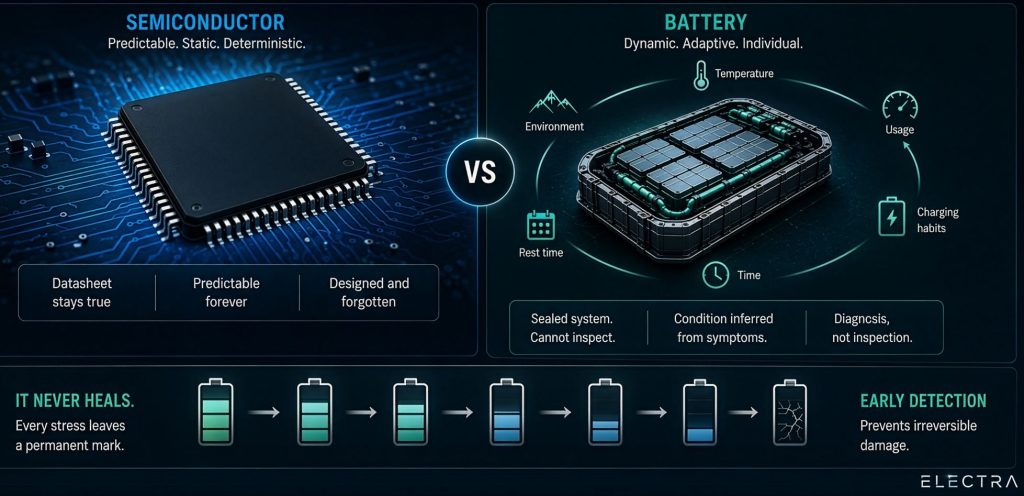
Here is the reason worth dwelling on: the industry’s instinct is to treat a battery as a component when it behaves far more like an organism.
A semiconductor is deterministic. Same input, same output, on the day it ships and a decade later. It has a datasheet, and the datasheet stays true. That is the entire basis of modern electronics: parts that behave predictably enough to be designed around and then forgotten.
A battery does none of this. It is an electrochemical system in continuous, irreversible change. It metabolises — takes in energy, converts it, produces heat, and wears in the process. Its internal chemistry evolves through mechanisms that depend on everything that has ever happened to it: how hot it has been, how hard it has been worked, how long it has rested, how full it has been left standing.
It is environmentally sensitive in ways that look almost like mood. A cold morning genuinely reduces what a pack can deliver, and it recovers when warm. A hot afternoon changes what it will safely accept. Its behaviour also depends on the path it took to get to its present state, not just the state itself — which means you cannot read its condition off a single measurement the way you read a voltage on a chip.
And critically: you cannot open it up to look. A pack in service is a sealed system. Everything you know about its internal condition is inferred from external symptoms — voltage, current, temperature, over time. That is not engineering inspection. That is diagnosis. It is much closer to medicine than to electronics.
The metaphor breaks in one place, and it matters: unlike a living organism, a battery never heals. Every stress leaves a permanent mark. Which makes early detection more valuable, not less — you are not treating an illness; you are preventing accumulated damage that can never be undone.
So the honest conclusion is that a battery cannot be managed with a datasheet, because a datasheet describes something static and a battery is not static. What it needs is something closer to a diagnostic intelligence: a system that learns each individual pack, tracks it across its life, and recognises when it begins deviating from its own normal. Something that functions, in effect, as a brain for the battery.
That is the real argument for AI here. Not that machine learning is fashionable. That a fixed model is the wrong instrument for a system that will not hold still.
What the software is actually estimating
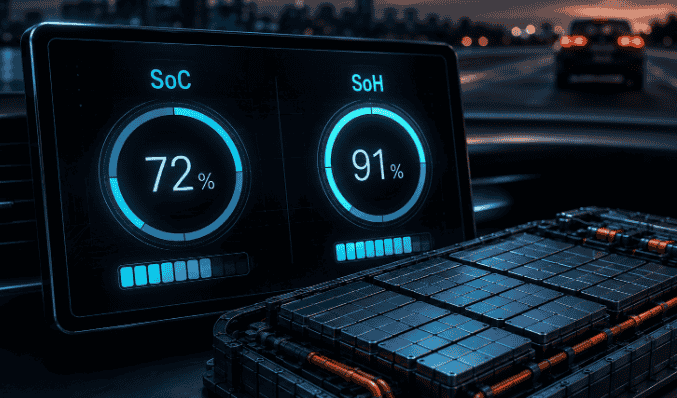
Two numbers do most of the work.
- State of Charge is how much usable energy is left right now. It shows as the range figure on the dashboard.
- State of Health is how much capacity the pack retains compared with when it was new. It determines residual value, warranty exposure, and whether a retired pack has a second life.
A conventional battery management system estimates both using models calibrated at the factory on a new cell. Given everything above, the structural weakness is predictable: accuracy decays as the pack ages. The model describes a battery that no longer exists. Error therefore grows precisely during the years when accurate health data matters most — warranty claims, resale, replacement planning.
Adaptive approaches invert that. The model is periodically re-trained against the pack’s own accumulated operating data and updated over the air, so it follows the battery as the battery changes. Reported error stays flat or improves across the same period during which a fixed model drifts.
Eight use cases, grouped by the problem they solve
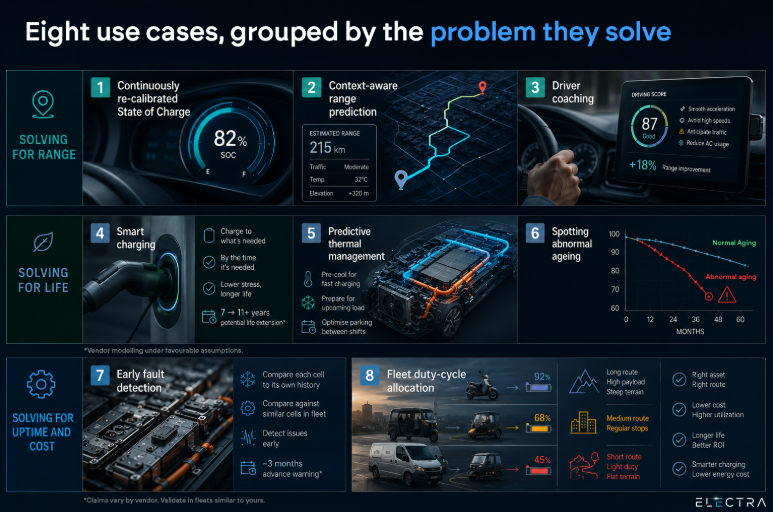
Solving for vehicle range
1. Continuously recalibrated State of Charge. The estimate runs on the vehicle because control decisions cannot wait for a network round-trip. The learning runs centrally, where fleet-scale data lives. Improved models are pushed back down. Vendors report sub-1% error against a roughly 10–15% real-world range gap — figures worth testing rather than accepting, for reasons covered below.
2. Context-aware range prediction. State of Charge tells you what is in the pack. Range depends on route topography, ambient temperature, air-conditioning load, payload, traffic, and driving style. That is a prediction problem, and it is where most dashboard error originates. Fewer and better-planned charging stops follow directly from getting it right.
3. Driver coaching. Personalised feedback on the specific habits costing range and life on this route, in this vehicle. Unglamorous, and often the fastest payback in a fleet because the intervention is behavioural rather than capital.
Solving for battery life
4. Smart charging. Only two things about charging are genuinely controllable: how full you charge, and how fast. They also happen to be the two dominant degradation accelerators. Smart charging learns a vehicle’s real usage pattern — when it plugs in, how long it sits, how much energy the next shift actually needs — and charges to what is required, by the time it is required, instead of to 100% as fast as possible.
The gains here are the largest of any use case listed; claimed pack-life extension runs from roughly seven years to eleven or more. Those figures come from vendor modelling under favourable assumptions and should be read as directional. The physics is not controversial: less time at high charge and lower average charging power means slower ageing.
For a battery-swapping operator this is a station problem, not a vehicle problem. You are charging a pool of packs of mixed age and history. Charging them identically ignores that they are no longer identical — an important point for India’s two- and three-wheeler swapping networks specifically.
5. Predictive thermal management. Reactive cooling responds to heat already in the cells. Predictive control uses the known upcoming event — a fast charge, a climb, a forecast — to cool in advance. In Indian summer conditions this is probably the most under-exploited lever available. It is also a parking question: where a pack sits, at what charge level, for how many hours between shifts is a real variable most operators never treat as one.
6. Spotting abnormal ageing. Not just measuring degradation but distinguishing normal from abnormal. A pack ageing along its expected curve needs nothing. A pack diverging from it needs attention now, while the fix is still cheap.
Solving for uptime and cost
7. Early fault detection. Fixed alarm thresholds catch a fault once it has already become a fault. The useful approach is comparative: measure each cell against its own history, and against every comparable cell across the fleet. A developing internal short, or a cell drifting from its neighbours, shows up as an outlier long before it trips a limit. Advance-warning claims commonly run to around three months; ask to see the evidence on a fleet resembling yours.
8. Fleet duty-cycle allocation. The least exotic use case and often the quickest payback. With trustworthy per-vehicle health data you can match assets to routes deliberately: aged packs onto short, light, shallow-cycle duty; healthy packs onto the demanding runs. Rotate rather than run each asset to failure. Schedule maintenance against predicted need rather than the calendar. Schedule charging into cooler hours, which in most markets are also cheaper hours.
No new hardware. Only reliable health data and the discipline to act on it.
Where this becomes a compliance question
Battery health is the dominant determinant of an EV’s residual value, and in a still-forming used-EV market the inability to evidence that health credibly is a real constraint on capital. Buyers discount for uncertainty, financiers price for it, and the secondary market stays thin as a result. A continuously maintained, auditable health record turns the pack from an opaque risk into an assessable asset.
Regulation is arriving on the same axis. EU Regulation 2023/1542 requires a digital battery passport for batteries above 2 kWh from 18 February 2027. Alongside static identification and materials data, it mandates dynamic performance fields — certified energy remaining, state of charge, internal resistance, and the number of full charge-discharge cycles among them. None of these can be looked up in a datasheet. They have to be computed continuously from operating data, which makes the passport requirement quietly a battery-analytics requirement.
For any Indian manufacturer exporting to Europe, that is a 2027 deadline needing 2026 engineering.
What it takes, and what it does not do
The bar to entry is lower than most operators assume. Pack-level voltage, current, and temperature, plus ambient temperature and a reliable timestamp, sampled at least once a minute, are enough to begin useful health estimation. Cell-level data is what unlocks the fault detection in use case 7 and is worth specifying at design time even if nothing consumes it yet.
The bar is also absolute. Lose the ambient temperature channel, run a poorly calibrated current sensor, or break timestamp integrity across a connectivity gap, and the output is confident nonsense. Most disappointing deployments in this field are data problems wearing a modeling costume.
Some further honest limits:
- It will not rescue a bad pack design. If the cooling cannot remove the heat, or cells were mismatched at assembly, software optimises within the envelope the hardware allows and no further.
- Life predictions deserve more skepticism than health measurements. Current health is an estimate of a present condition. Remaining life is a forecast of a duty cycle that has not happened yet, and inherits every assumption about future use.
- Accuracy claims are frequently not comparable. “Sub-1% error” means very little without the chemistry, the temperature range, the age range tested, and whether validation used data the model had never seen.
- Cybersecurity travels with battery intelligence. A pack whose operating limits are influenced by a remote model is an attack surface, which is the direction AIS 156 and equivalent international requirements point.
- Vendor economics are modeled, not measured. Every return-on-investment figure in this field rests on assumptions about utilization, tariffs, and duty cycle. Ask to see them.
Questions worth asking any vendor
- What accuracy, on which chemistry, across what temperature and age range, measured against what benchmark?
- Was validation done on real-world data the model had never seen, or on its own training data?
- Does the stated accuracy still hold at middle and end of life, or only on a new pack?
- Which data do you need, at what sampling rate, and what degrades when a channel goes missing?
- What runs on the vehicle, what runs in the cloud, and how does the system behave when connectivity drops?
- What life extension has actually been measured in a comparable deployment, against what baseline?
- Does the health record survive a change of vendor, and who owns the underlying data?
The shift
Cells are converging. Chemistry roadmaps are broadly public, manufacturing quality is rising across the industry, and the gap between a good cell and an average one is narrowing. What increasingly separates a pack that lasts eleven years from one that fails in six is not the cell. It is how accurately its condition is known, how adaptively it is charged and cooled, how early its faults are caught, and how deliberately it is dispatched.
For Indian OEMs and fleet operators, that is an unusually cheap lever. It does not require re-tooling a production line. It requires taking telemetry seriously at the design stage, being properly sceptical about accuracy claims, and being willing to change operating practice when the data says the current practice is expensive.
We have spent a decade trying to specify batteries like components. They were never components. They are closer to patients — and patients need diagnosis, not datasheets.
About ELECTRA AI – Founded in 2015 and headquartered in the USA, ELECTRA AI is an AI-enabled battery intelligence provider. The AI-driven cleantech and B2B software company delivers end-to-end intelligence across the battery lifecycle to create the AI-Brain for batteries, an AI-BMS that enables batteries to sense, reason, and act.
Read more: Clean Electric Deploys 3,000+ FLO150 Battery Packs for Electric L5 3Ws
Subscribe & Stay Informed
Subscribe today for free and stay on top of latest developments in EV domain.