Why Batteries have a Defined Cutoff Instead of Being Used Until 0% SoH

End-of-life (EOL) of a battery cell and battery system is defined as the State-of-Health (SoH) value at which the battery is no longer fit to serve the intended application.
SoH of a battery is calculated as = Existing Capacity (Ah) / Nominal Capacity (Ah) * 100%
Reaching the EOL is often misunderstood as the battery completely stopping working. It actually means the battery system is no longer suitable to be used due to the following reasons:
- Unacceptable Performance: Battery degradation (range for an EV or backup time for Energy Storage) is noticeably faster than before. EOL can mean different things to different application users. For example, a power tool application user would define EOL as when the battery can no longer deliver the high power required by the tool; the battery would simply cut off due to a voltage drop or an overtemperature issue detected by the system.
- Increase in internal resistance (IR): It leads to higher heat generation in the battery system, lowers battery efficiency, and/or increases auxiliary power consumption to cool the battery.
Depending on the application, EOL is considered when the ACIR reaches 1.5x to 2x of the original value. An increase in IR also lowers the battery’s C-rate capability. Fast charging and high-power discharge capability. For example, high-performance electric vehicles consider 80% SoH as EOL due to reduced fast-charging capability and limited ability to handle regenerative braking and acceleration.

- Drop in Voltage Profile: Aging batteries have a lower voltage profile, and this drop can lead to premature battery cut-off (undervoltage cut-off mechanism) even when the cells still have Ampere-hour (Ah) capacity left.
- Uneven SoH of cells in a battery system: The degradation of the cells is not even anymore after reaching a certain SoH; hence, cells have different SoH, and the lowest-capacity cell decides the overall energy delivered by the battery system. This is a key reason the EOL of the cells and battery system is defined.
Here is an example where one cell has 4% lower SoH than the other cells, meaning the other cells cannot be fully charged during charging or fully discharged during discharge.
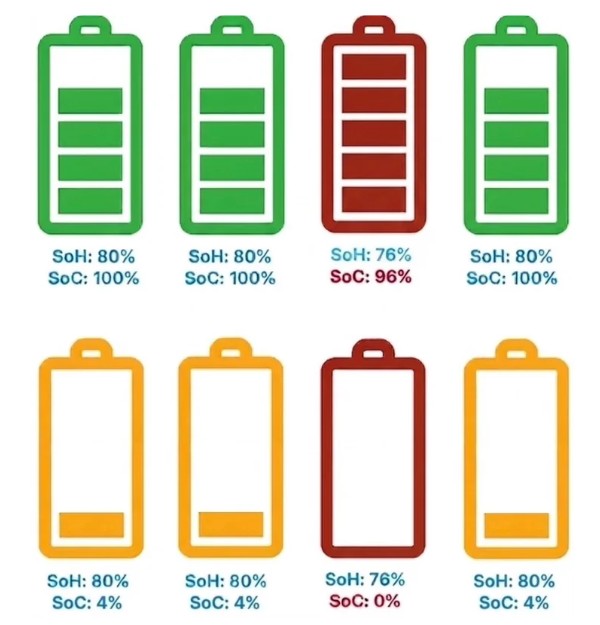
This leads to lower energy retention in the battery.
Hence, it must go to a repurposing/refurbishing facility to make a second-life battery system using cells with similar grouping values.
DCIR values play a crucial role when grouping cells disassembled from a first-life battery system for assembly into a second-life battery system. These second-life batteries are typically built for low-voltage, low-power applications and, most importantly, for low-DoD applications.
Cell EOL vs Battery System EOL
The difference between cell degradation and battery system degradation is explained very well in BESS projects where the cells are rated as EOL at 70% SoH, whereas the system is rated at 60% SoH. This is possible because the BMS can balance the cells to some extent and by not keeping the depth of discharge (DoD) very close to 100%.
EOL Management for BESS
When using a centralized PCS (bidirectional inverter for the battery), a 100% DoD usage pattern will have serious impacts, especially when the system SoH goes below 70%. It is a well-known fact that SoC error is up to 5% for large-scale LFP battery systems. This number increases as the system nears EOL. If you choose to operate close to 100% DoD for a large energy storage (multiple-cluster type) system, it is recommended to use a dedicated string PCS for every cluster.
String PCS manages the discharge profile of every cluster individually and can provide maximum energy output. However, string PCS is more expensive than centralized PCS, which can affect project viability.
About the author

Rahul Bollini, Bollini Energy
Rahul is a seasoned technical expert in Lithium-ion cells, EV batteries and BESS, with over 11 years of experience in manufacturing facility setup, process development, and project execution. Based in Bangalore and Shenzhen, he provides technical leadership and end-to-end project support to companies across global markets. He can be reached at +91-7204957389; bollinienergy@gmail.com.
This article was first published in EVreporter Sep 2026 magazine.
Also read: Next Generation BESS Technologies using 392Ah/587Ah/684Ah LFP Cells
Subscribe & Stay Informed
Subscribe today for free and stay on top of latest developments in EV domain.