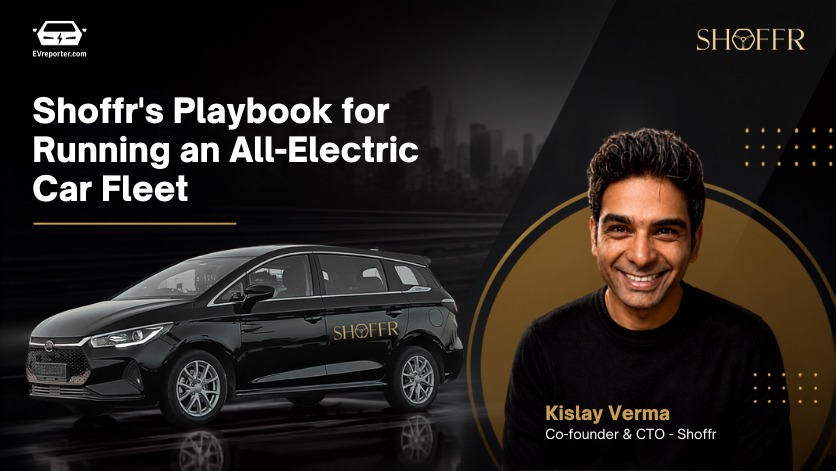
Driving Electric: Shoffr’s Playbook for Running an All-Electric Car Fleet

Launched in November 2022, Shoffr is a premium ride-hailing service that currently operates
an exclusive fleet of 250+ BYD electric SUVs across Bangalore, Delhi NCR, and Hyderabad. We sat down with Kislay Verma, Co-founder & CTO at Shoffr, to talk about the operational realities of running an all-electric fleet, from choosing an OEM partner to expansion strategy.
What factors go into selecting an OEM/EV model, and why has BYD been your exclusive choice so far?
Getting an electric car into your fleet is more expensive; running it is cheaper, so you have to find that balance between the two.
While selecting the EV model, downtime and the charging window are the main operational factors to account for. That’s the advantage BYD provides: it can charge from 0 to 100% within 70 to 75 minutes. The most important factor is getting a battery that measures up to fleet usage expectations. Any car in a fleet needs to be able to run 300 to 400 kilometres a day, and there aren’t many cars that can do that. We were the first people to start buying from BYD from a fleet perspective in India.
Does Shoffr own or lease its BYD vehicles? Would you describe the business model as asset-heavy or asset-light?
We feel there is just no way of being asset-light in the EV industry. Approximately half our fleet is owned by us; the other half is leased. The key thing is that we have complete operational control.
Does Shoffr install its own charging infra or rely on public chargers?
We use public charging infrastructure because setting up your own charging infrastructure requires its own very deep expertise. It is more efficient to partner with charging operators, rather than build everything in-house. We have partnerships with pretty much all the major mid-level players in India, wherever we are.
What role does technology play in optimizing ride allocation?
Technology obviously plays a massive role, because we run operations with a very lean team, and our philosophy from day one has been to operate like that and let tech do as much as possible. Without tech, we would not be able to run this size operation.
There’s a typical driver app, there’s a customer-facing app, and website tools for our internal systems. Our CRM is built in-house using AI. About 80% of our allocation is automated at the moment. There is a manual team which keeps an eye on this. If something is going wrong, they fix it.
A lot of people reach out to us assuming it makes sense for a company like ours to have AI chatbots. That is something, at least for now, we draw the line at, because that is not the kind of experience we want to give.
Shoffr caters to a range of use cases including corporate travel and airport transfers. What does the revenue mix look like?
The four core services we offer now are: airport transfers, intracity travel- some people want to keep the car at their disposal for X number of hours, or outstation trips. On top of that, corporate, wedding, events, our website, etc, are all different customer funnels. They are built on top of these four core service pillars. Events and weddings are very seasonal. The majority of October, November, and December revenue come from weddings.
Can you mention some of the stakeholders Shoffr works with?
We partner with local garage vendors, drivers, and charging infrastructure providers, and only one OEM, i.e. BYD for now. We have our corporate partners like Zerodha and others.
Stakeholders like charging station owners love us because our cars provide very high utilisation. On the charging side, we partner deeply with the likes of Statiq, JioBP, and Shell.
What groundwork needs to be laid before Shoffr enters a new city?
When you enter a new city, some things can be carried from the existing setup, while some can’t be. We have an outsized brand presence, and that carries. The technology we have built can carry to a new city. What absolutely does not carry across from one city to another is the on-the-ground work.
We have to find a garage; operations managers and teams and drivers, and buy the cars, and we have to figure out partners and the servicing supply side. We find partners on the corporate and demand side.
And then there’s the obvious part: the B2C GTM (go-to-market), to announce that you have arrived in Hyderabad. We reach out to our existing customers who we know are from Hyderabad. We’ll figure out, using flight data, which person flew to and from Hyderabad; these kinds of things go into the GTM of each city.
Having recently expanded into Hyderabad, what does Shoffr’s future expansion
roadmap look like?
We want to expand to other cities, but we just launched Hyderabad on June 1st. We are not aggregators. So right now, we are focused on making Hyderabad the success story, like Delhi and Bangalore have been in the past. Expansion will obviously happen. We want to be present wherever there is demand for such a service at scale. For now, we want to deepen our presence in all three of these cities.
Also read: Nearly 85,000 Electric Cars Sold in India During Q1 FY 2026 – 2027
Subscribe & Stay Informed
Subscribe today for free and stay on top of latest developments in EV domain.