Inside TRION: E3 Electric.ai’s Sanjeev P on Modularity, AI, and Solving EV Ownership Concerns

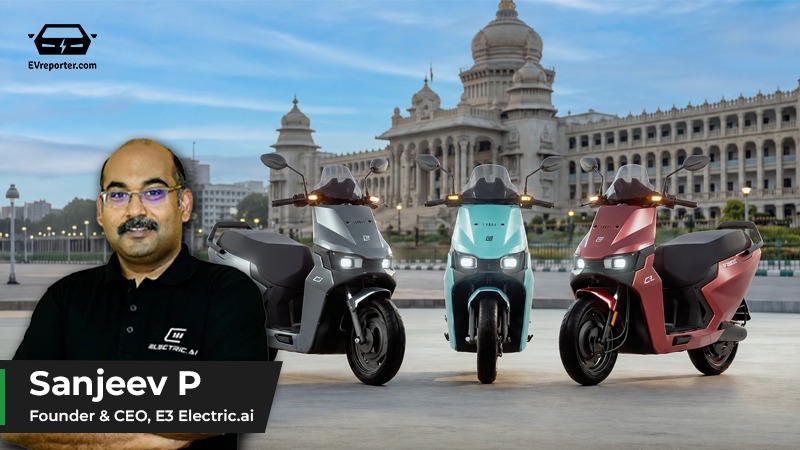
E3 Electric.ai, a Bengaluru-based deep-tech mobility company, has introduced the TRION electric scooter, built around modularity, AI and a human-centric approach.
NASSCOM awarded E3 Electric AI as a Deep Tech 2025 winner in the mobility and logistics sector. EVreporter team interviewed Founder & CEO Sanjeev P to discuss the vision behind TRION, its technology and scale-up plans.
What was the inspiration behind E3 Electric.ai and TRION?
For our Viksit Bharat dream of growing India’s economy from around $4 trillion today to eventually $30 trillion, there are going to be two key things that will help us progress. One is communication, and the second is mobility.
The first revolution is what connected urban and rural India through the internet and smartphones — a billion and a half people with a billion smartphones. We are the world’s leaders when it comes to technology and data connectivity.
When it comes to mobility in India, 80% of personal mobility is 2Ws. Everybody knows EV is the way to go. But there are ownership concerns — where will I charge my battery or vehicle, is it safe to ride, what about sudden failures, where do I service, and what about parts? These are the common ownership challenges that actually inspired me.
We are not just going to build scooter technology. How are we going to marry intelligent smartphones and the backbone of data connectivity with the mobility product to solve for the ownership experience? Therefore, that inspired E3.
E3 comes from the idea that 2,300 years ago, Euclid said any physical object in this world is defined by three dimensions — length, breadth and height. For mobility, I was wondering what could be the three dimensions that gave birth to modularity, AI and a human-centric approach.
Does the TRION platform also address the performance segment?
Yes, we have a suite of products.
- The C2 is a full-blown performance commuter scooter. It goes up to 82 km/h and has 145 Nm of torque. It performs better than most of the ICE commuter scooters. It is optimised for performance.
- Then we have the other variant, which is optimised for range — the 165 km IDC range on a 3 kWh battery. We have seen really good real-world range with that product.
- Then the third, or the entry-most one, has a smaller 2.3 kWh removable pack, where you have the convenience of taking it to an apartment for charging. It is meant for shorter rides, and even that has 108 km IDC range.
How are we able to do that so quickly – Because of the modular platform.
How do AI and data connectivity contribute to the ownership experience?
Tyres, brakes and metal — that’s about 10% of the overall BOM. In EVs, we are actually providing customers with electronics and software.
The electronics are constantly sending very important data to the cloud. We just have to build an ML algorithm system to build the intelligence that can now tell you, ‘If you are travelling from point A to point B, based on your riding pattern, what the exact range would be.’ You can travel 40 km or 60 km, and then the cloud can inform you – “These are the charging points you can use’.
That’s why we went with the public Type 7 charger. The battery is LFP with PCM (phase-change material) to ensure safety with fast charging. Everything we did, we put the customer at the centre — a human-centric approach.
What was the biggest gap you saw in the Indian electric two-wheeler market?
The unpredictable service failures. And these can only be solved if electronics can ping back through a prediction model and send an alert, “Hey, check this out. You may want to service the product.” Or the sensors in the battery can tell you that you’re actually abusing it or you’re heating it up, or you’re going to run out of charge. I think that’s the confidence and the trust we wanted to build.
What was the biggest learning from the prototype development process?
We iterated very fast because we use Gravity Sketch and a different way to get to the design iterations. The frame went through more than 17 changes. We decided not to compromise and give our best.
For example, we wanted large wheels as they give you stability and are suitable for our roads. When you put large wheels on a scooter, you also have to consider riders of different heights and body sizes. We designed TRION to be comfortable for both a shorter rider, represented by a 5-foot, 5th-percentile female, and a taller rider, represented by a 6-foot, 95th-percentile male. We focused on achieving a 785 mm seat height, comfortable ground reach and legroom, along with ample boot space. We achieved all of that.
It’s just a 1,275 mm wheelbase, probably the best in the industry. Even 12-inch scooters out there are longer than this. The ground clearance is 165 mm. We matched everything, got the best anthropometry, and great seats and comfort. That went through a lot of iterations.
What inspired the design of TRION?
We wanted to get the best lighting and the best design out there that does not look like anything else. This is a relook at how scooters have to be. It’s a design breakthrough.
Let it move — the lights, the lines, the edginess, the design — which is why we took inspiration from the Mars Rover. On 6 August 2012, NASA’s Mars Rover Curiosity landed on Mars. And so is TRION today, launched on Earth. If you look at the Mars Rover, it has three interesting things: the edgy surface, large wheels and brilliant lights. And you look at India, we have these common problems, and then a cool product. That was our inspiration.
We offer the industry’s best-ever lighting – dual LED projector headlamps and luxury-grade collimator-lens-based rear lamps — nobody will dare to do it. “Head-turner” is what you can call it. No compromise.
How future-ready is the TRION platform, particularly as battery and software technologies evolve?
The modular platform we selected was absolutely for the same reason, because electronic parts are evolving by the year, or even faster. We wanted to not just build many avatars for different customers — range optimiser, performance optimiser — but also future-grade tech.
You could bring in a new motor technology, new controller technology, a new battery technology and build the TRION platform because this platform will be able to move really fast. You can’t keep re-engineering the frame.
Even with the battery, we chose advanced LFP, and we added a phase-change material for ultimate safety. When it comes to new technology, you can see a removable battery, fixed battery and fast charging.
What is the one engineering decision in TRION that your team is most proud of?
There are 14 tech innovations. Each of these impacts the customer in a very positive way, each of these. The good news is, when they ride it and look at it, they’ll be able to assimilate the 14 great things that were put into innovating this product.
What is the current production capacity, localisation level and expansion plan?
We’ve invented more than 81 parts of this product. They are 100% localised in India. Of course, we all know cells are coming from an international source for almost everyone. But everything else in the product is completely developed in-house, along with our 60-plus Tier-1 supplier partners.
We have a capacity to go up to 100,000 units. We can build more capacity if the demand increases.
If you look at the paradigm today for ICE two-wheelers, if I break it into the top 200 towns and the next 500, the top 200 contribute 45%, and the balance contributes 55%. In EVs, 75% is in the top 200 towns.
We’re starting with Bangalore. We have plans to go to at least 90-odd markets. This includes urban as well as rural markets, Tier-2 and Tier-3.
Also read: E3 Electric.Ai Launches E3 TRION Electric Scooter, Priced from ₹99,999
Subscribe & Stay Informed
Subscribe today for free and stay on top of latest developments in EV domain.