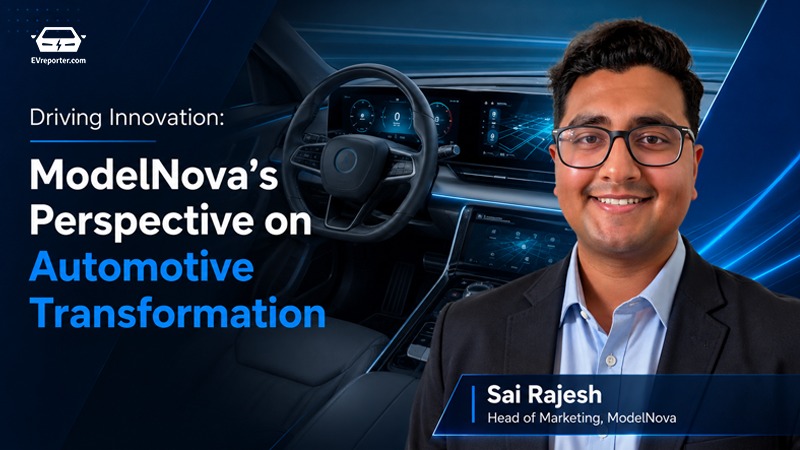
Driving Innovation: ModelNova’s Perspective on Automotive Transformation

ModelNova is a USA-based edge AI software and models company focused on bridging the gap between working AI models and products shipping on constrained edge silicon.
Launched as an independent company in July 2026, it builds on more than 22 years of embedded engineering expertise at embedUR Systems. Today, it collaborates across the edge silicon ecosystem with partners including Alif Semiconductor, Renesas, Synaptics, NXP, STMicroelectronics, Infineon, Silicon Labs, CEVA, and Arm.
In this discussion, Head of Marketing, Sai Rajesh shares insights into ModelNova’s AI technology and its relevance for the automotive sector.
Can you explain what ModelNova AI’s offerings are for automotive OEMs and component makers?
At ModelNova, we focus on building software that takes edge AI from a simple demo to a working, shipping product – specifically on MCU-class silicon that is used across a vehicle’s cabin, body, and sensor electronics. We ship AI in the vehicle where it is hardest to ship, with tight memory, power, and BOM constraints. For automotive OEMs and component makers, we provide four offerings:
- ModelNova Zoo – 175+ free, quantized, optimized open-source models for component makers to validate edge AI as a feasible path to enabling intelligent vehicles. It’s the quickest way to validate whether a chip already shipping in a vehicle is a good fit for edge AI before committing to a design or a lengthy model creation process.
- Fusion Studio – A clean way to take a “starting-point” model from the Zoo and retrain it on data to prepare a model for shipping to market. A team without AI expertise can easily take a Zoo model, retrain it for their specific use case, and then click-to-deploy to silicon already on the vehicle’s parts list.
- NovaEyeD – Production-grade face recognition pipeline. A licensable AI model pipeline that handles face detection, registration, recognition, and anti-spoofing/liveness detection. Useful whether you wish to enable vehicle owners to enter securely without a key or simply to kick off a personalization routine that auto-adjusts seats, temperature, and more based on who the driver is.
- Wireless Sensing – As requirements around the world for features like child and/or pet detection in the vehicle increase, not everyone is comfortable with a camera always pointed at them. Wireless Sensing gives automotive manufacturers a path to meeting these emerging requirements. Use UWB, WiFi, BLE, or other connectivity methods to determine whether a human or pet is still in the vehicle once it’s stationary and locked. Or use UWB to enable various gesture-recognition AI models around the vehicle – whether it’s for touch-free trunk opening or touch-free air conditioning and volume control.
Please help us understand what unique value your products would deliver across the automotive value chain — from Tier-1, 2 suppliers and OEMs to end users?
For Tier-2 suppliers and silicon vendors, the ModelNova Zoo answers the first question their customers ask: “What can this chip actually run?” Quantized, optimized models that demonstrate real AI workloads on their parts. That shortens their customers’ evaluation cycles, which shortens their own design-win cycles.
For Tier-1 suppliers, the value is engineering economics. A Tier-1 building an AI-enabled cabin controller or smart sensor module today faces a choice: build an in-house ML team, or contract the model work out and lose iteration speed. Fusion Studio removes that choice —existing embedded engineers take a starting-point model, retrain it on their data, and deploy to the silicon already on their parts list. For features they don’t want to build at all, NovaEyeD and Wireless Sensing are licensable, production-grade, and already scoped to automotive use cases like driver recognition and in-cabin presence detection.
For OEMs, it’s about where features can live. Our models run in the 200–500 KB range with real-time inference, which means AI features fit on MCU-class parts distributed through the vehicle — a door controller, a cabin module — instead of competing for space on the central compute stack. That decouples feature rollout from the big platform decisions: an OEM can add driver recognition or child presence detection to a vehicle line without re-architecting hardware platforms or its BOM.
For end users, everything runs locally. Face data and presence data never leave the vehicle; features respond instantly, and they work in a parking garage with no signal. Privacy, latency, and reliability aren’t add-ons — they’re properties of running at the edge.
In terms of in‑cabin technology, how does edge AI improve the end-user experience? Can you share some practical examples?
Edge AI improves the end-user experience in terms of in-cabin technology in 3 ways.
- Features work everywhere. AI that depends on the cloud or any network connectivity is no longer reliable in certain situations. As an end user, I expect all the features I pay for to work whether I’m 3 floors underground in a parking garage or on a road trip through a rural area.
- AI responds instantly. With cloud-dependent AI or AI that runs inference elsewhere, you’re simply hoping the model responds within a certain time frame. With edge AI, inference results are delivered with predictable latency every single time. A function that took 15ms the first time you ran it will still take 15ms when you use it 15 years after purchasing your vehicle.
- The AI processing of my data happens inside the vehicle. Whether it’s a camera running recognition on me the minute I turn the car on, or data on who entered the vehicle and where, that data is always being processed in my vehicle, and nothing is being sent out. My image, my name, or a video feed of me cannot be accessed by anyone seeking to do harm or take advantage of the data being collected within my vehicle, because the data is never being sent anywhere.
Does edge AI work better with electric vehicles as compared to ICE vehicles?
We strongly feel that edge AI is powertrain-agnostic. When it comes down to it, edge AI doesn’t necessarily run better on electric vs ICE vehicles since our models run on MCUs within the cabin, body, and sensors of the vehicle.
However, EVs are often more conducive for deploying this type of technology for three reasons which I’ve highlighted below:
- Newer electric architectures: EV programs tend to be built on modern zonal or domain-based electrical/electronic architectures, with various capable MCUs already deployed throughout the vehicle. In EVs, the hardware our models run on is often already part of the parts list.
- Energy economics: In EVs, every little bit of power is best optimized for range usage since that is one of the core metrics buyers look at when evaluating different EV options on the market. Edge AI models running at 500 KB–5 MB run at milliwatt-scale power on MCUs — and where a use case demands it, we’ve optimized models down to the 200–500 KB range for real-time inference on the most constrained parts.
- Program mindset: EV programs typically run as software-defined programs today, where teams expect to add and update features constantly throughout a vehicle’s lifetime. Edge AI fits that model well — a deployed AI feature is software on an MCU, so it can be retrained and updated over the vehicle’s life like any other software component.
So, in a nutshell, edge AI as a technology doesn’t prefer either EVs or ICE vehicles, and it also doesn’t
specifically run better on one over the other.
The fastest adopters are likely to be EV vehicles because their architecture, energy budget, and development-oriented culture are already aligned with edge AI. ICE and hybrid platforms with modern cabin electronics can deploy the same features, these platforms remain the volume of the global market.
Can you also talk about any third‑party validation or customer qualification for your offerings?
Most of our third-party validation is public. The ModelNova Zoo powers silicon vendors’ model zoos today. We work across the edge silicon ecosystem: Alif Semiconductor, Renesas, Synaptics, NXP, STMicroelectronics, Infineon, Silicon Labs, CEVA, and Arm.
This year alone, that’s included three joint public webinars with partners across our product lines: Fusion Studio with Alif Semiconductor in March, NovaEyeD with STMicroelectronics in April, and our Arm integration for Fusion Studio in July.
We don’t discuss customer deal specifics, as a matter of policy. Everything above is verifiable — the webinars are public, the partners are named, and the models are free to download and run yourself.
What TRL are your models currently at? How would you define their market readiness, and what is the estimated deployment timeline for on-road vehicles?
Our models are at TRL 7–9, depending on the model. At the top of that range, NovaEyeD is commercially shipping now. Across the rest of the portfolio, models from the ModelNova Zoo run quantized and optimized on commercial silicon today, and power silicon vendors’ own model zoos — with real-time performance demonstrated on production parts like ST’s STM32N6, not in simulation.
Market readiness for on-road deployment runs on a different clock. Our software enters a vehicle
through a Tier-1 or OEM program, and it’s that program — its integration, validation, and qualification work — that sets the timeline, not our software’s maturity. We’re ready for integration today; any deployment date is set inside those programs.
Not all in-cabin AI carries the same qualification burden, though. Comfort and personalization features— driver recognition, adjusting seats and climate— follow a lighter path to production than safety-relevant functions like child-presence detection, which are validated against defined performance protocols. Convenience features reach on-road vehicles on the fast end of program cycles; safety-rated features follow the longer path.
Also read: E3 Electric.AI Launches E3 TRION Electric Scooter, Priced from ₹99,999
Subscribe & Stay Informed
Subscribe today for free and stay on top of latest developments in EV domain.