What Does Amara Raja’s 60 MWh Customer Qualification Plant Mean for its Gigafactory Ambition?

A Conversation with Vikramadithya Gourineni
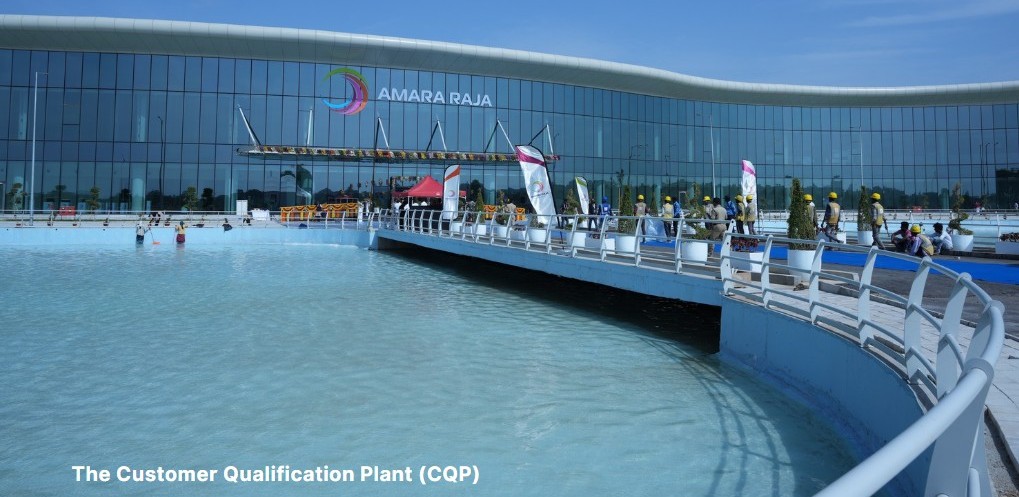
In July 2026, Amara Raja Advanced Cell Technologies commissioned its Customer Qualification Plant (CQP) at its Giga Corridor in Telangana, an initial 60 MWh facility built to manufacture cylindrical and prismatic lithium-ion cells across multiple chemistries. Cells from the plant are expected to go to customers for validation starting August 2026.
The CQP represents ~₹500 crore of investment, part of Amara Raja’s Phase 1 outlay of over ₹1,500 crore under its ₹9,500 crore Giga Corridor programme, and will feed into the company’s 2 GWh commercial cell manufacturing line, slated to begin production next year.
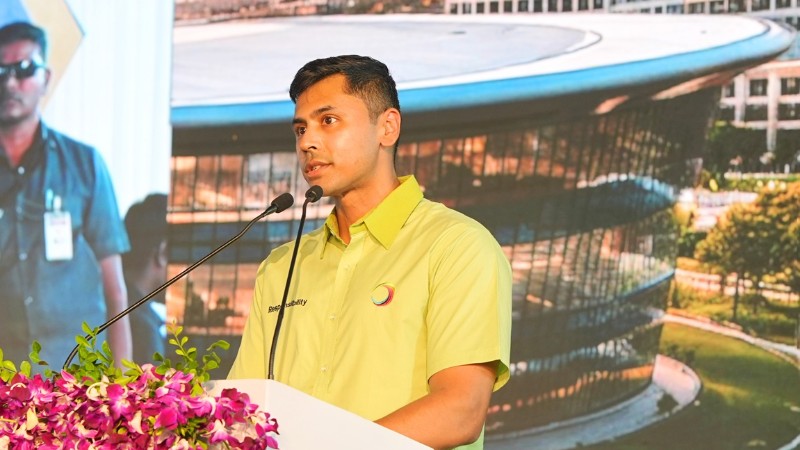
EVreporter spoke to Vikramadithya Gourineni, Executive Director at Amara Raja Energy & Mobility, about how the company’s cell strategy has evolved, and where things stand on sourcing, OEM engagement, and the road to commercialisation.
In practice, what does ‘customer qualification’ mean for Amara Raja before commissioning the first 2 GWh line?
Generally speaking, when we want to enter an automotive account, we submit up to 3 categories of samples – A, B, and C. This mirrors exactly our own three-tier industrialisation architecture of R&D, Qualification, and Commercialisation.
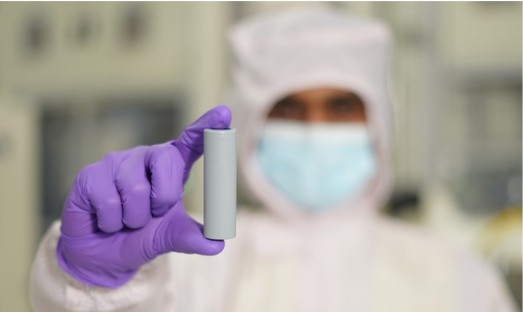
- The A sample is an early functional prototype meant to validate the cell design and chemistry, which we provide from the pilot line at our R&D facility, ‘ePositive Energy Labs’.
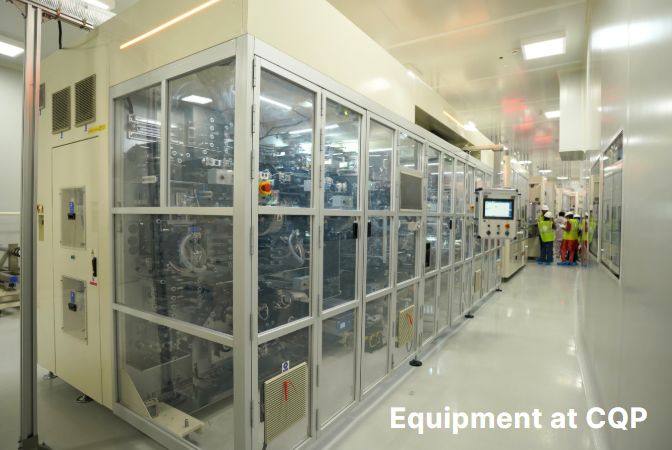
- The Customer Qualification Plant, or CQP, will deliver the B sample, which validates the manufacturability of the product using processes that closely imitate what we will deploy at our future gigafactories.
- The final C sample is the production version delivered at the gigafactory.
In this case, validation goes beyond simply supplying samples, but ensures that the product developed in a lab can be translated to repeatable, economically viable manufacturing. We produce large enough batches of cells to prove out safety, reliability, final product integration and field testing, among other things.
The technology licensing agreements seem not to have progressed as anticipated due to geopolitical developments. Whose cell technology is the CQP actually built on today, and how has that changed from what was originally envisaged?
Our technology strategy has evolved significantly over the past few years. We had originally pursued external technology partnerships to accelerate our entry into cell manufacturing with a greater degree of customer credibility and less risk on the critical parameters like product technology, process efficacy, and supply chain. As circumstances evolved, collaboration in the manner we envisaged could not proceed. Increased investment into internal technology development was always part of the long-term plan.
“ As a result, we front-loaded our investments into R&D infrastructure and talent. Today, neither ePositive Labs nor the CQP are dependent on any external technology partner. ”
They are multi-chemistry, multi-format, flexible design platforms where we can develop, validate, and industrialize both internally developed technologies and anything gained in collaboration with partners. Similarly, the cells we are now working to commercialize are also a result of in-house development, but it is worth noting that we worked closely with equipment suppliers to validate our manufacturing processes.
Our most important goal today is to accumulate capabilities and develop people. We learned this through earlier technology tie-ups when we launched lead-acid batteries. A product or process can be shared, experts can be hired, but long-term success is only possible through building enduring systems, processes, and local talent pools.
Is Amara Raja still committed to 2170 NMC as the first mass-production line in 2027?
Yes, the 2170 cell remains the first cell that will be commercialized in our gigafactory next year. Despite some evolution in the types of cells being used today, this cell remains the most used in the electrical two-wheeler segment and continues to see strong adoption across many other domains such as power tools, AGVs, and drones among others.
The value of commercialising the 2170 goes well beyond the individual product. It allows us to build manufacturing know-how that transfers across future formats and chemistries.
With any cell that you commercialize, there is a learning value in both the chemistry as well as the mechanical. 2170 is a highly flexible and standard form factor and will continue to see wide adoption. We are planning further variants in the future, ranging from higher power applications to complete shifts in chemistry, as well as furthering this know-how to expand into a range of larger-sized cylindrical cells.
For the initial production run, you’ve earlier said Amara Raja will likely rely on the supply chain of technology partners, including their approved vendors. How has this position evolved over the last couple of years?
Since we are working on commercializing in-house cell designs as opposed to a partner design, there is no pre-qualified supply chain for us to leverage. We have been actively engaging the global supplier network and qualifying materials as per our design. Until now, we have used imported materials for our work in the development facilities and will initially do so for the launch of the gigafactory; and we are keen to begin with suppliers with proven scale and performance.
However, I am excited about the types of announcements and investments being made in domestic battery material supply chains. It is our goal to maximize the amount of value that can be captured within India, which will happen progressively.
Amara Raja has been investing in material testing infrastructure to help qualify future domestic suppliers. Can you share which or what kind of Indian material suppliers are currently in that pipeline or already qualified?
A critical part of our development infrastructure is advanced material characterisation labs, where we have already begun testing local materials and collaborating with suppliers to help meet required specs.
From this month, we will also start trial production at the CQP using select domestic materials.
Our next few months of production feature the use of local anode, cathode, and electrolyte.
I am quite optimistic about the types of efforts coming up in India, but there is a time factor that involves thorough testing and validation of material in finished cells, as well as the time it takes for suppliers to ramp up capacities to the required volumes. Some are at advanced stages, even further ahead than us, while others are yet to begin their industrialisation. The shift to local materials will happen gradually but intentionally.
What kind of customers are engaging with the CQP for cell qualification right now?
The main customer category we are currently engaged with is two-wheeler OEMs, given the product roadmap we chose.
We are also introducing samples of LFP prismatic cells this year for both stationary and automotive applications. We are largely focused on internal development of a range of standardised cell platforms that enable us to address a wide range of applications. Segments such as Light Electric Mobility and Stationary are more amenable to such an approach. Passenger Cars, on the other hand, are much more varied and involve longer development and validation timelines. The stationary cells will largely be consumed within our own products, while engagement with automotive OEMs in the passenger segment is at very initial stages.
Can storage be a good entry point for Indian cell manufacturers? Amara Raja is set to commission its 10 GWh BESS facility this year. Are you considering creating captive demand through the BESS business?
Absolutely. Stationary energy storage is one of the most attractive entry points for an emerging cell manufacturer. Unlike many automotive applications, ESS tends to favour greater standardisation in cell formats and longer product lifecycles. That allows manufacturers to focus on improving manufacturing efficiency, yield and cost while serving a broad customer base with a relatively limited number of cell platforms.
That is one of the reasons we are investing across the value chain of cells, packs, and complete ESS solutions. Our 10 GWh ESS facility gives us an excellent platform to understand system-level requirements and, over time, to integrate our own cells as they are successfully commercialised and qualified. While this provides a benefit of captive demand, it is also our opportunity to accelerate learning, validate products in real-world applications, and continuously improve both our cells and systems.
Our development roadmap includes large-format LFP cells for stationary storage, and both ePositive and the CQP have been designed to support those programmes. While the initial BESS deployments will use externally sourced cells, our objective is to transition to in-house cells once successfully commercialised.
Cell Manufacturing is a hard business. What would determine long-term success?
Deciding to build a cell manufacturing capability is the beginning of a long journey. It requires patience, sustained investment, and the willingness to learn through every stage of industrialisation. While we reflect upon the successes and failures of others, there are no shortcuts to developing our own deep manufacturing capability. Technology can be transferred; capability cannot.
Every successive cell programme teaches us far more than how to design and manufacture a single product. We are learning how design decisions fundamentally influence manufacturability and cost, how different materials behave in production, how processes interact, which variables drive yield, how quality systems need to evolve, and ultimately how a factory learns.
This accumulated know-how – more than patents and individual IPs – is what ultimately creates a durable competitive advantage. Even if someone were to hand us an exhaustive manual, true understanding only comes from working through each challenge ourselves. The real test is how effectively we convert individually accumulated knowledge and experiences into institutional memory, embedded in robust systems and processes. This, more than any single product or technology, will determine our long-term success.
Also read: Amara Raja launches 60 MWh Customer Qualification Plant for Li-ion cells
Subscribe & Stay Informed
Subscribe today for free and stay on top of latest developments in EV domain.