The Role of Copper in Electric Vehicles and the Supply Crunch in India

Authored by Mr Dilip Chenoy, Former Secretary General, FICCI and Director General, Society of Indian Automobile Manufacturers.
At the heart of the electric vehicle (EV) revolution lies copper, given its critical role throughout the new global automotive value chain. Its strategic importance encompasses not just the production of electric vehicles, the creation of charging infrastructure, but also the development of energy storage.
Copper’s value in the EV ecosystem stems from its low cost compared to alternative metals, coupled with high durability, malleability, and conductivity.
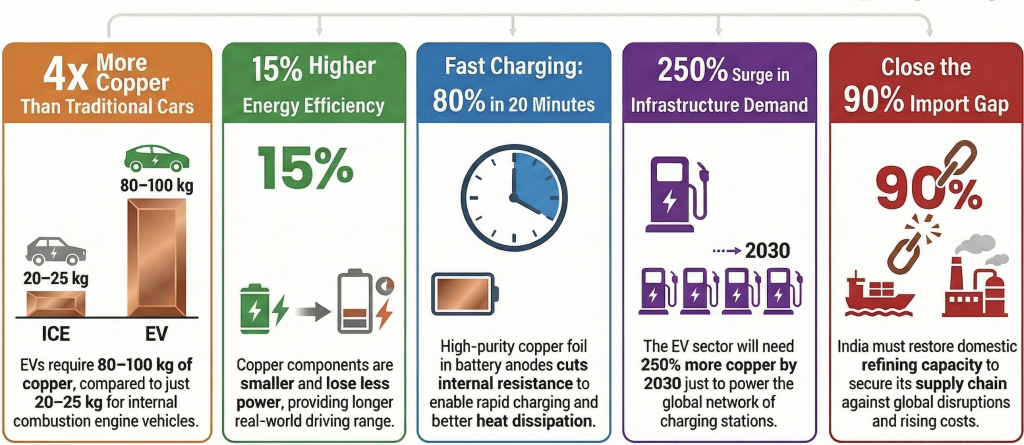
EVs consume 80–100 kg of copper, much more than traditional internal combustion engine (ICE) vehicles (20–25 kg) and hybrid electric cars (40 kg).
Copper’s unmatched electrical conductivity of 59.6 MegaSiemens per meter (MS/m) at room temperature compares favourably with aluminium’s 37.8 MS/m, its closest alternative. This allows automobile manufacturers to pack in smaller copper components tightly, ensuring higher efficiency, as less power is lost through poor conductivity.
Although cheaper than copper, aluminium cables have a disadvantage: they require twice the cross-sectional area to carry the same amount of current, thereby taking up more space. Additionally, copper is 100% recyclable, meaning it can be used time and time again without any loss of conductivity.
Copper in EV Powertrain
Copper windings are key to EV motors because they generate strong magnetic fields, improving torque and speed. More copper in motors means smaller, tighter designs, lower resistance, and less heat waste, providing more energy for quick acceleration and long highway drives.
Similarly, EV inverters and controllers use copper busbars—solid metallic strips or bars that distribute electrical power in a variety of systems to handle high-voltage power smoothly, cutting losses by up to 20% compared to other materials. Hence, EVs with more copper achieve 10–15% higher energy efficiency, resulting in longer real-world range, even in tough conditions such as cold weather or heavy loads.
Battery Boost
Lithium-ion batteries use copper foil in the anode to ensure better conductivity. Stronger, purer copper improves electron flow by reducing internal resistance, resulting in super-fast charging—like 80% in just 20 minutes. Its higher thermal conductivity dissipates heat well, ensuring that batteries remain safe from degradation and retain more than 90% capacity even after thousands of cycles.
Optimised copper content in EVs delivers 5–10% gains in battery efficiency, directly boosting the range an electric vehicle can travel on a single charge.
Copper in EV Charging Infrastructure
Additionally, copper also plays an important role in electric vehicle infrastructure. In fact, Wood Mackenzie, a leading global research, analytics, and consultancy firm tracking energy, renewables, metals, and mining industries, estimates that the EV sector will need 250% more copper by 2030 just for charging stations alone.
This growth is dependent on the belief that there will be more than 20 million EV charging points globally. Charging stations alone contain 0.7 kg of copper (for a 3.3 kW charger) or 8 kg (for a 200-kW charger).
Wiring and Durability Edge
Copper’s low resistance ensures that EV wiring harnesses continue to handle massive currents—over 400 volts—without voltage drops or fires. Thicker copper cables, up to 370 kg, ensure greater safety and performance in trucks or buses. Copper’s corrosion-resistant properties prolong its longevity: it can last for 20 to 30 years even in the most adverse conditions, lowering maintenance and total ownership costs.
Copper Consumption vs Availability in India
Despite India’s focus on electrifying its transport system, a copper supply crunch could derail its ambitious EV rollout target, inflate costs, and strain its foreign currency reserves. Geopolitics and breakdowns in existing global supply chains can exacerbate the situation, given Indonesia’s ban on copper concentrate and China’s dominance in refining.
India’s copper consumption reached 1,878 kilotonnes in FY25, up 9.3% year on year, driven by EVs, renewables, and infrastructure.
- Analysts predict total demand reaching 3.24 million tonnes by FY30 in conventional sectors, plus 274,000 tonnes from energy transition—including EVs and battery storage.
- Domestic production, however, continues to lag, with the country producing approximately 497,000 metric tons of refined copper and importing 90% of its copper concentrates—a figure expected to touch 97% by 2047.
India’s challenge is not only rising demand but also constrained domestic refining capacity. Sterlite Copper, once India’s largest copper smelter and a major supplier to the power, infrastructure, and automotive sectors, played a critical role in supporting the country’s copper ecosystem and reducing dependence on imports. As EV adoption accelerates and copper demand surges, strengthening and restoring such domestic refining capabilities will be essential for securing an affordable supply and ensuring that India’s green mobility ambitions are not constrained by global supply disruptions.
However, decisive reforms, such as streamlining mining auctions, clearances, and exploration through the National Mineral Exploration Trust, can unlock greenfield sites. There is also a need to incentivise private investment with FDI reforms and reopen earlier smelters. These initiatives can turn the crunch into an opportunity—securing jobs, energy security, and EV leadership.
India must act swiftly to smooth its green future.
Also Read: Guide for LFP Cell Authentication using 24-digit Code
Subscribe & Stay Informed
Subscribe today for free and stay on top of latest developments in EV domain.