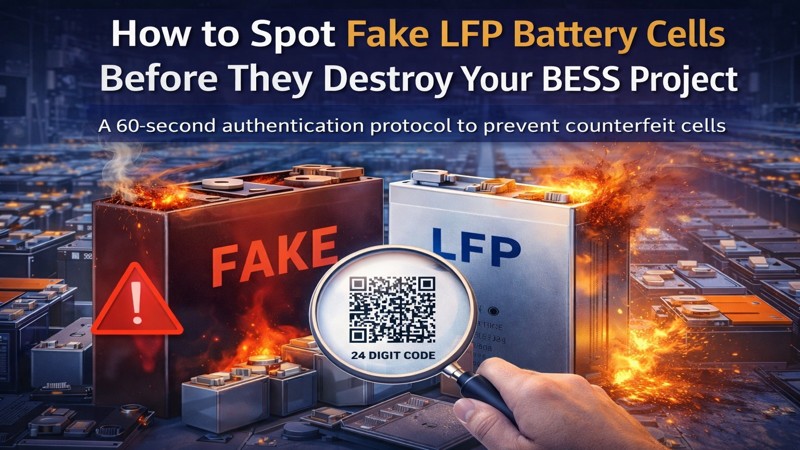
How to spot counterfeit LFP cells before they destroy your BESS project

A 60-second authentication protocol that could save India’s energy storage industry from a counterfeit crisis – An article By Dr. Ravindra Kempaiah, CTO at Zenfinity Energy Pvt. Ltd
As lithium carbonate prices surge 80% in just 70 days and China tightens export restrictions, India’s battery energy storage sector faces an unexpected threat: a flood of counterfeit and substandard LFP cells being pitched as “cost-effective alternatives.”
With India targeting 250 GWh of BESS deployment by 2030 and most systems carrying 12-year performance guarantees, the stakes have never been higher. A single shipment of (A-) grade cells currently offered at 12-15% discounts across the supply chain can transform a profitable project into a warranty disaster within 18-24 months.
“We’re seeing procurement teams under unprecedented cost pressure,” says Dr. Ravindra Kempaiah, CTO at Zenfinity Energy and former researcher at Argonne National Lab and Dalhousie University. “When LFP cell costs increase 20-25% overnight, that 12% discount on A- grade cells looks attractive. But it’s deferred catastrophic failure, and we are seeing a massive influx of such cells in L3 and L5 markets.”
The solution? A systematic authentication protocol that can verify any LFP prismatic cell in under 60 seconds using its 24-digit QR code, before those cells enter your battery system.
The Counterfeit Cell Crisis: Why Now?
India’s rapid electrification of L3 and L5 vehicle segments has created massive demand for affordable battery solutions. Combined with recent lithium price spikes, this has triggered what industry experts describe as a “perfect storm” for the proliferation of counterfeit cells.
The current market dynamics:
- Battery-grade Li₂CO₃: Up from ~₹9 lakh/ton (Nov 2025) to ₹22 lakh/ton (Feb 2026)
- LFP cell costs: Increased 20-25% in 60 days
- Manufacturer response: Pushing aged inventory and A- grade cells to maintain cash flow
- Procurement pressure: CFOs demanding cost reduction amid rising material prices
“The percentage of batteries requiring constant intervention to resolve imbalance issues is increasing day-by-day,” notes Dr. Kempaiah. “Most of these failures trace back to mixed-grade cells that were never properly authenticated at receiving.”
The consequences extend beyond individual projects. Counterfeit cells pose critical risks:
Thermal runaway: Substandard cells strain BMS calibration, raising the risk of uncontrolled thermal events in deployed BESS systems.
Capacity fraud: Inflated Ah ratings are common, with actual usable capacity often 20-30% lower than labeled, resulting in collapsed energy commitments.
Premature degradation: Inferior electrodes compress cycle life from 3,000+ cycles to under 700 cycles, eliminating ROI within months of deployment.
Regulatory non-compliance: With EU Battery Passport (mandatory Feb 2027) and India’s Battery Aadhar program (2025-26 rollout) requiring cell-level traceability, unverifiable cells will soon face customs rejection.
Decoding the 24-Digit Identity: Your First Line of Defence
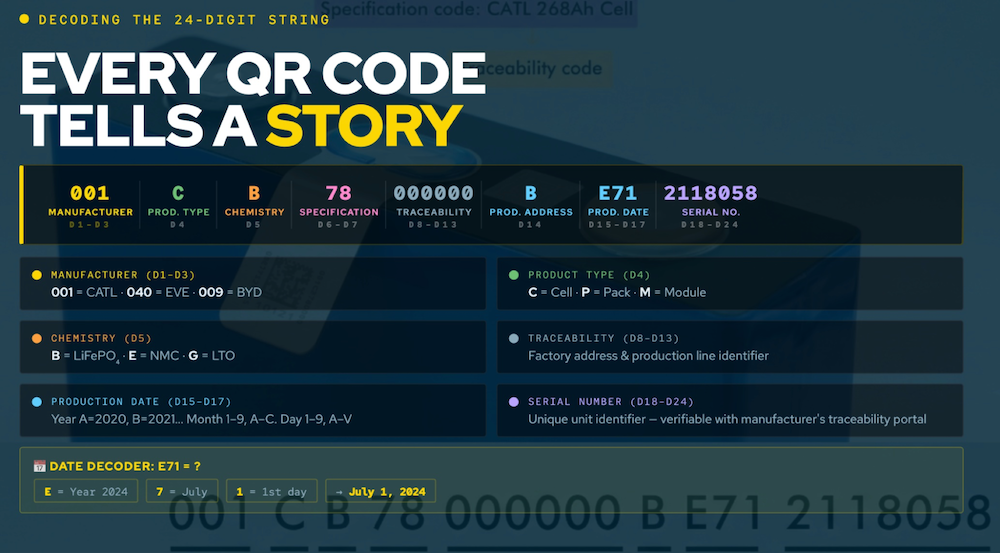
Every authentic prismatic LFP cell carries a 24-digit QR code that provides complete traceability. This string is divided into seven data segments, each revealing critical information:
Segment Breakdown:
D1-D3: Manufacturer Code (3 characters)
- Identifies the OEM brand
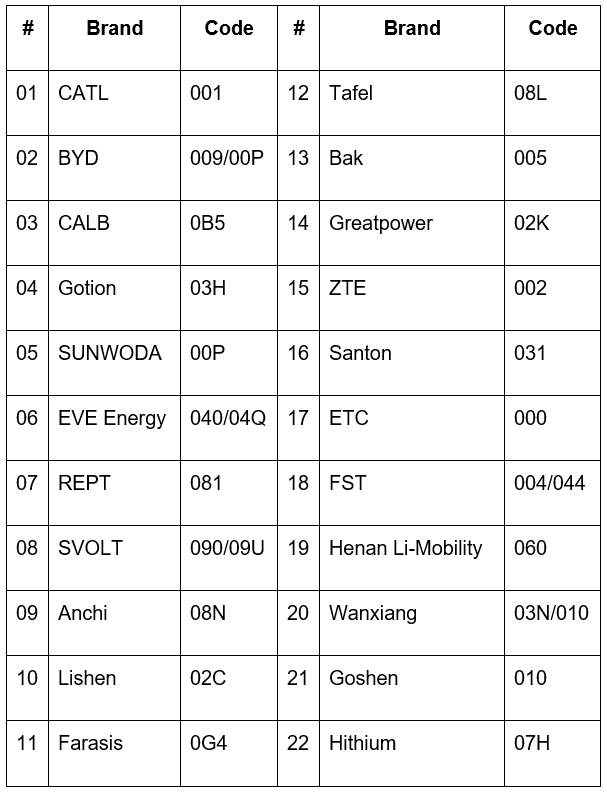
- Examples: CATL (001), EVE Energy (040 or 04Q), BYD (009 or 00P), REPT (081)
- Complete reference covers 22 major manufacturers
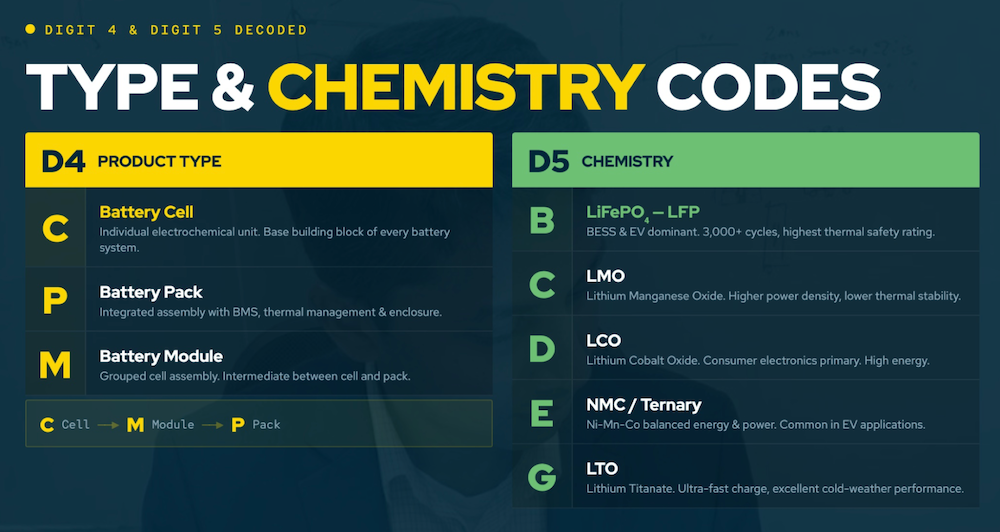
D4: Product Type (1 character)
- C = Cell (individual electrochemical unit)
- P = Pack (integrated assembly with BMS)
- M = Module (grouped cell assembly)
D5: Chemistry Code (1 character)
- B = LiFePO₄ (LFP) – BESS & EV dominant, 3,000+ cycles, highest thermal safety
- C = LMO (Lithium Manganese Oxide)
- D = LCO (Lithium Cobalt Oxide)
- E = NMC/Ternary (Ni-Mn-Co balanced)
- G = LTO (Lithium Titanate)
“For BESS applications, you’re looking for ‘B’ in position 5,” explains Dr. Kempaiah. “Any other chemistry is a red flag unless you’ve specifically ordered it.”
D6-D7: Specification Code (2 characters)
- Manufacturer-defined technical specifications
- Varies by OEM, cross-reference with datasheet
D8-D13: Traceability Code (6 characters)
- Factory address and production line identifier
- Enables verification through the manufacturer’s portal
D14: Production Address (1 character)
- Specific facility within the manufacturer’s network
D15-D17: Production Date (3 characters)
- Year: A=2020, B=2021, C=2022, D=2023, E=2024, F=2025…
- Month: 1-9 = Jan-Sep, A=Oct, B=Nov, C=Dec
- Day: 1-9 = 1st-9th, A=10th, B=11th… V=31st
Example: E71 = E (2024), 7 (July), 1 (1st day) = July 1, 2024
D18-D24: Serial Number (7 characters)
- Unique unit identifier
- Verifiable through manufacturer’s traceability portal
- Critical for Battery Passport compliance
The Complete Manufacturer Reference
To enable instant verification, here are the D1-D3 codes for India’s most commonly encountered LFP manufacturers:
Instant Validation: Red Flags That Demand Rejection
Procurement teams can identify counterfeit or substandard cells in under 60 seconds using these validation rules:
Structural Validation:
1. Character Count
- MUST be exactly 24 characters
- Example of INVALID: B37485746488 (only 12 characters)
- Reject immediately if the length is wrong
2. Type Code Verification
- Digit 4 must be C, P, or M
- Example of INVALID: 001Q4Q00Q903KDI047683630 (Digit 4 is Q)
- Any other character indicates counterfeit
3. Chemistry Code Verification
- Digit 5 must be B, C, D, E, or G
- For BESS: Should always be B (LiFePO₄)
- Mismatch indicates wrong chemistry or fake code
Physical Authentication:
4. QR Code Engraving Quality
- Authentic A-grade cells: Laser-engraved QR codes with tactile texture
- Counterfeits: Flat white paint printing
- Test: Run a fingernail across the code-laser marks have depth, paint is smooth
5. QR Position Verification
- A-grade codes: Always in datasheet-specified position
- B-grade indicators: Original large QR scraped off, smaller code in a different location
- Request the cell datasheet and verify the position before acceptance
6. Production Date Window
- Reject cells >18 months old (risk of capacity fade)
- Current date: March 2026
- Acceptable window: Sept 2024 onwards (codes D9x through F3x)
- Aged stock indicator: Codes earlier than D (2023) should raise concerns
Understanding the Grade Spectrum: What Procurement Teams Miss
“Grade is rarely labeled on packaging,” warns Dr. Kempaiah. “The QR code position, engraving quality, and traceability are your only reliable indicators.“
Grade A (Target – Always Demand for BESS)
- Full-spec, laser-engraved QR in datasheet position
- Capacity within ±2%, matched internal resistance
- New cells meeting all manufacturer specifications
- QR code authentic, traceable, laser-engraved per datasheet
- Mandate: Always specify Grade A in procurement contracts
Grade A- (Avoid – Often Sold as “Alternative”)
- Minor spec deviation, shipped on price pressure
- Cells with slight capacity or IR variance
- Performance drops 8-15% faster than Grade A
- Current market: Being offered at 12-15% discounts
- Warning: Often marketed as Grade A at lower price
Grade B (Reject – High Failure Risk)
- Original QR scraped, replaced with new code at a different position
- Cells with cosmetic or minor electrical defects
- Significant capacity fade within 300-500 cycles
- Identifier: Smaller QR code in non-standard position
Grade B- (Hard Reject – Never Deploy)
- QR absent, painted, or points to an unknown URL
- Refurbished, recycled, or counterfeit cells
- No laser-engraved QR or QR returns no traceable data
- Extreme cycle life degradation and thermal risk
- Rule: Never deploy in BESS under any condition
The 4-Step Field Authentication Protocol
Industry experts recommend this systematic approach for every incoming cell shipment:
Step 1: Locate & Combine the Code
- Scan QR with Data Matrix reader app (available free on iOS/Android)
- If code spans two parts, combine them in the correct order
- Verify a complete 24-character string
Step 2: Validate Structure
- Confirm exactly 24 characters
- Check Digit 4: Must be C, P, or M
- Check Digit 5: Must be B, C, D, E, or G (B for BESS)
- Reject immediately on any structural deviation
Step 3: Decode All 7 Segments
- Verify manufacturer (D1-D3) against the approved supplier list
- Confirm chemistry (D5) matches the purchase order
- Check production date (D15-D17) is within the acceptable window
- Trace serial number (D18-D24) via the manufacturer portal
- Red flag: Portal returns no data or mismatched information
Step 4: Physical Cross-Verification
- Confirm QR is laser-engraved (not painted)
- Verify QR position matches the cell datasheet
- Check that adhesive traces around the label are consistent
- Measure cell weight (should match datasheet ±2%)
- For remote sourcing: Request a high-resolution QR photo before purchase
“This protocol takes 60 seconds per cell sample,” notes Dr. Kempaiah. “But it prevents 18 months of warranty nightmares.”
Battery Passport & Battery Aadhar: Why Authentication Is No Longer Optional
The global regulatory landscape is shifting toward mandatory cell-level traceability:
EU Battery Regulation (2023/1542)
- Digital Battery Passport: Mandatory by February 2027
- Requirements: Manufacturer identity, production date, chemistry, supply chain traceability
- Impact: Indian manufacturers exporting to EU must implement now
India’s Battery Aadhar Program
- BIS implementing mandatory QR traceability: Expected 2025-26
- Battery Aadhar mandate: 21-digit BPAN code
- Scope: All battery imports and domestic manufacturing
- Enforcement: No QR code = No import clearance
“Battery Passport isn’t coming-it’s here,” emphasizes Dr. Kempaiah. “Every cell’s QR code and traceability data will become a regulatory compliance requirement. Authentication today is preparation for mandatory compliance tomorrow.”
For India’s BESS sector targeting 200 GWh deployment by 2030, this means:
- Documentation requirements for every cell in every pack
- Audit trails from cell manufacturing through deployment
- Traceability portals integrated with procurement workflows
- Rejection of cells with unverifiable codes at customs
The EV/RESS Cascade Effect: When Mixed Grades Meet
The authentication protocol becomes even more critical when considering how mixed-grade cells perform in battery packs.
Real-world scenario: 350V battery pack for electric bus
Module 1: Grade A cells (Jan 2024 production) Module 2: Grade A- cells (Aug 2022 production, marketed as fresh) Module 3: Relabeled B-grade cells (original QR scraped)
Timeline of failure:
- Month 1: BMS shows balanced voltages (appears normal)
- Month 6: Module 3 sags under load → BMS throttles entire pack → 18% range loss
- Month 12: Module 2 develops high IR → 40% longer charging time → thermal management runs constantly
- Month 18: Module 1 is still performing to spec, but the pack retired due to Module 2 & 3 failures
Result: 33% of good cells were discarded because procurement didn’t verify grades.
“In RESS and EV applications, pack performance is limited by your weakest module,” explains Dr. Kempaiah. “Mixed-grade cells don’t average out-they cascade down. This is why L3 and L5 vehicles in India are seeing such high battery imbalance rates.”
Industry Impact: What Needs to Change
For India to meet its ambitious BESS and EV targets, systematic authentication must become standard practice across the supply chain.
For Procurement Teams:
- Implement QR verification at receiving (before cells enter production)
- Maintain approved manufacturer code lists
- Reject aged stock (>12 months for critical applications)
- Document traceability for Battery Aadhar compliance
For BESS Integrators:
- Specify Grade A cells explicitly in contracts
- Conduct random sample authentication on every shipment
- Verify physical markers (laser engraving, QR position)
- Build audit trails for warranty protection
For BMS Engineers:
- Advocate for cell authentication upstream
- Document cell grade in commissioning reports
- Flag imbalance patterns that suggest mixed grades
- Reject responsibility for failures due to substandard cells
For Policy Makers:
- Accelerate Battery Aadhar implementation timeline
- Mandate traceability documentation for all imports
- Create public database of verified manufacturer codes
- Penalize counterfeit cell distribution
“The best BMS design can’t compensate for counterfeit cells with falsified QR codes,” notes Dr. Kempaiah. “Authentication is everyone’s responsibility-from procurement to policy.”
Looking Ahead: Authentication as Infrastructure
As India scales battery manufacturing and deployment, from 2/3-wheelers to grid-scale storage, cell authentication must evolve from a quality checkpoint to a critical infrastructure.
Dr. Kempaiah’s vision: “In 2027, when Battery Passport and Battery Aadhar are fully enforced, unverifiable cells won’t just be risky-they’ll be illegal. The procurement teams building authentication capability today are future-proofing their operations. Those waiting for regulatory enforcement are setting themselves up for customs rejections and project delays.”
For an industry targeting 200 GWh of BESS deployment with 12-year warranties, the math is clear: 60 seconds of authentication prevents 24 months of warranty disasters. The 24-digit QR code isn’t just a label. It’s a passport, a warranty, and a promise. Learn to read it.
About the author

Dr. Ravindra Kempaiah is Chief Technology Officer at Zenfinity Energy Pvt. Ltd., an IIT Madras-incubated company focused on long-lifetime batteries for EVs and energy storage. He received his PhD from the University of Illinois, Chicago, where he worked on manganese-based cathode materials with scientists at Argonne National Laboratory. He completed his post-doctoral research with Dr. Jeff Dahn at Dalhousie University, Canada, one of the world’s foremost battery researchers. In Canada, he founded Zen Energy Inc. to develop micromobility batteries before returning to India to contribute to the nation’s energy transition.
Zenfinity Energy is located at IIT Madras Research Park, Chennai, and works with BESS integrators and EV manufacturers across India’s energy storage sector. Contact: zenfinity.energy
This article is based on authentication protocols developed at Zenfinity Energy and shared as an industry resource. The complete visual guide is available through the company’s LinkedIn page.
Also read: The rise of 587Ah cells and 6.25MWh Battery Energy Storage System
Subscribe & Stay Informed
Subscribe today for free and stay on top of latest developments in EV domain.