Guidance for First-Time Founders in EV Ecosystem

Practical questions every founder asks, common gaps investors see in decks, what founders should know about equity dilution and control, and how to evaluate whether an investor is the right fit.
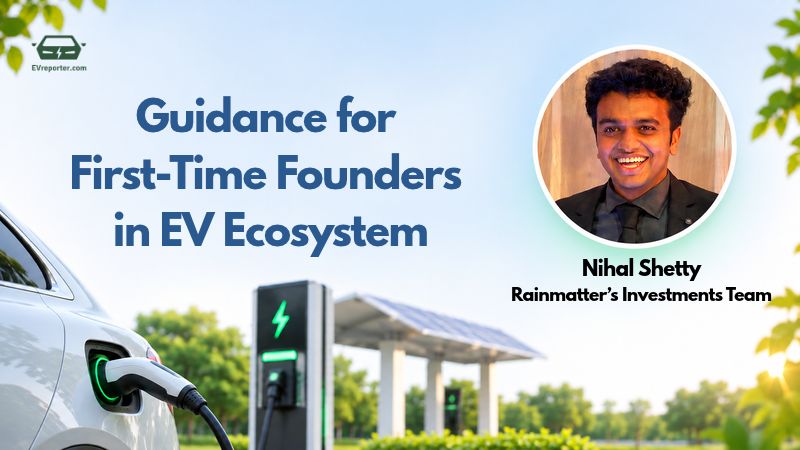
Nihal Shetty from Rainmatter’s Investments Team shares guidance for founders building in the EV domain.
In order to raise capital, what type of organization should a start up be?
To raise institutional capital, the startup must be registered as a Private Limited Company (in India). This structure is essential because it allows for the issuance of equity and Compulsorily Convertible Preference Shares (CCPS), which are the standard instruments used by venture capital and seed investors in India.
At what stage of operations should the founders approach seed or early stage investors?
For an EV hardware or component startup, pitching a pure paper plan is rarely enough. Founders should ideally approach seed investors when they have:
- A working proof-of-concept (PoC) or early prototype
- Initial validation, which could be in the form of successful bench testing, a pilot program, or
- Letters of Intent (LOIs) from B2B clients (e.g., fleet operators or OEMs).
How should founders approach valuation at the seed stage?
Seed-stage valuation is more of an art than a science, as there are no historical cash flows to discount. Founders could use the milestone-based approach:
- Calculate the exact capital needed to reach the next significant milestone (e.g., completing homologation, setting up a micro-factory, or delivering the first 1,000 units), plus a buffer, ensuring 18 to 24 months of runway.
- Standard market practice is to dilute between 15% and 20% of equity in a seed round.
The valuation is mathematically derived from these two numbers i.e., Capital Needed / % Dilution.
What advice would you give to young founders looking to raise capital for their prototypes and pilots?
Be frugal and obsess over the core engineering. Do not waste time and money over-engineering a prototype just to make it look pretty for a pitch deck.
Your early prototype only needs to prove that the core technology actually works and that it can eventually be manufactured at a viable cost.
Non-dilutive funding, such as grants and government schemes, as a key lever for hardware startups at the prototype stage.
Keep your heads down, build a scrappy but functional product, and don’t get distracted by the PR and vanity that often surrounds fundraising.
What are the must have and key parameters in a start-up pitch?
- A clear problem statement
- A deep understanding of unit economics at scale
- A realistic homologation/certification timeline
- A clear “Right to Win” (e.g., a proprietary powertrain design, a unique cell chemistry or a locked-in supply chain)
- Clarity on the customer’s needs and wants
- Team and the plan to retain talent
– The most frequent mistake EV founders make is treating hardware like software. Pitch decks often underestimate the time required for testing, vendor qualification and regulatory approvals.
– Another common gap is ignoring the Bill of Materials (BOM) cost at lower volumes, leading to wildly unrealistic early margin projections.
– Biggest gap – No clear answer to “why now?” For example, EV specific tailwinds, falling cell costs, PLI/FAME policies, or the charging infrastructure rollout – the factors that validate the timing of the work start-up is doing.
What do you wish more founders knew about raising capital and equity dilution?
High valuations are not trophies: Optimizing for the highest possible seed valuation creates immense pressure to justify an even higher price in Series A. If market conditions cool or R&D takes longer than expected, you risk a down-round.
Focus on control over minor dilution: Founders often fight over 1-2% of equity dilution but concede standard board control or veto rights. Protecting your operational freedom is just as important as protecting your cap table.
How should founders evaluate whether an investor is the right fit?
Founders should reverse-pitch the investor. Ask them: What is your fund’s typical time horizon? Have you invested in hardware or manufacturing before? Speak to founders in their portfolio who have gone through tough times to see how the investor reacted. An EV startup needs investors who understand supply chain shocks and hardware iteration cycles, not just software metrics.
EV hardware startups often have long R&D and customer qualification cycles, along with sizable capital requirements. How do you balance your patient capital approach with the need to see traction?
At Rainmatter, we understand that building physical infrastructure and hardware takes time. We do not look for the hockey-stick Month-over-Month user growth expected in consumer tech. Instead, we measure traction through engineering and operational milestones.
Apart from financial backing, what other support can startups expect from Rainmatter?
Our most significant non-financial value-add is structural and is primarily that we do not force founders to scale unnaturally or chase premature exits just to return a fund.
Founders get access to the broader Zerodha and Rainmatter ecosystem. This includes cross-learning with other climate-tech and hardware founders, access to strategic mentorship, and introductions to our network of distribution partners, policymakers, and industry veterans who have successfully scaled hardware businesses in India.
This interview was first published in EVreporter Nov 2026 magazine.
Also read: Naxatra Labs raises $3 million in Pre-Series A funding led by Rainmatter
Subscribe & Stay Informed
Subscribe today for free and stay on top of latest developments in EV domain.