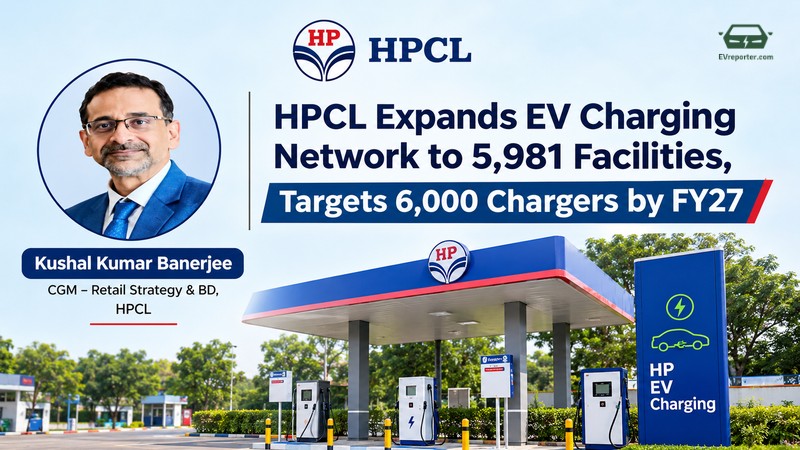
HPCL Expands EV Charging Network to 5,981 Facilities, including 176 Battery-Swapping Stations

Hindustan Petroleum Corporation Limited (HPCL) is expanding its electric vehicle (EV) charging and battery-swapping infrastructure across India, leveraging its network of over 25,000 retail outlets. As of November 1, 2026, the company had about 5,981 EV charging facilities, including AC slow chargers and DC fast chargers, and 176 battery-swapping stations.
In this interview with EVreporter, Mr. Kushal Kumar Banerjee, CGM – Retail Strategy & BD, HPCL, discusses the company’s charging infrastructure expansion, maintenance and utilization challenges, industry partnerships, participation in government schemes, and plans to develop high-power charging infrastructure for electric trucks and buses.
Share the current scale, geographic footprint, and specifications of HPCL’s EV charging. Could you also add the current count of CCS2 and AC Type 2 connectors in your network?
As of 1st November 2026, HPCL’s EV charging network stood at approximately 5,981 facilities across its 25,000+ retail outlets. This represents growth of nearly 11% from around 5,400 earlier in the year.
The network comprises roughly 2,180 AC slow chargers and 3,627 DC fast chargers. DC units are predominantly CCS2-compatible (the dominant standard for public fast charging in India), and the mix shows a clear shift toward higher-power DC infrastructure.
The geographic footprint is pan-India, with priority on major cities, high-traffic retail outlets, and highway corridors. HPCL is actively deploying higher-capacity units (120 kW/180 kW), including ~100 planned 240 kW chargers, along strategic routes to support longer-distance travel and commercial vehicles. The target is to commission around 6,000 chargers by the end of FY27.
OMCs face criticism for poor maintenance and non-working chargers. How does HPCL respond to this criticism? What steps are being taken to ensure better charger maintenance?
HPCL acknowledges industry-wide challenges with uptime and customer experience. The company prioritises operational reliability through:
- Central monitoring via the HP e-Charge platform.
- Focus on utilisation, operational uptime, and repeat usage as core commercial metrics.
- Partnerships that bring specialized operations expertise to sites.
- Expansion into asset-light and higher-utilization models (residential, fleet depots, commercial hubs).
- HPCL has developed a dedicated offline charger-tracking portal that gives a realistic view of functional/non-functional EVCS, ticket creation, follow-up, and closure within the stipulated time.
HPCL is definitely building a commercially sustainable charging business by March 2030, with reliability as a key pillar.
Charging utilization is a major challenge among CPOs. What is the current utilization of HPCL’s EV charging network?
Utilization varies significantly by location, charger type (AC vs DC), and vehicle segment. It is noted that DC fast chargers typically require 15–25% utilization to achieve attractive economics, depending on electricity tariffs, capital costs, and operating expenses.
Continuous focus on improving traction has driven a significant jump in weekly charging revenues over a recent period, but overall utilization remains a shared industry challenge. HPCL is addressing this by prioritizing high-traffic and corridor sites and expanding into residential and fleet applications. Also, chargers and battery swap stations have been installed at public places/bus stops jointly with CPO/OEM partners.
HPCL is establishing EV charging and battery-swapping stations across its retail outlets. What criteria do you use to select new locations for these services?
Selection prioritizes:
- Existing high-traffic retail outlets with space, power availability, and amenities.
- Highway and freight corridors (especially those supporting trucks and buses).
- Urban residential complexes, offices, malls, and fleet depots.
- Expected utilisation, grid connectivity, and partnership opportunities.
- Alignment with government programmes (PM e-DRIVE and earlier FAME-II).
HPCL leverages its existing fuel-station footprint for rapid, lower-cost deployment while selectively expanding beyond pure retail sites.
Please share the current scale of HPCL’s battery-swapping network, and the stakeholders you are working with for its installation and utilization.
HPCL operates over 176 battery-swapping stations jointly with major OEMs like Honda, Voltup, Yuma, VGreen, and Blue Energy Motors, etc. This segment primarily caters to the B2B EV segment, such as the e- commerce segment / commercial truck segment.
Key partners in the commercial segment category include:
- Blue Energy Motors (heavy-duty truck swapping; recent Bhiwandi station on the Mumbai–Pune corridor).
- Energy In Motion (EIM) – swap-and-charge hubs planned on major freight corridors (Mumbai–Pune, Delhi–Jaipur, Chennai–Bengaluru).
- Collaborations such as Honda, Yuma, Mooving Mobility (for lighter vehicles), and others are focused on two- and three-wheelers.
Your note says INR 199 crores were allocated to HPCL under the FAME-II scheme. Can you share the progress HPCL has made on EV charging infrastructure with the allocation?
Under FAME-II, the three OMCs (IOCL, BPCL, HPCL) collectively received substantial support from MHI for setting up EVCS at strategic locations/highways. HPCL’s share contributed to the broader OMC effort, resulting in thousands of operational public charging stations nationwide.
As of mid-2026, OMCs had installed the vast majority of their FAME-II-sanctioned chargers, with high energization rates. Under this Scheme, HPCL has set up more than 2250 EVCS on an all-India basis. In overall, HPCL has installed 5,981 (including FAME-II) EV Chargers and Battery Swapping Stations in its efforts to strengthen EV Charging Infrastructure in the country.
What are HPCL’s plans for the PM eDrive scheme?
HPCL is actively participating in PM e-DRIVE and will be setting up around 323 EVCS, with a clear focus on:
- Deploying higher-power chargers (including 240 kW units) for electric trucks and buses.
- Targeting 50 major highway corridors.
- Supporting commercial-vehicle electrification alongside continued passenger-vehicle infrastructure.
You have announced industry collaborations with Statiq, Ionage, SNAP E Cab, and Mahindra. How are you forming tie-ups with third-party EVCS/BSS players across the market?
HPCL follows a partnership-led, asset-light approach:
- Mahindra Charge_iN – Agreement (March 2026) for 180 kW dual-gun ultra-fast chargers at HPCL outlets; first joint station operational on Mumbai–Pune Expressway.
- Statiq – Integration of HPCL’s network (5,000+ chargers) into Statiq’s EVLinq platform for discovery, access, and interoperability.
- Snap-E Cabs – Access to HP e-Charge network for fleet operations, focused initially on Eastern India/Kolkata and highways.
- Additional partners for battery swapping (Blue Energy Motors, Energy In Motion) and other operators.
Tie-ups typically involve site access, digital platform integration, or joint deployment of specialised hardware, allowing HPCL to scale faster while partners bring technology, batteries, or demand.
Which EV segment is driving the highest charging demand on HPCL’s network today?
Passenger four-wheelers currently account for most sessions on the existing network. However, HPCL is also shifting emphasis toward commercial vehicles — electric trucks and buses — especially on highway corridors, where higher-power chargers and battery swapping deliver greater utilization and strategic impact. Two- and three-wheeler demand remains relevant at many retail and urban sites.
How does HPCL differentiate itself from other CPOs in India’s increasingly competitive EV charging market?
HPCL’s key advantages:
- Unmatched physical footprint of 25,000+ retail outlets providing ready sites, power, amenities, and 24×7 presence.
- Integrated multi-energy hubs (fuel + EV charging + battery swapping) known as ‘Energy Station’.
- Strong digital platform (HP e-Charge) plus interoperability partnerships.
- Focus on both passenger and commercial segments, with growing high-power (180–240 kW) and swapping capability.
- Ability to scale via partnerships while retaining control of prime locations.
This positions HPCL as a convenience and corridor leader rather than a pure-play urban CPO.
What would be the next major milestone for HPCL’s EV business?
Key near-term milestones include:
- Reaching ~6,000 chargers by the end of FY27.
- Operationalizing high-power (240 kW) chargers and swap hubs across the targeted 50 highway corridors.
- Scaling commercial-vehicle (truck/bus) infrastructure and battery-swapping networks with partners.
- Building a commercially sustainable EV energy business by March 2030, with stronger utilization, uptime, and repeat usage metrics.
These steps will further turn HPCL’s retail network into multi-energy mobility hubs that support India’s broader EV transition.
Also read: Blue Energy Motors and HPCL Open Electric Truck Battery Swapping Station in Bhiwandi, Maharashtra
Subscribe & Stay Informed
Subscribe today for free and stay on top of latest developments in EV domain.