Economics and Practical Realities of Operating an Electric Car Fleet in India

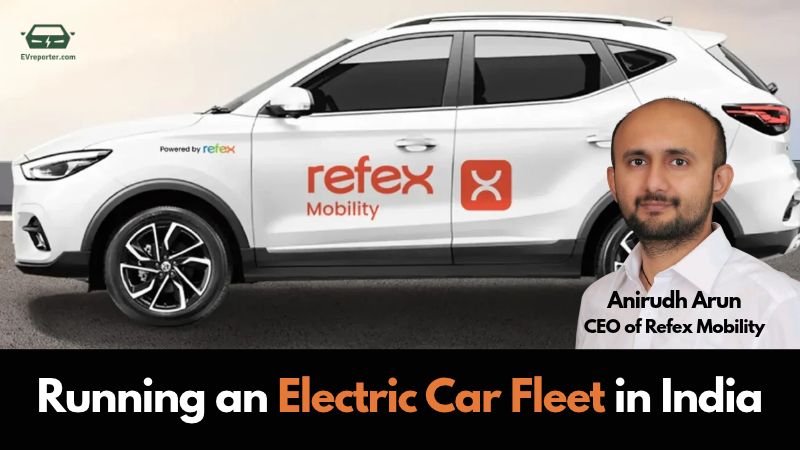
Anirudh Arun, CEO of Refex Mobility, explains why EVs are best suited to planned routes and captive charging today, commercial EV TCO parity vs. CNG, ESG as the driver for corporate adoption of electric fleets, challenges with scaling an EV fleet, and how fleet choices depend on policy.
Current scale of operations at Refex Mobility
Refex Mobility is a clean, connected, sustainable, and reliable mobility platform built as safe transportation infrastructure rather than a purely B2C brand or B2B service.
Strong presence in employee transportation and a fast-growing corporate car rental business, partnering with 100+ leading companies across India. Services include airport transfers, intercity rentals, point-to-point rides, and premium travel for individuals and families. We also partner with B2C ride-hailing platforms, online travel agencies, and airlines. We operate around 2,000 vehicles on our platform weekly. ~90% of our fleet is electric.
We believe we are India’s largest electric mobility service by vehicles actively operating on the road. We currently operate across five metropolitan regions—Chennai, Bengaluru, Hyderabad, Mumbai, and Delhi NCR—and plan to expand into a couple more cities soon.
Challenges with the Real-time Ride Hailing Usecase with EVs
Real-time ride-hailing is not inherently difficult to serve. We support it through our platform partners. Two key aspects matter here:
- When building a ride-hailing platform, you need sufficient vehicle density to make it viable on both the supply and demand sides. In cities such as Delhi NCR, Bengaluru, and Mumbai, you would need 3,000–5,000 vehicles to support real-time ride-hailing. Operating with 200–300 EVs would lead to empty runs, long pickup distances, and vehicle unavailability. This is where network effects matter. Plus, most drivers do not own EVs. If more drivers owned EVs, ride-hailing platforms would naturally have more EVs available.
- Vehicle robustness is another important factor. Most electric cars in this segment currently offer a real-world range of around 180–210 km. Electric SUVs may offer higher ranges, but they can be less cost-efficient than comparable CNG vehicles, which remain highly competitive in total cost of ownership.
This is why EVs are better suited to planned deployment models, where operators can forecast trips, map charging infrastructure, and coordinate operations through a technology platform. These systems can guide driver partners on when to charge, schedule their next pickup, or take a break, making EV operations smoother.
That said, EV adoption in real-time ride-hailing is increasing as vehicle quality improves. I believe that 2028 will be an inflection point for electric mobility; we are still a few quarters away from large-scale EV adoption across several use cases that currently face challenges.
CNG has traditionally been the benchmark for total cost of ownership in commercial vehicle operations. How do CNG and EVs compare in terms of TCO?
- The upfront cost of an EV is roughly 35– 40% higher than that of an equivalent CNG vehicle. This is why continued state government support and avoiding registration taxes on EVs is important. Some states have started moving towards introducing these taxes, which I believe is premature and could slow electrification.
- The second aspect is charging costs. In commercial use cases, relying entirely on slow AC charging is difficult as operators need fast public charging to minimize downtime. Commercial fast-charging rates range from ₹17–23 per kWh. With each unit providing around 7 km of range, operating costs come to ₹2.5–3 per km. In comparison, CNG vehicles cost around ₹4 per km to operate. Therefore, the cost advantage of EVs is less significant than it may initially appear. They need to cover about 3–4 lakh km to offset the price difference.
- Assuming customers pay the same fare for both CNG and EV services, vehicle durability becomes a critical factor in determining TCO. I believe the inflection point will come when the following happen.
- OEMs need to improve EV durability so that vehicles can reliably cover 4–5 lakh km over their lifetime. This would also improve residual values after three or four years, an area where CNG vehicles currently have an advantage. Improvements in real-world vehicle range would also help.
- Upfront vehicle costs need to decline through economies of scale. The current 35–40% price difference between EVs and CNG vehicles needs to narrow to around 15–20%.
- Greater access to AC charging near drivers’ homes and operational areas will further reduce costs. This would reduce dependence on public fast charging, reserving it for essential situations.
Do you own these vehicles or lease them under an asset-light model?
We work with multiple models.
- Vehicle ownership – we own the vehicles and deploy them across contracts or through driver partners operating on different platforms. This model suits well-capitalized companies with strong balance sheets that banks can finance.
- Leasing – requires less upfront capital and is often easier for entrepreneurs starting a business. Typically involves higher financing or interest costs.
- Driver-partner-owned vehicles – Once you establish a strong demand network, build expertise in EV operations, and earn trust, some partners begin investing in their own EVs and approach you. We can support these entrepreneurs through our technical expertise, charging infrastructure knowledge, and demand partnerships. We also help with financing, vehicle maintenance, and improving vehicle residual values. I believe all three models are important for building a sustainable, long-term EV mobility business.
Could you walk us through the unit economics of an EV in fleet operations?
Unit economics of an electric sedan over 4 years, in alignment with the financing tenure
Electric sedans entering our platform typically cost about ₹12 lakh. Charging costs are around ₹2.5–3 per km, while maintenance costs are ₹1–1.5 per km.
At an average utilization of 4,000 km per month, charging and maintenance together
cost ₹15,000–16,000, while ₹30,000 goes towards the asset.
If monthly charging and maintenance expenses can be reduced from ₹15,000 to ₹11,000–12,000, the savings would be ₹3,000– 4,000 per month, or ₹1.5–2 lakh over 48 months on a ₹12 lakh asset.
In metros, drivers need to earn at least ₹25,000 per month. Additional overheads must be spread across a larger fleet, making scale essential for profitability.
Given these costs, a vehicle needs to generate ₹65,000–75,000 in monthly platform revenue for the business model to work. This revenue must be sustained throughout the 4-year period, accounting for seasonal downtime and supply-demand fluctuations.
At around ₹75,000 in monthly revenue per vehicle (electric sedan), the driver partner can earn a reasonable income, operating expenses can be covered, EMIs can be paid, and the fleet operator can generate a margin.
Another important consideration is how to exit the asset after the financing period. One option is to deploy the vehicle in a second-life use case with less demanding operating requirements. Alternatively, operators can secure contracts for 3-4-year-old EVs at slightly discounted rates compared to new vehicles. The objective is to extend the vehicle’s revenue generating life beyond its initial financing period.
Unlike CNG, there is still uncertainty around achieving profitability over a four-year period with EVs. Would it be fair to say that, at present, ESG goals, rather than TCO, is driving the adoption of electric cars in commercial operations?
I think electric 4W passenger mobility is nearing TCO parity. CNG, however, has established strong unit economics and remains a viable option. CNG vehicles face no additional tariff or carbon tax, making it hard to charge a green premium for EVs. Therefore, ESG goals are currently a major driver of electric 4W adoption, particularly among corporations.
However, EVs already offer better TCO than CNG vehicles in specific use cases.
Consider a fixed deployment model where a vehicle operates for 12 hours and covers around 200 km daily. If the corporate facility has captive charging infrastructure, the operating economics become much more favorable. Many large corporations have suitable real estate and sufficient electrical capacity to install AC charging infrastructure for 30–40 vehicles. In such cases, EVs can already offer better TCO than CNG vehicles. However, relatively few operators have been able to leverage these advantages effectively.
How do you decide which vehicle models to include in the fleet?
Vehicle selection is influenced by: The products OEMs introduce based on market research and feedback, and the specific requirements of each use case.
- For airport transfers, we prioritize comfortable seating, large boot space, and some differentiation from regular cars. SUVs like MG ZS EV and Tata Nexon EV work well.
- For employee transportation, the focus is on reliability, seating capacity, and reducing the cost per employee per km. Large boot space matters less, while comfortable seating and effective rear-seat air conditioning are essential. Vehicles such as the Kia Carens Clavis EV, with its Ertiga-like seating configuration, and some upcoming models are suited.
- For regular city commuting, we use models from Citroën and Tata. Tata has also upgraded its battery pack from 26 kWh to 32 kWh, reflecting the OEM’s response to market requirements and customer feedback.
What kind of planning goes into launching operations in a new city? Do state EV policies influence expansion decisions?
State policies influence our decisions through subsidies, tax exemptions, and toll waivers. We also evaluate charging station availability and average charging tariffs in each city. Competitive vehicle pricing and OEM-backed resale-value programs can also make a big
difference.
However, the most important consideration is the type of contract we can secure and how effectively EVs can benefit from the available policies and infrastructure. While we actively encourage customers to adopt EVs, the client makes the final decision. If a company prefers a fleet comprising EVs and hybrids or CNG vehicles, we accommodate that requirement.
Could you highlight a couple of challenges you face specifically because of your choice of EV powertrain?
There are several challenges, and intercity travel remains a limitation for EVs.
For example, we are currently discussing how to launch airport transfer services to Noida International Airport and Navi Mumbai Airport. Noida International Airport is quite far, roughly 100 km one way from Gurugram. If an electric Tata Tigor has only 50% charge remaining, we need to assess whether it can complete the trip or whether another vehicle needs to be assigned, potentially from a greater distance. With CNG, this is much simpler.
Driving intercity to interior destinations, say Mumbai to Shirdi, can be difficult with an EV. Conventional vehicles such as the Toyota Innova Crysta make these journeys much simpler. I believe these limitations will gradually be addressed as the EV ecosystem and charging infrastructure continue to evolve.
What are some common misconceptions about running an EV fleet?
Many people assume EVs are automatically cheaper to operate. Many customers think that because EVs are cheaper to operate, they should receive lower transportation rates. However, cost parity doesn’t exist across all use cases today.
Another misconception is that higher vehicle utilisation automatically improves TCO. There needs to be a balance, as maintenance costs can increase significantly beyond a certain level of utilisation. Increased utilisation can also affect the vehicle’s overall asset life. Balancing utilisation, maintenance costs and asset life is essential for sustainable fleet economics.
On personal EV adoption – EVs are actually more user-friendly for retail users than people think. If you have charging figured out, today is a great time for retail EV adoption even if it’s your only car. I think the biggest priority for the government and the discoms is solving this last-mile home charging issue to enable massive electrification on the retail mobility side. A lot of effort is happening there, but I think more problem-solving on this aspect will actually help EV adoption.
This interview was first published in EVreporter Nov 2026 magazine.
Also read: Refex Green Mobility starts Delhi NCR operations
Subscribe & Stay Informed
Subscribe today for free and stay on top of latest developments in EV domain.