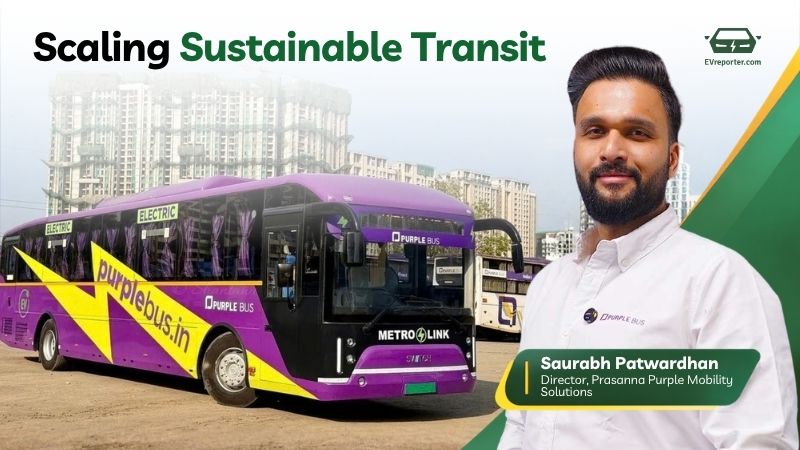
Intercity Routes Under 400 km Set To Lead Electric Bus Adoption | Prasanna Purple Mobility

Founded in 1995, Prasanna Purple is a leading mobility platform offering transportation services across intercity, intra-city, and metro feeder networks, along with staff transportation, school and college transportation, and ad hoc services. The company runs 750 buses and touches more than a million passengers monthly across 8 states in India.
In an interaction with EVreporter, Saurabh Patwardhan, Director of Prasanna Purple Mobility Solutions, shared about the company’s e-bus operations, economics, scale-up plans, and charging infrastructure.
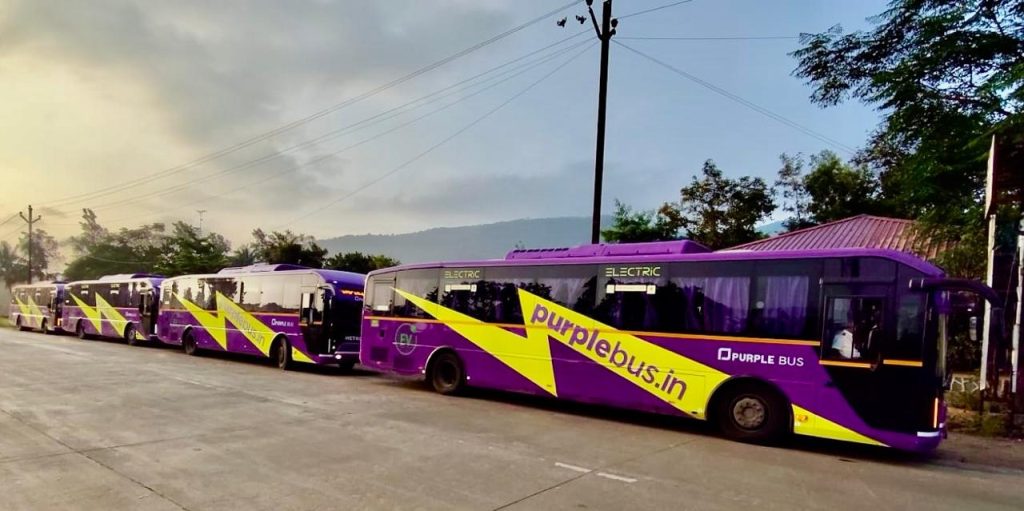
Prasanna Purple entered intercity EVs about two years ago. It now privately operates 26 buses and runs 52 intercity EV buses with Maharashtra State Road Transport Corporation (MSRTC) and expects to cross 100 e-buses this year, with plans to deploy an additional 250 buses over the next couple of years.
Tracking the Right Numbers for Intercity Electric Bus Operations
ICE is a fairly established, straightforward operating model, while EVs require significantly more planning and configuration to optimize total cost of ownership (TCO) for a specific use case. Running this fleet optimally means tracking the right numbers. For the intercity e-bus P&L, the company monitors monthly km per bus, energy consumption, uptime percentage, seat fill ratio, and average selling price. Tracking cost per seat-km is a critical performance marker, as it can be correlated with commensurate revenue on a per-seat, per-km basis.
Deciding which routes to electrify follows a similar discipline; the primary consideration is whether there’s a demand/supply gap and white space for a high-quality operator to make a difference. This analysis is backed by a checklist of more than 20 parameters, including energy costs and the expected number of monthly trips a bus can make.
Patwardhan believes that e-bus adoption will move fastest on the intercity routes under 400 km and city bus services driven by GCC/CESL contracts, along with some penetration in corporate mobility driven by ESG/SDG mandates.
Gross Cost Contract (GCC) is a model where bus operators are paid a fixed fee per kilometer by the contracting authority. Convergence Energy Services Limited (CESL) is a government-owned company under the Ministry of Power that aggregates demand for electric buses and floats tenders on behalf of multiple STUs.
As the charging infrastructure evolves and electric bus technology matures by 2030, 40-50% of shorter, high-dividend tier 1 and tier 2 routes will start going electric, he added.
Baking Reliability into E-Bus Operations
The complexity of e-bus operations extends to reliability: on concerns raised by some State Transport Undertakings (STUs) about e-bus uptime, Patwardhan acknowledged that their company’s own experience with e-buses has been mixed, with initial hiccups and uncertainty.
But choosing the right OEM partner, investing in infrastructure, maintaining a strong preventive maintenance setup, and monitoring alerts and thermal warnings can give EVs an edge, since they have significantly fewer moving parts that can wear out. For larger, compliant fleet owners, this translates into a competitive advantage through higher potential uptime and lower lifetime maintenance costs.
Solving Financing for E-bus Adoption
Financing is shifting alongside the technology. Unlike ICE buses, which are mostly bank-financed and operator-owned, EV buses are increasingly leased through new-age lenders like Vertelo and Drivn. Prasanna Purple partnered with leading leasing companies to address scale and longer tenure requirements, since EVs need a certain deployment volume for the economics to work. Banks remain hesitant to finance EVs at scale currently, though Patwardhan is optimistic that an upcoming interest subvention scheme and other central-level support will bring banks into the space.
Training the Drivers Right
Driver behavior also plays an outsized role in EV economics: a driver can influence almost 20% of energy bills.
While the difference between a good and bad driver in ICE vehicles is around 5-8% in fuel efficiency, the gap in EVs can be 35-40% in energy consumption, which can be avoided by investing in a structured driver training calendar covering safety, efficiency, and soft skills.
Opportunities for Charging Infrastructure Players
Patwardhan sees tremendous opportunity for charge point operators (CPOs) to build captive and open-access charging solutions for fleet owners. Currently, high-capacity DC 360 kWh chargers with adequate power supply are difficult to find at public stations, which remains one of the biggest challenges for fleet owners looking to electrify.
The company is also closely watching emerging technologies such as hypercharging, battery swapping, and flash charging, which could accelerate adoption if they improve fleet uptime and reduce TCO.
Also read: Unit Economics of Intercity Electric Buses
Subscribe & Stay Informed
Subscribe today for free and stay on top of latest developments in EV domain.