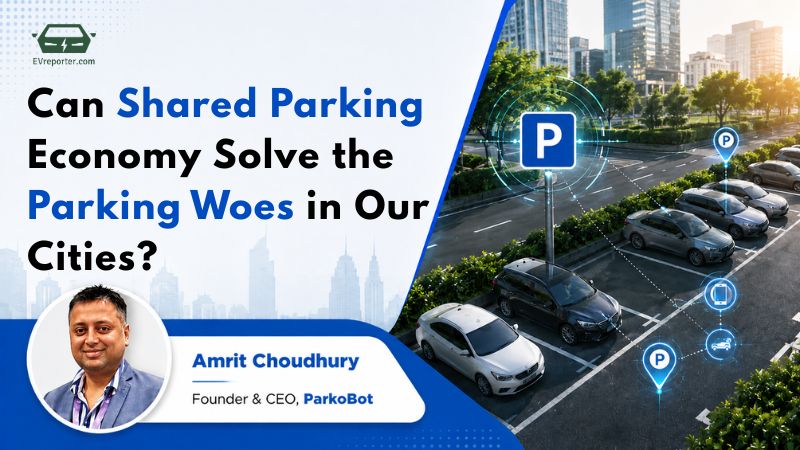
Can A Shared Parking Business Model Solve the Parking Woes in Our Cities?

Guest article by Amrit Choudhury, Founder & CEO, ParkoBot
India’s urban and road infrastructure is evolving at a breakneck speed as more vehicles are added. Electric vehicles, connected transport, digital payments and intelligent traffic systems are reshaping how people move through cities. Yet one of the most fundamental components of urban mobility—parking—continues to be treated largely as a static real-estate problem rather than a dynamic mobility resource.
For millions of commuters, the parking journey begins before they reach their destination. Time is spent searching, circling blocks and waiting outside full facilities, even though unused parking spaces often exist only a short distance away. This paradox suggests that the challenge is not only one of inadequate supply, but also of poor visibility and utilisation.
Most cities instinctively respond by building more parking. While additional infrastructure has its place, urban land is finite, construction is expensive, and every new parking structure competes with housing, public spaces and commercial development. A more fundamental question, therefore, deserves attention: Are cities short of parking, or are they failing to utilise the parking that already exists?
The Hidden Parking Capacity Within Our Cities
Residential parking remains largely vacant during office hours, while office campuses reach peak occupancy. Hotels, schools, hospitals, convention centres, malls and religious institutions each experience different demand cycles. Looked at individually, they appear constrained; viewed collectively, they reveal significant idle capacity. The issue is temporal rather than purely physical.
DAILY PARKING PARADOX
Morning: Residential occupancy ↓| Office occupancy ↑
Evening: Residential occupancy ↑| Office occupancy ↓
Result: Vehicles search while many spaces remain idle.
From Ownership to Utilisation
Parking has traditionally been allocated by ownership. A parking bay assigned to an employee often remains blocked even when that employee is travelling, working remotely or has already left for the day. Availability is governed by entitlement rather than actual use.
The wider economy has already embraced utilisation-based models. Hotels monetise vacant rooms, cloud platforms share computing capacity, ride-sharing increases vehicle utilisation, and co-working spaces unlock underused office space. Parking is one of the last major urban assets yet to complete this transition.
Global cities like Amsterdam, Tokyo, SF, Seoul and Singapore are already linking parking policy with highly efficient automated parking systems and leveraging intelligent transport infrastructure to respond to parking demands.
The Shared Parking Economy
A shared parking economy makes temporarily unused parking spaces discoverable and accessible when owners are not using them. Rather than increasing concrete, it increases utilisation. Digital discovery, reservations, secure access, cashless payments, and real-time occupancy form the foundation of this model.
Owner → Digital Platform → Discovery → Reservation → Access → Payment → Exit
Benefits: Owner earns | Driver saves time | City reduces congestion
How does ParkoBot work?
ParkoBot turns unused and underutilized parking spaces into smart, bookable and revenue-generating assets. Its IoT-enabled devices connect physical parking spaces to a digital platform, providing real-time visibility of parking availability and occupancy.
Space owners monetize idle capacity, businesses optimize their parking infrastructure, and drivers can discover and book parking with greater convenience. ParkoBot creates a connected ecosystem where every parking space becomes visible, manageable and commercially valuable.
By connecting parking supply with demand, it helps reduce the time spent searching for parking, minimize unnecessary traffic movement, and contribute to lower congestion.
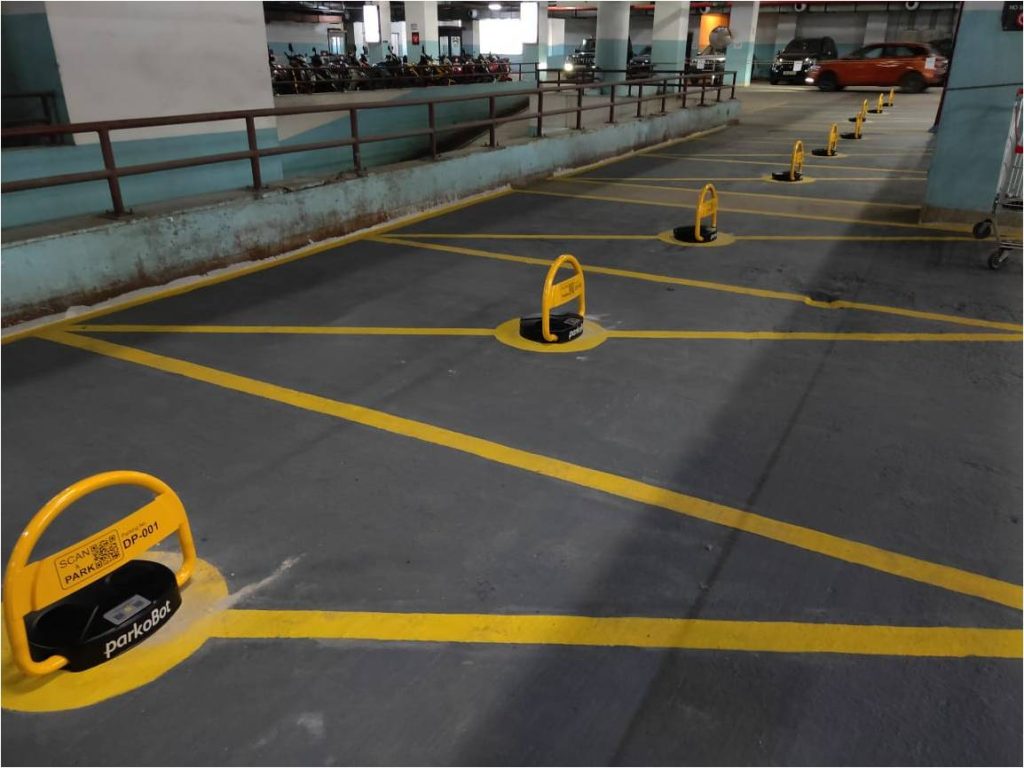
Earning potential for parking space owners – Parking space owners can potentially earn an average of ₹15,000–₹25,000 per month, depending on parking rates, occupancy, location, and booking demand. These figures are indicative estimates and may vary based on actual utilization.
Scale of ParkoBot operations – ParkoBot currently powers 2,310+ active parking spots across individual owners and large parking hosts, facilitating 31,500+ vehicle transactions every month.
Why It Matters for Electric Mobility
As EV adoption grows, parking becomes more than a place to leave a vehicle. It is where vehicles recharge, fleets rotate, deliveries pause, and future connected services converge. Efficient access to parking directly improves charger utilisation and supports fleet electrification.
Policy and Challenges
Tech alone can’t solve decongestion for urban roads and cities. It will take all the key stakeholders of the ecosystem including municipalities, property owners and real estate players to come together to build on this vision in collaboration with tech companies. Cities would need to understand interoperable parking data, clear liability frameworks, privacy safeguards, dynamic pricing policies. Trust and governance will be as important as software.
Looking Ahead
Artificial intelligence, connected vehicles and smart-city platforms will gradually transform parking into an intelligent urban network capable of predicting demand and allocating capacity dynamically. The shared parking economy is therefore not simply a convenience feature; it represents a shift towards treating parking as part of critical mobility infrastructure.
Traditional: Build More Parking → Higher Cost → More Land
Shared Economy: Existing Spaces → Digital Visibility → Dynamic Allocation → Better Utilisation
Conclusion
India does not necessarily need dramatically more parking infrastructure before it learns to use existing parking more intelligently. Unlocking idle capacity can reduce congestion, improve travel efficiency and support the country’s transition to connected and electric mobility. The future of parking will depend not only on how many spaces cities build, but on how effectively they connect, manage and share the millions of spaces that already exist.
About the author

Amrit Choudhury, Founder & CEO, ParkoBot
First-gen entrepreneur who started NICK IT in 2007 – Specialized in RFID, Bluetooth, IoT-based enterprise mobility solutions & B2B tracking & Rewards company. Enterprise partners: HDFC, Samsung, Pernod Ricard, Carlsberg, Diageo, Coke.
Also read: Driving Innovation: ModelNova’s Perspective on Automotive Transformation
Subscribe & Stay Informed
Subscribe today for free and stay on top of latest developments in EV domain.