Hydrogen ICE vehicles and their relevance in commercial mobility

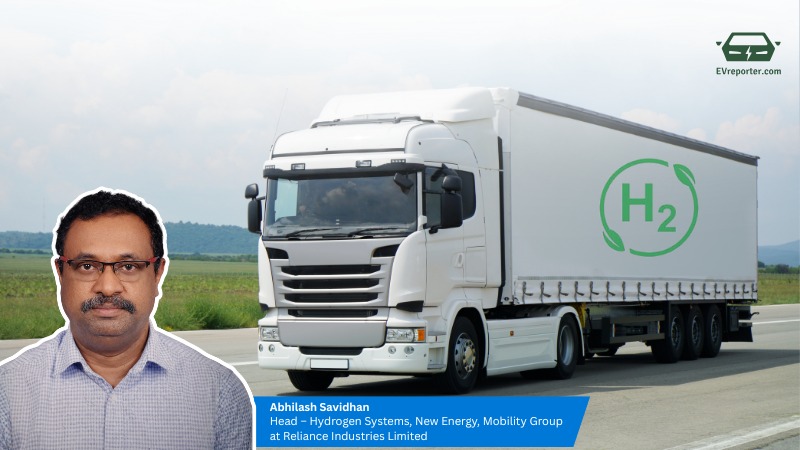
In this interaction with EVreporter, Abhilash Savidhan, Head – Hydrogen Systems, New Energy, Mobility Group at Reliance Industries Limited, discusses the technical requirements of converting internal combustion engine (ICE) vehicles to hydrogen, the role of H₂-ICE technology in heavy-duty applications, comparisons with battery electric and fuel cell technologies, developments in refuelling infrastructure, and the current policy framework in India.
What are the key technical modifications required to convert a traditional ICE truck to run on hydrogen?
At its core, converting a diesel truck to run on hydrogen involves transitioning the engine from compression ignition to spark ignition, broadly similar in concept to diesel to CNG conversion, but requiring far more extensive re-engineering due to hydrogen’s unique physiochemical properties, combustion and material characteristics.
Hydrogen engines operate at lower compression ratios, typically achieved through redesigned pistons and optimised combustion chamber geometry to manage hydrogen’s high flame speed and knock sensitivity. A full spark-ignition system, including spark plugs, ignition coils, and a dedicated Engine Management System, is required. The control unit manages air-fuel ratio, injection timing, spark timing, and safety diagnostics through hydrogen-specific calibration maps and sensor integration.
The diesel injection system is replaced with a hydrogen-specific fuel delivery system. Depending on the architecture, this may involve port injection (10–20 bar) or high-pressure direct injection (up to 350 bar). Injector sizing, pressure regulation, and flow control are designed specifically for hydrogen’s low volumetric energy density and high flow requirements.
All hydrogen-wetted components must be compatible with hydrogen service to address risks such as embrittlement and leakage. Component specifications differ significantly from CNG due to hydrogen’s distinct physical and combustion properties.
The vehicle must integrate certified high-pressure hydrogen storage (typically Type III or IV cylinders), pressure regulation hardware, and refuelling interfaces compliant with hydrogen standards. A comprehensive safety architecture including leak detection, automatic shut-off, venting systems, and thermal protection is also incorporated. In essence, while the conversion philosophy resembles diesel-to-gas adaptations, hydrogen conversion is a system-level redesign of combustion, fuel delivery, controls, storage, and safety.
Given India’s push toward electric mobility, what specific use cases make H2-ICE technology relevant for the market?
While battery electric mobility is gaining strong policy and market momentum in India, hydrogen ICE technology is particularly relevant for hard-to-electrify, high-utilisation segments where battery solutions face constraints around weight, range, payload, and downtime.
Medium- and heavy-duty trucks, though limited in number, contribute disproportionately to transport-sector emissions, accounting for over 40% of transport-sector pollutants. In long-haul freight, construction logistics, and intercity haulage, battery systems often impose payload penalties and long charging downtimes. H₂-ICE offers a familiar powertrain architecture with fast refuelling, high range, and minimal payload compromise, making it well-suited for these duty cycles.
Applications demanding very high uptime such as mining trucks, port equipment, and off-highway machinery (excavators, loaders, articulated haulers) are strong candidates. These operate in confined geographies where dedicated hydrogen refuelling infrastructure can be deployed efficiently. The ability to refuel quickly and operate continuously gives hydrogen ICE a clear operational advantage over battery systems in such environments.
Diesel generator (DG) sets remain a major source of urban air pollution, contributing an estimated 7-18% of ambient pollution in non-attainment cities. Hydrogen ICE engines can serve as a low-carbon alternative in telecom towers, commercial buildings, data centres, and industrial backup power systems, segments where reliability, quick refuelling, and long operating hours are critical.
Hydrogen ICE is also gaining traction in marine propulsion, where electrification is challenging due to energy density constraints. Several global players are already piloting large-bore hydrogen engines for maritime use, signalling strong future potential.
In the Indian context, H₂-ICE should be viewed not as a competitor to battery electric mobility but as a complementary decarbonisation pathway for sectors where electrification is operationally or economically constrained. Its ability to leverage existing engine manufacturing ecosystems, supply chains, and service infrastructure further enhances its near to mid-term relevance.
How would H2-ICE commercial vehicles compare to electric and fuel cell solutions in terms of efficiency and total cost of ownership?
From a pure thermodynamic standpoint, hydrogen internal combustion engines will remain constrained by Carnot cycle limits and therefore achieve diesel-like brake thermal efficiencies. In contrast, fuel cells, being electrochemical devices, offer higher theoretical efficiencies (up to ~80%), with current practical tank-to-wheel efficiencies in the 40-50% range. These are affected by activation losses, ohmic losses, parasitic balance-of-plant loads, and fuel crossover. But there remains scope for further improvement through stack and system optimisation
Battery electric vehicles, by comparison, deliver the highest drivetrain efficiency today, with battery-to-wheel efficiencies in the ~80-85% range. However, for commercial vehicles, efficiency alone does not determine technology viability. Total cost of ownership (TCO), operational flexibility, and localisation potential are equally decisive.
From a cost perspective, H₂-ICE technology benefits from strong architectural overlap with conventional ICE and CNG systems. Hydrogen fuel delivery and storage systems, while technically more demanding, are functionally analogous to CNG. India’s CNG transition provides a useful precedent. In the early 2000s, CNG kits were largely imported and prohibitively expensive; today, a fully localised supply chain has reduced system costs to a fraction of initial levels. A similar localisation trajectory is feasible for hydrogen ICE components at scale, given that the technology does not rely heavily on rare-earth materials, precious-metal catalysts, or manufacturing capabilities beyond India’s existing automotive and industrial base.
Fuel cell systems, by contrast, still face a longer path to localisation and cost reduction. Stack materials, precision manufacturing and balance-of-plant components contribute to higher system costs and technological complexity, although sustained investment and policy support would narrow this gap over time.
In a scaled scenario, H₂-ICE commercial vehicles have the potential to achieve diesel- or CNG-comparable TCO, provided hydrogen fuel prices reach commercially viable levels. When this occurs, hydrogen ICE can offer a compelling value proposition, particularly in heavy-duty and high-utilisation segments, combining familiar powertrain economics with zero-carbon tailpipe operation. Relative to battery electric commercial vehicles, H₂-ICE may offer advantages in payload retention, refuelling time, and asset utilisation in long-haul or high-uptime applications. Consequently, rather than viewing these technologies in isolation, the market is likely to evolve toward a multi-technology equilibrium, where battery electric, fuel cell, and hydrogen ICE solutions are deployed according to duty cycle and economic optimisation.
While H2-ICE produces zero CO2 emissions at the tailpipe, do you see any challenges around NOx emissions?
If you run the engines at the right lambda (air-fuel ratio), the in-cylinder temperatures do not go very high, which aids NOx formation. Engine and vehicle manufacturers worldwide have achieved Euro 4 (equivalent to BS IV) without after-treatment, and some claim to have cleared Euro 6 (equivalent to BS VI) without after-treatment. Euro 6 won’t be super easy, and it may require a NOx reduction system. But it depends on the mechanisms the engine manufacturer is implementing to control combustion temperatures, compression ratio and so on.
Can you share details about ongoing H2-ICE pilot projects or deployments in India? Which companies or fleets are currently testing these vehicles, and can you share early feedback on performance and operational economics?
India’s hydrogen ICE development is currently in an active pilot and pre-commercialisation phase, led by a mix of large industrial groups and commercial vehicle OEMs aligned with net-zero commitments.
– Reliance Industries, in partnership with Ashok Leyland, initiated early hydrogen ICE engine development around 2022 as part of its broader decarbonisation roadmap.
– Since then, most major commercial vehicle OEMs, including Tata Motors and VE Commercial Vehicles (Volvo-Eicher), have commenced parallel development programmes. Several hydrogen-powered trucks and buses were publicly showcased at Auto Expo and subsequent mobility forums, signalling clear industry intent. Most OEMs have established dedicated hydrogen engine development and validation facilities that cover combustion optimisation, durability, safety validation, and vehicle integration. Programmes are at varying stages of maturity, from prototypes to pilot fleet demonstrations in controlled environments. The industry’s aspiration is to achieve diesel-equivalent drivability, range, and reliability while leveraging hydrogen’s zero-carbon tailpipe emissions potential.
However, hydrogen’s unique combustion behaviour, like high flame speed, low ignition energy, and lower volumetric energy density, requires careful calibration trade-offs. Each OEM is therefore tuning engine performance, efficiency, and durability in line with its own product philosophy and duty-cycle focus, much as seen historically with diesel and CNG platforms.
Given that most deployments remain in pilot or controlled fleet trials, detailed operational economics are still evolving. Early feedback across programmes indicates performance characteristics approaching conventional ICE expectations in targeted duty cycles.
TCO sensitivity is seen to be primarily linked to hydrogen fuel cost and supply logistics rather than vehicle hardware. As hydrogen production scales and distribution stabilise, the expectation is that operational economics will progressively align with diesel/CNG benchmarks in high-utilisation commercial segments. Overall, India’s H₂ICE landscape is slowly transitioning from technology validation to early ecosystem building, with multiple OEMs positioning themselves for potential scale-up once fuel availability, infrastructure, and policy signals converge.
What is the current state of hydrogen refuelling infrastructure in India?
India’s hydrogen refuelling infrastructure is currently in an early deployment and pilot phase, closely aligned with the National Green Hydrogen Mission (NGHM) announced in January 2023.
– Under this framework, the Ministry of New and Renewable Energy (MNRE) has initiated multiple programmes, including mobility pilots with an allocated outlay of approximately ₹496 crore through FY26 to support hydrogen use in transport applications.
– Public sector energy companies like NTPC, Indian Oil, BPCL, and HPCL are leading early efforts to establish hydrogen refuelling stations (HRS) across select corridors. These installations are largely linked to pilot vehicle deployments and demonstrations rather than open commercial retailing, reflecting the current stage of ecosystem maturity.
– The recently announced Hydrogen Valley Innovation Clusters in Pune, Jodhpur, Bhubaneswar, and Kerala are expected to further accelerate infrastructure development by demonstrating integrated hydrogen ecosystems from production and storage to mobility and industrial use. These clusters will likely serve as anchor hubs for initial HRS deployment and technology validation.
From an economic standpoint, current hydrogen refuelling stations remain capital-intensive, with capex typically estimated at 5 to 6 times that of equivalent CNG stations. This is driven by low deployment volumes, limited localisation of critical components, and high costs associated with compression, storage, and dispensing systems. However, encouragingly, several Indian manufacturers have begun local development of high-value subsystems such as hydrogen compressors, high-pressure storage, and dispensing equipment. As with the earlier evolution of CNG infrastructure in India, scale and localisation will be the primary levers for cost reduction. With coordinated growth in vehicle deployment, hydrogen production, and policy support, HRS economics are expected to improve progressively, enabling a transition from pilot-based infrastructure to commercially viable refuelling networks over the coming decade.
How supportive is the current policy environment for H2-ICE technology?
The current policy environment for hydrogen mobility, including H₂-ICE, is supportive, though it is still in a near-proof-of-concept phase. The National Green Hydrogen Mission (NGHM) has been a pivotal catalyst, with targeted funding for transport pilots, R&D programmes, Centres of Excellence, and viability-gap-funded demonstration projects. These initiatives have created tangible momentum across the hydrogen mobility ecosystem and enabled OEMs and technology providers to begin real-world validation of hydrogen ICE platforms. Hydrogen Valley Innovation Clusters (HVICs) are further strengthening this ecosystem approach by enabling integrated demonstrations across production, storage, dispensing, and mobility use cases.
On the regulatory front, India has made encouraging progress. Standards such as AIS 195 for hydrogen-powered vehicles have been notified, and a broader set of technical standards spanning production, storage, dispensing, and vehicle integration is either published or under development. Regulatory bodies, industry, and academia are collaborating closely to ensure that codes and standards evolve inline with technological progress.
Notably, India’s approach to hydrogen standardisation differs from earlier regulatory harmonisation exercises. Unlike previous transitions where Indian automotive standards largely aligned with European frameworks, India is now among the early movers in hydrogen mobility. This creates both an opportunity and a challenge: standards must remain globally informed yet tailored to Indian operating conditions, infrastructure realities, and cost sensitivities. Given the pace of technological learning worldwide, maintaining agile and future-ready regulations will be critical.
Certain regulatory elements, such as draft notifications on the identification and classification of hydrogen-fuelled vehicles with a specific colour scheme for High Security Registration Plates (HSRP), are still under finalisation. Overall, however, the policy direction is constructive and enabling. Looking ahead, policy evolution must gradually transition from pilot-stage support to commercialisation-ready frameworks. This could include fiscal incentives comparable to those available for electric vehicles, demand creation through public procurement and fleet mandates, and inclusion of hydrogen-powered vehicles, including H₂-ICE, within future incentive schemes such as FAME III or equivalent programmes. Such measures would provide the long-term demand visibility required for the industry to commit capital, scale localisation, and move from demonstration to meaningful deployment.
Looking ahead to 2030, what role do you see H2-ICE playing in India’s clean mobility transition? What are the biggest technical, commercial, and infrastructural hurdles that need to be overcome, and what would be your roadmap for scaling this technology?
By 2030, H₂-ICE is likely to emerge as a strategic bridge technology in India’s decarbonisation journey, particularly for heavy-duty, high-utilisation, and hard-to-electrify segments such as long-haul trucking, mining, off-highway equipment, marine, and distributed power. Rather than competing with battery electric or fuel cell solutions, it will complement them in a multi-technology transition.
Technical hurdles include combustion optimisation for efficiency and NOx control, durability validation under hydrogen operation, and full localisation of hydrogen-compatible components. The commercial challenge is achieving diesel/CNG-comparable TCO through affordable green hydrogen pricing, scale-led component cost reductions, and demand visibility for OEM investments. From an Infrastructure point of view, the development of hydrogen production, storage, and refuelling networks at commercially viable capex, supported by localisation of high-value equipment such as compressors and storage systems.
Roadmap to scale
- 2025–27: Pilot fleets in captive and high-uptime applications; cluster-based hydrogen production and refuelling; continued policy and R&D support.
- 2027–30: Localisation and cost optimisation of vehicles and infrastructure; early commercial deployments in trucking, mining, and industrial fleets; targeted fiscal incentives and public procurement.
- Post-2030: Scale-driven cost parity with diesel/CNG in select segments, enabling broader adoption. If hydrogen fuel costs are rationalised and infrastructure is developed in parallel with vehicle deployment, H₂-ICE can evolve into a commercially viable zero-carbon workhorse for India’s heavy-duty mobility ecosystem by the end of the decade.
Disclaimer: Opinions expressed are personal.
This interview was also published in EVreporter Mar 2026 magazine.
Also read: Hydrogen fuel cells: Clean energy for the transportation sector
Subscribe & Stay Informed
Subscribe today for free and stay on top of latest developments in EV domain.