Scaling Electric Fleets Through Mobile Service Networks | Battwheels Garages

Field breakdowns and repair delays, not charging anxiety, are proving to be the real test of whether commercial operators will scale their electric fleets. Electric vehicles are selling. Charging stations are coming up. Subsidies are flowing. But ask a fleet operator in Delhi or a delivery startup in Bangalore what keeps them up at night, and the answer isn’t range or upfront cost anymore.
It’s this: what happens when the vehicle breaks down at 2 PM on a working day? That question is starting to matter more than most policy discussions acknowledge. And it’s where a different kind of infrastructure, less visible than charging stations and harder to legislate, is beginning to make a difference.
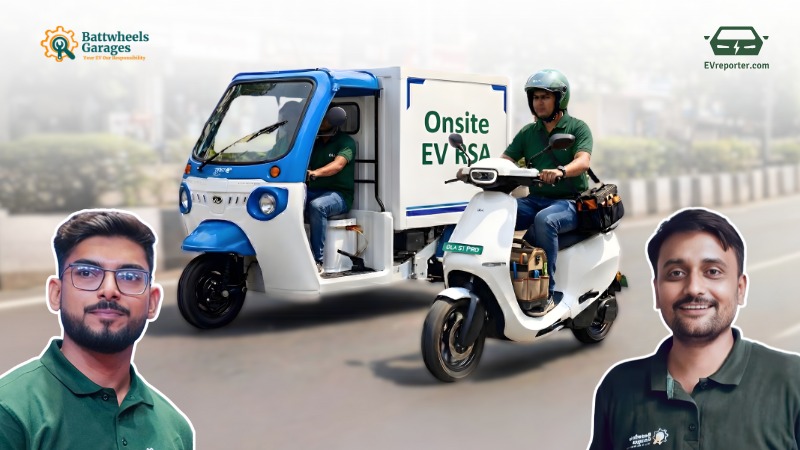
Battwheels Garages, a company that runs mobile EV repair teams across Indian cities, has spent the last few years dealing with the unglamorous side of the EV transition: breakdowns, downtime, and the chaos that follows when a commercial vehicle stops earning. Their work offers a ground-level view of a problem the industry is only now beginning to take seriously.
Founded by Deepak Tiwary and Amit Singh in 2024, Battwheels Garages is an EV-focused service network – with onsite repair as its core focus.
The company provides services across 11 cities, serving over 50 OEM & fleet operators.
Battwheels Garages has serviced over 10,000 vehicles (e-2W, 3W, 4W and commercial EVs) to date, fixing over 85% EV service issues on-site.
The Real Bottleneck Isn’t Always the Battery
India’s EV adoption has been driven largely by high-use commercial segments — autorickshaws, delivery bikes, shared cabs, and last-mile logistics vans. These vehicles don’t sit idle. They run 12 to 16 hours a day, through traffic, heat, dust, and waterlogged streets.
Breakdowns happen. Often. But here’s the thing: most EV breakdowns aren’t catastrophic. Many of them are electrical faults, sensor glitches, software errors, loose wiring, or battery management systems throwing up error codes. Many of these issues can be fixed on the spot if someone trained with the right tools shows up. The problem is that most service systems aren’t built that way.
The default response is still: tow the vehicle, take it to a workshop, wait for diagnosis, wait for parts, wait for repair. That can mean two days of lost income, sometimes more. For a fleet operator running tight margins, that’s not a technical issue. It’s an existential one.
When Downtime Shapes Adoption
“People don’t decide whether to trust EVs based on a brochure,” says a spokesperson from Battwheels. “They decide based on what happens the first time something goes wrong.”
That moment — when a vehicle is stranded, and the operator is on the phone trying to figure out the next steps — is when adoption either strengthens or cracks.
If the response is fast and professional, and the vehicle is back on the road within hours, confidence builds. If it’s slow, uncertain, and requires the operator to chase service centres across town, the calculation changes. Suddenly, the perceived risk of running an EV fleet doesn’t feel worth it. Fleet operators talk to each other. Word spreads fast about which vehicles are reliable and, just as importantly, which service networks actually show up.
Mobile Service Changes the Math
Mobile service networks flip the traditional model. Instead of moving the vehicle to the technician, they move the technician to the vehicle.
Battwheels operates on an onsite-first basis. When a breakdown call comes in, a trained technician is dispatched with diagnostic equipment and common spare parts. The goal is to diagnose and fix the issue on the spot.
If the problem genuinely requires a workshop — say, a major powertrain fault — then escalation happens. But that’s the exception, not the rule. The benefits are straightforward: less downtime, less revenue loss, less hassle for the operator, and less pressure on already stretched service centres.
It also changes the relationship between the customer and the technology. EVs stop feeling fragile. They start feeling like workhorses — because the system around them actually works.
Behind this onsite-first model is Battwheels OS — an in-house service management platform built specifically for EV aftersales. When a breakdown call comes in, the system manages ticket creation, technician assignment, real-time diagnostics support, parts tracking, and invoicing — all from the field. For fleet operators and OEM partners, this means every service event is logged, traceable, and feeds back into operational planning. It’s the kind of backend infrastructure that rarely makes headlines, but without it, running a consistent onsite service network across multiple cities and vehicle platforms simply wouldn’t hold together at scale.
Fleets Need Predictability to Scale
Fleet operators don’t expand based on optimism. They expand based on predictability. If a fleet manager is running 50 EVs and considering adding 200 more, the decision hinges on whether operations can scale without breaking. Service reliability is part of that equation. If breakdowns mean chaos, scaling feels risky. If breakdowns mean a phone call and a fix within hours, scaling feels manageable.
This matters for OEMs too. A vehicle brand’s reputation isn’t just built on how well the product works — it’s built on how well the aftersales system handles things when it doesn’t. Mobile service networks, in effect, become a buffer. They catch problems early, resolve them fast, and prevent minor faults from spiralling into brand-damaging customer experiences. Reliability isn’t just about the vehicle. It’s about the entire system. If the system fails, the vehicle gets blamed.
Building This Isn’t Easy
Running a mobile EV service network is harder than it looks. Technicians need to be trained across multiple vehicle platforms and architectures — two-wheelers, three-wheelers, light commercial vehicles — each with different systems. Spare parts need to be stocked intelligently. Decisions need to be made quickly, often in difficult roadside conditions.
Unlike a service centre where conditions are controlled, mobile service happens in the real world — on highways, in narrow lanes, during monsoons, and in 45-degree heat. The margin for error is smaller and the operational complexity is higher. Effective mobile networks require sustained field experience, disciplined execution, and a willingness to solve problems that don’t fit neatly into a manual.
Adoption Gets Won in the Field
As India’s EV numbers grow, the conversation is slowly shifting. Charging infrastructure still matters. Subsidies still help. But increasingly, the question is: what happens after the sale?
Mobile service networks won’t make headlines the way new vehicle launches do. But they might be just as important in determining whether EVs move from being a promising technology to a reliable, scalable reality. Adoption doesn’t happen in boardrooms. It happens on the road, one breakdown at a time. If the response is good, trust builds. If it’s not, people go back to what they know.
About Battwheels Garages
Battwheels Garages provides mobile EV service and roadside assistance across electric two-wheelers, three-wheelers, four-wheelers, and commercial fleets in India. The company works with OEMs and fleet operators to reduce downtime and improve vehicle reliability through on-site diagnostics and repair.
Also Read: Scooters lead, Motorcycles lag in EV penetration
Subscribe & Stay Informed
Subscribe today for free and stay on top of latest developments in EV domain.