Why safety and performance must run as one in India’s EV fleets

India’s electric fleets are moving from pilot to production at a pace that would have seemed improbable even two years ago, and with that scale-up comes a new mandate: treat safety and performance as one operating discipline, not as parallel workstreams. The economics already point the way. Through 2024-25, battery-electric heavy trucks began regular service on bulk and port corridors, supported by the first battery-swapping networks and early megawatt-class charging tailored to high-GVW duty cycles.
The stakes are also high, as medium- and heavy-duty trucks account for roughly 3% of India’s vehicle stock but contribute around half of road transport emissions, meaning every electric unit deployed in this segment has an outsized impact on both air quality and cost-per-kilometre.
The next wave of electric bus adoption will be judged not on pilots and promises, but on hard operating metrics: cost-per-kilometre, uptime, schedule adherence and incident reduction. For fleet operators, financiers and city agencies alike, capital is no longer the only constraint; the real differentiator is execution- how fleets convert data into coaching, plan charging around duty cycles, and standardise safety practices that protect range, assets and service reliability.
For India’s EV ecosystem, efficiency and safety are increasingly two sides of the same coin. Safe driving behaviours like anticipatory braking, disciplined following distance and consistent speed management are the very behaviours that stabilise energy curves, preserve state-of-charge buffers and reduce variability that wrecks schedules and charging plans. Harsh braking, last-minute lane changes and tailgating don’t just increase collision risk; they also spike energy consumption and compress already tight charging windows. This is why leading EV fleets now treat driver coaching as a cost-per-kilometre lever, not just a compliance box. The fleets that are winning tenders and renewals are the ones treating “safety data” as operational intelligence, linking it to route design, depot planning, SoC thresholds and even vehicle allocation strategies for high-density corridors.
How AI-powered video telematics systems can help enhance safety
Today’s AI-powered video telematics systems are enabling fleets to shift from reactive to proactive safety management. These systems deliver real-time alerts for risky behaviours such as distracted driving, unsafe following distance and signal violations while also recognising positive behaviours. This allows managers to reinforce what’s working rather than spending all their time chasing exceptions. When drivers see that good habits are noticed and ultimately reflected in schedules, recognition and even incentives, they adopt change faster, attrition falls, and operations teams get what they value most: predictability. For EV fleets, that predictability translates directly into more accurate range planning, better utilisation of depots and chargers, and fewer unplanned disruptions that eat into the total cost of ownership (TCO) advantage of going electric.
Case in point
One of India’s largest fleet operators, managing over 1,000 trailers across long-haul routes, discovered this firsthand. Despite having safety protocols and tracking tools in place, its biggest risks- driver fatigue and distraction were still showing up in incident logs and near-miss reports. Traditional systems were good at documenting what had gone wrong, but they were not helping drivers at the moment. The turning point came when the fleet deployed a modern edge-AI based road safety platform. Unlike passive recorders, this system provided instant audio alerts with up to 99 per cent alert accuracy that helped drivers self-correct as soon as risk emerged. Within the first six months, this shift from passive monitoring to active coaching delivered a 25% reduction in distraction cases and a 50% reduction in potential collision incidents.
Over two years, the behavioural change became even clearer: for following-distance alerts at standard risk (around a 1.2-second gap), 97.5% of vehicles took corrective action at least 90% of the time, and even in high-risk situations (around a 0.6-second gap), 46.3% of drivers responded with corrective action every single time. The business impact was equally tangible, with fewer accidents, significantly fewer shipment delays, and a noticeable improvement in on-time, damage-free deliveries, prompting the customer to say that the system had given them the “visibility and coaching tools to build a true culture of safety and accountability” and a partner in their goal of helping drivers get home safe every day.
Conclusion
For EV operators reading this, the lesson goes beyond a single fleet or technology stack. Electric buses and trucks introduce new constraints like battery health, charging windows, demand charges, and payload-range trade-offs, but the frontline risk is still human. The fleets that will set the benchmark in India are the ones that build an operating model where every kilometre is both safe and intelligent: where driver coaching is continuous, where safety data is fused with telematics and energy data, and where technology doesn’t just record mistakes but actively helps drivers avoid them.
As India moves towards larger-scale deployment of electric trucks and tens of thousands of e-buses under schemes like PM-eBus Sewa, combining EV economics with a driver-first safety culture is what will turn early momentum into a durable advantage. In that sense, improving EV fleet performance and improving road safety are not two parallel goals, rather, they are the same journey, and the fleets that understand this will lead the market.
About the author

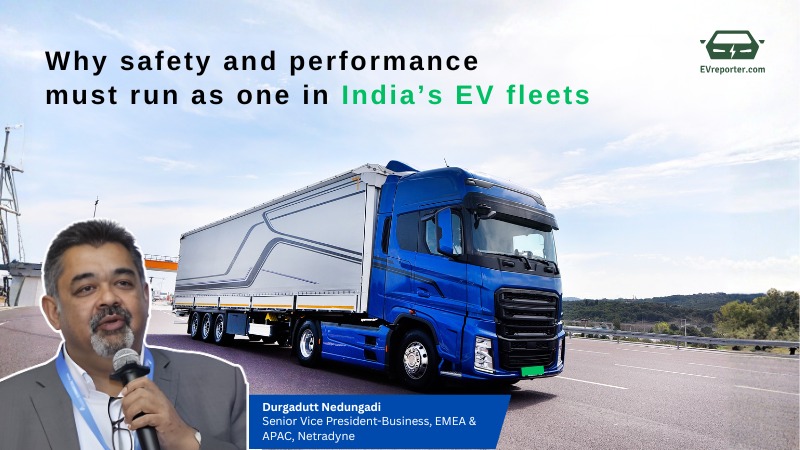
Durgadutt Nedungadi, Senior Vice President-Business, EMEA & APAC, Netradyne
Also read: Understanding AI-based road safety solutions for commercial fleets
Subscribe & Stay Informed
Subscribe today for free and stay on top of latest developments in EV domain.