Why High-Wattage Motors and Advanced Power Electronics Are Critical for Heavy-Duty Electrification

The electrification of commercial transport, from long-haul trucks and buses to heavy industrial fleets, is no longer aspirational; it is accelerating globally and in India alike. While passenger EV adoption is well-reported, heavy-duty electrification presents distinct engineering and economic imperatives that hinge on high-wattage electric traction motors and state-of-the-art power electronics. These two technology pillars determine not only performance and energy efficiency, but also total cost of ownership (TCO), operational uptime, and the scalability of fleet deployments.
Defining Heavy-Duty Electrification Needs
Heavy-duty electric vehicles (HD EVs) differ fundamentally from light EVs in both duty cycles and power demands. The global electric commercial vehicle traction market was valued at USD 2.1 billion in 2024 and is expected to grow at a CAGR of 28.8% during the forecast period. The demand for electric commercial vehicles (ECVs) has increased in recent years, driven by several key factors.
A delivery van or passenger car typically uses traction motors in the 30–100 kW range; by contrast, electric trucks and buses frequently require motors exceeding 200 kW, often up to 400 kW or more, to deliver sustained torque and speed under heavy loads and real-world terrains.
According to current market segmentation, the 200–400 kW traction motor segment accounts for over 35% of the electric commercial vehicle traction motor market, dominating heavy-duty truck and bus applications. Above-400 kW units serve the highest-load cases, including highway freight and industrial transport.
High-wattage traction motors provide:
- Sustained torque and acceleration under load, enabling gross combination weights (GCW) of 20–40 tons and above without performance degradation
- Improved gradeability and range consistency, critical for long-haul logistics and intercity routes
- Enhanced thermal resilience, as high-power motors with superior cooling systems sustain performance in demanding duty cycles
These attributes are non-negotiable for commercial operators whose costs scale with downtime and energy inefficiency; poor powertrain performance directly impacts fleet economics.
Invisible Power Electronics as an Engine for Electric Drive Systems
While motors deliver mechanical power, power electronics orchestrate how electricity flows from the battery to the motor and back. In HD EVs, advanced inverters and power converters are essential for:
- Efficient DC–AC conversion, ensuring minimal conversion losses and optimal utilization of battery energy
- Torque vectoring and speed control, enabling precision motor control across a wide range of load and speed regimes, especially under heavy payload conditions
- Regenerative braking feeds, returning energy to the battery during deceleration to extend range, which is essential for stop-start duty cycles
- Thermal and reliability management, mitigating heat and electrical stress that are heightened in high-power applications
Emerging power module designs using silicon carbide (SiC) and gallium nitride (GaN) semiconductors are now achieving higher power density and efficiency than legacy silicon systems, enabling compact hardware that handles heavy-duty currents and heat more effectively.
In heavy trucks, modular advanced power electronics can reduce wiring complexity, improve flexibility across different vehicle sizes, and simplify integration into OEM architectures, lowering costs while enhancing reliability.
Performance and Efficiency: The Economics of Power Electrification
Investments in commercial electrification are justified only when operational advantages outweigh the costs. Efficiency and energy density are two key metrics that are predominantly driven by traction motors and power electronics.
- System integration: Well-matched motors and inverters help reduce battery capacity requirements for a given range, cutting upfront costs and improving payload capacity
- Efficiency of motors: Heavy-duty traction motors and their associated power conversion systems can achieve efficiencies upwards of 95%, whereas internal combustion-based powertrains suffer significant losses due to mechanical and thermodynamic inefficiencies
For example, the nation’s first mass-produced electric heavy-truck platform offers a 350 kW permanent-magnet motor, delivering robust torque for heavy logistics operations, with optimized power electronics ensuring smooth energy delivery and compatibility with on-route charging.
Real-World Imperatives in Heavy-Duty EV Deployment
Commercial operators evaluate electrification through the lenses of TCO, uptime, and reliability. Advanced motors and power electronics matter because:
- Range and utilization: Heavy-duty trucks often travel more than 300 km per day. High-efficiency systems, coupled with fast-charging infrastructure (240 kW+) and battery swapping, reduce dwell time and increase utilization
- Infrastructure synergy: As megawatt-class charging continues to grow, with several industry players announcing 600 kW to multi-megawatt stations worldwide, vehicles must be capable of drawing high power safely and efficiently
- Lifecycle costs: Enhanced thermal management in power electronics reduces failure rates and extends service intervals, lowering maintenance expenses over the vehicle’s lifetime
In commercial fleets, even modest improvements in drivetrain efficiency can translate into material annual energy savings. For electrified fleets, per-kilometer energy savings scale directly with total mileage, making efficiency a key return-on-investment driver.
In India, supportive policies such as the PM E-Drive scheme are accelerating EV adoption across vehicle classes, including buses and trucks, fueling demand for heavy-duty EV powertrains alongside charging infrastructure expansion.
Conclusion
The electrification of heavy-duty operations is not simply a matter of replacing diesel engines with electric motors. It requires high-wattage traction motors capable of continuous, high-torque performance under demanding loads, combined with advanced power electronics that manage energy flows efficiently, reliably, and with minimal losses. Equally critical is integrated systems engineering that balances motor sizing, inverter capacity, thermal management, and grid dynamics.
For fleet operators and OEMs, the strategic selection of traction motors and power electronics directly impacts economics, reliability, and long-term scalability. As the market matures, sustained investment in these core technologies will distinguish incremental electrification efforts from truly transformative solutions in heavy-duty transport.
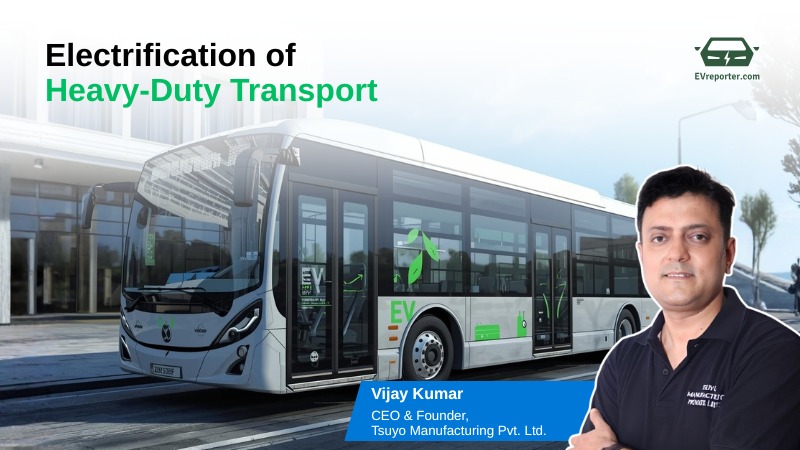
The article is authored by Vijay Kumar, CEO and Founder, Tsuyo Manufacturing Pvt. Ltd.
Also Read: Is Megawatt Charging System (MCS) the future of Heavy-Duty EV Charging?
Subscribe & Stay Informed
Subscribe today for free and stay on top of latest developments in EV domain.