Export Readiness of EVs in India & Technology Gap for Global Scale

Authored by Adarshkumar Balaraman, Co-founder & Chief Operating Officer, Vecmocon Technologies.

In this article, we unpack where India stands today in EV exports—across technology readiness, manufacturing processes, and product quality. We examine the kind of EV technologies India is currently able to export—largely dominated by two- and three-wheelers—and explore what it will take to achieve the true essence of “Made in India for the world.”
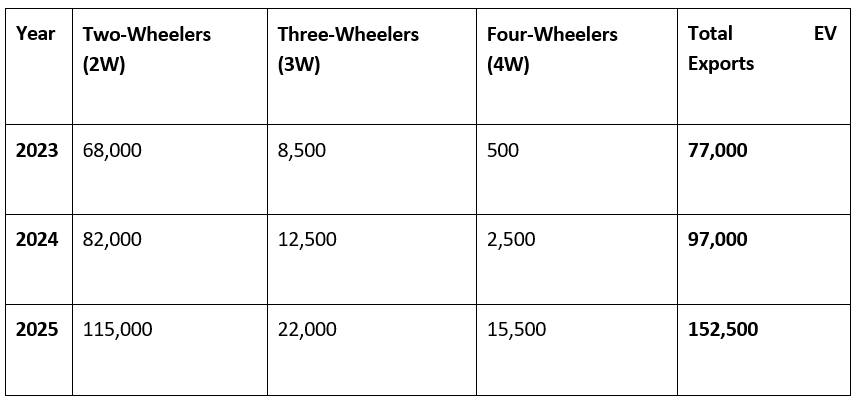
India’s rapidly growing EV ecosystem is now beginning to reflect its momentum on the global stage through rising EV exports. With approximately 75,000 EVs exported in 2023, India crossed its own benchmark by exporting over 97,000 EVs in 2024. While official figures for 2025 are yet to be released, early indicators suggest that the year will register a significant acceleration in EV exports, signalling India’s growing intent to participate in the global electric mobility supply chain.
At first glance, these numbers may appear encouraging. However, when viewed against global benchmarks, India’s EV export journey is still at a very nascent stage. China exports close to 3 million EVs annually, while Europe exports around 800,000 units, followed by Japan and South Korea, which continue to top the charts through superior technology maturity, manufacturing depth, and stringent safety standards.
In comparison, India is still developing the technological capability and safety maturity required to compete at the Global level, and the development of functionally compliant technology becomes crucial for us to compete at that level.
Current EV Exports from India
India’s electric vehicle (EV) export landscape is currently transitioning from a domestic-focused industry to a global manufacturing hub. The primary focus is on LFP (Lithium Iron Phosphate) battery chemistry and Mid-drive/Hub motor technologies, which offer high thermal stability suitable for tropical and emerging markets. While Two-wheelers (2W) and Three-wheelers (3W) have traditionally dominated exports, 2025 marked a strategic pivot toward Passenger Vehicles (4W).
Key players include Maruti Suzuki (e-Vitara), TVS Motor Company (iQube), Bajaj Auto (Chetak), Citroën India (e-C3), and Mahindra Electric (Treo).
India EV Export Breakup (Year-wise & Category-wise)
The following table highlights the estimated unit exports based on industry data from SIAM and individual OEM announcements for 2023, 2024, and 2025.
Tech Summary & Key Markets
India primarily exports LFP-based battery packs and locally developed Battery Management Systems (BMS), valued for their cost-efficiency and durability. The technology is optimised for high-utilisation environments like last-mile delivery and urban commuting.
- Key Destination Markets:
– Europe & UK: Primarily 4W SUVs (Maruti e-Vitara) and high-end 3Ws.
– ASEAN (Indonesia, Vietnam): 2W scooters and compact 4Ws (Citroën e-C3).
– SAARC (Nepal, Sri Lanka): A diverse range of 2Ws and 3Ws for personal and commercial use.
– Africa & Latin America: Rugged 3Ws and cargo variants for logistics.
- Applications: The range includes personal urban mobility (scooters/cars), e-commerce logistics (cargo 3Ws), and public transport (L5 category rickshaws).
Primary Reasons for Other Countries to Choose India
While the US has tech expertise, China has expertise in mass production and cheap products, and Europe has expertise in automotive technologies. Honestly speaking, India still has not created any such significant differentiator. However, international partners are increasingly turning to India for the following pragmatic reasons:
- Supply Chain Diversification (China Plus One): To avoid over-reliance on China, global OEMs and nations are sourcing from India to ensure supply chain resilience against geopolitical shifts and trade wars.
- Frugal & Rugged Engineering: India excels at building “value-engineered” products. Indian EVs are designed for extreme heat, dust, and poor road conditions—making them more durable for emerging markets (Africa, Latin America, SE Asia) than many Chinese or Western alternatives.
- Software & Data Trust: As EVs become “computers on wheels,” Western nations perceive India as a more transparent partner regarding data privacy, cybersecurity, and software-defined vehicle (SDV) protocols.
- Existing Global Networks: Major Indian players like Bajaj, TVS, and Maruti Suzuki already have massive, established service and spare-part networks in over 70 countries, making the transition from ICE to EV procurement seamless for existing partners.
- Competitive Cost-to-Quality Ratio: While not as cheap as China, India offers a middle ground—significantly higher build quality and safety standards than the lowest-tier Chinese exports at a fraction of the cost of European models.
Opportunities for India to Grow its EV Export Portfolio
To scale from a nascent player to a global leader, India must pivot from “value-added assembly” to “core technology ownership.” Here is the roadmap for growth across applications and the technical gaps that need immediate resolution.
Opportunities by Application
- Commercial Fleets & LCVs: There is a massive global gap for affordable, rugged Light Commercial Vehicles (LCVs) for last-mile delivery in ASEAN and African markets.
- High-Performance e-2Ws: Transitioning from “commuter scooters” to high-spec electric motorcycles ($3,000+$ price bracket) for the European and North American markets.
- E-Buses & Public Transit: Leveraging India’s experience with massive public tenders (CESL) to export turnkey e-bus solutions to South America and Central Asia.
- Specialized Agricultural EVs: Developing electric tractors and small-form tillers for European boutique farms and emerging agricultural economies.
While developing EVs for these applications, we also need to take care to use high-grade components and microcontrollers to ensure adherence to stringent product standards, functional safety and longevity.
The Technology Gap: What India Lacks
To match international standards, India must transition from importing sub-systems to mastering high-precision engineering:
- Cell Localization & Chemistry: India currently exports battery packs but imports nearly 90% of its cells. To compete with China, the country needs to accelerate the development of local gigafactories capable of producing high-quality LFP and NMC batteries, while simultaneously advancing engineering efforts toward next-generation chemistries such as solid-state batteries.
- Thermal Management: Current Indian tech is optimized for “passive cooling.” Global markets require Active Liquid Cooling and advanced Heat Pump technology to ensure battery performance in sub-zero European winters.
- Power Electronics (SiC): Transitioning from Silicon to Silicon Carbide (SiC) Inverters is essential to increase vehicle range by 5–10% and reduce weight—a standard requirement for premium global exports.
- Safety & Compliance: Moving beyond basic AIS standards to full alignment with UNECE R100 and Euro NCAP (5-star) protocols, which require advanced crash-safety structures and Battery Management Systems (BMS) with predictive failure analytics.
- Precision Manufacturing: A shift toward Integrated Die-Casting (similar to Tesla’s Giga-casting) and 100% automated robotic assembly lines is required to eliminate “process variability” and match the build quality of Japanese and German OEMs.
- ASIL-D based architecture: While most mobility applications in developed markets are built on higher-grade safety architectures such as ASIL-D, India’s EV ecosystem largely remains at the ASIL-B level. Although adoption of ASIL-C is steadily increasing, ASIL-D implementation is still at a nascent stage. Accelerating the transition toward ASIL-C and ASIL-D will be essential for India to play a significant role in global EV exports. This is where companies can enable OEMs by providing the technology, expertise, and scalable platforms required to develop high-integrity, safety-compliant vehicles.
The “Way Forward” Parameter
The ultimate differentiator will be the implementation of “Battery Passports”—a digital traceability system mandatory for the EU market by 2027. This tracks the carbon footprint and material sourcing of every battery, a standard India has yet to fully adopt, but must prioritise to gain global entry.
Building on the EU’s momentum, India has introduced the Battery Pack Aadhaar Number (BPAN), a 21-digit unique identification mandate designed to ensure the full lifecycle traceability of EV batteries. This “Battery Aadhaar” requires OEMs to log both static data (manufacturer and chemistry) and dynamic data (real-time State of Health and performance metrics) on a centralised government portal. Various companies are critical enablers in this transition; their integrated ecosystem of intelligent BMS and IoT devices provides the necessary digital backbone to capture and transfer this data securely. By automating the reporting of battery health and carbon footprint directly from the vehicle to the cloud, companies like Vecmocon enable OEMs to meet Indian BPAN standards seamlessly, ensuring global compliance while enhancing the secondary-market value of their battery assets.
Source
- SIAM (Society of Indian Automobile Manufacturers) Annual Export Data and IBEF Automobile Industry Analysis. (See ‘Exports’ section)
- CAAM (China Association of Automobile Manufacturers) for China data (Ref: NEV exports reached~1.2M in 2023 and grew toward 3M by 2025); ACEA (European Automobile Manufacturers’ Association) for EU data.
- NITI Aayog (National Mission on Transformative Mobility) and CareEdge Ratings.
- European Commission (Regulation EU 2023/1542) (Refer to Article 77 regarding the Battery Passport).
- Ministry of Road Transport and Highways (MoRTH) / AIS-156 (Amendment 3) (Refer to UID and digital logging requirements).
- ISO 26262 International Standard and ICAT (International Centre for Automotive Technology) technical benchmarks.
Also read: Vecmocon Technologies closes $18 million Series A funding round
Subscribe & Stay Informed
Subscribe today for free and stay on top of latest developments in EV domain.